
A Complete Guide to the Middle Ages Timeline
Picture a world where knights rode through misty forests, massive stone cathedrals pierced the skyline, and scholars preserved ancient knowledge in candlelit monasteries. This captivating era, known as the Medieval period or Middle Ages, shaped the foundations of modern civilization in ways that continue to influence our world today. Understanding when was medieval times helps us appreciate one of history’s most transformative and misunderstood periods.
The question of when was medieval times has fascinated historians, students, and history enthusiasts for generations. This remarkable era witnessed the rise and fall of empires, the birth of universities, and technological innovations that would change humanity forever.
Key Takeaways
• The Medieval period lasted approximately 1,000 years, from roughly 476 CE to 1453 CE
• Three distinct phases characterized medieval times: Early (476-1000 CE), High (1000-1300 CE), and Late Medieval periods (1300-1453 CE)
• Regional variations meant medieval times began and ended at different points across Europe, Asia, and other continents
• Major historical events like the fall of Rome and the fall of Constantinople marked the beginning and end of this era
• Cultural and technological achievements during medieval times laid the groundwork for the Renaissance and modern civilization
The Official Timeline: When Was Medieval Times Exactly? 📅
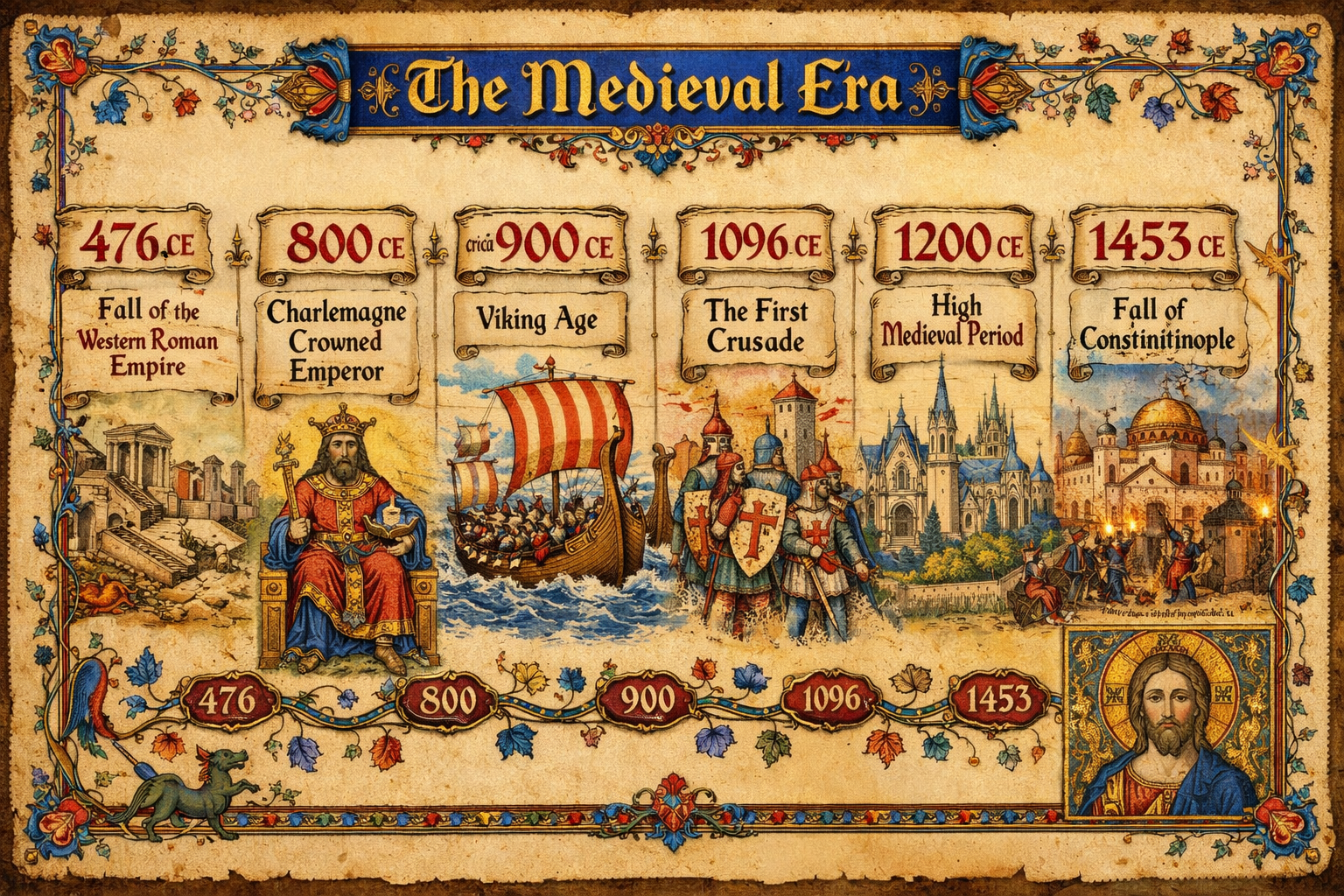
Traditional Dating of the Medieval Period
Historians traditionally date when was medieval times from 476 CE to 1453 CE, spanning nearly 1,000 years of human history. This periodization centers primarily on European history, though medieval developments occurred simultaneously across the globe.
The beginning marker of 476 CE represents the fall of the Western Roman Empire when Germanic chieftain Odoacer deposed the last Roman Emperor, Romulus Augustulus. This event symbolized the end of classical antiquity and the beginning of a new historical epoch.
The ending date of 1453 CE marks the fall of Constantinople to the Ottoman Empire, effectively ending the Byzantine Empire and concluding the medieval period. This date also coincides with other significant developments like the invention of the printing press and the beginning of the Age of Exploration.
Regional Variations in Medieval Chronology
| Region | Start Date | End Date | Key Characteristics |
|---|---|---|---|
| Western Europe | 476 CE | 1453 CE | Fall of Rome to Renaissance |
| Byzantine Empire | 330 CE | 1453 CE | Eastern Roman continuation |
| Islamic World | 622 CE | 1500 CE | Rise of Islam to Ottoman dominance |
| China | 220 CE | 1368 CE | End of Han to Ming Dynasty |
| Japan | 794 CE | 1185 CE | Heian to Kamakura periods |
Understanding these regional differences helps answer when was medieval times more comprehensively, as the medieval experience varied significantly across different civilizations and geographic areas.
The Three Phases: Breaking Down When Medieval Times Occurred
Early Medieval Period (476-1000 CE) ⚔️
The Early Medieval period, often called the “Dark Ages,” began when the Western Roman Empire collapsed. This era witnessed:
- Germanic migrations and the establishment of new kingdoms
- Rise of Christianity as the dominant religion in Europe
- Preservation of knowledge in monasteries and scriptoriums
- Development of feudalism as a social and economic system
During this phase, scholars like those mentioned in our exploration of mathematical genius throughout history worked to preserve classical knowledge while developing new understanding.
High Medieval Period (1000-1300 CE) 🏰
The High Medieval period represents the pinnacle of medieval civilization, characterized by:
- Population growth and agricultural expansion
- Crusades and increased contact between East and West
- Rise of universities and scholastic philosophy
- Gothic architecture and magnificent cathedral construction
- Economic expansion and the growth of trade networks
This period saw remarkable technological innovations that would influence later developments, including improvements in agriculture, engineering, and craftsmanship.
Late Medieval Period (1300-1453 CE) 💀
The Late Medieval period brought significant challenges and transformations:
- Black Death pandemic that killed one-third of Europe’s population
- Hundred Years’ War between England and France
- Great Western Schism dividing the Catholic Church
- Renaissance beginnings in Italy
- Technological advances like gunpowder and printing
Interestingly, recent research has challenged traditional views about the Black Death, with some studies suggesting that rats might not have been the primary cause of this devastating pandemic.
Major Events That Defined When Medieval Times Began and Ended
The Fall of Rome (476 CE) 🏛️
The deposition of Romulus Augustulus marked more than just a political change—it represented a fundamental shift in European civilization. This event traditionally answers the question of when was medieval times began because it:
- Ended centralized Roman authority in Western Europe
- Allowed Germanic tribes to establish independent kingdoms
- Shifted power from secular to religious institutions
- Created the political fragmentation characteristic of medieval Europe
The Fall of Constantinople (1453 CE) 🕌
The Ottoman conquest of Constantinople provides the traditional endpoint for when was medieval times concluded. This momentous event:
- Ended the 1,000-year Byzantine Empire
- Completed Ottoman control over key trade routes
- Prompted Greek scholars to flee westward, bringing classical texts
- Coincided with Renaissance developments and Age of Exploration
These bookend events help historians understand the scope and duration of the medieval period, though scholars continue to debate the precise boundaries of this era.
Regional Perspectives: When Was Medieval Times Around the World? 🌍
Medieval Europe vs. Global Medieval Periods
While European medieval times followed the 476-1453 CE timeline, other regions experienced their own “medieval” periods:
Islamic Golden Age (8th-13th centuries)
- Preservation and expansion of classical knowledge
- Advances in mathematics, medicine, and philosophy
- Cultural flowering in Baghdad, Córdoba, and Cairo
Medieval China (220-1368 CE)
- Period of Disunity through Yuan Dynasty
- Technological innovations like gunpowder and printing
- Cultural achievements in poetry, painting, and philosophy
Medieval Japan (794-1185 CE)
- Heian period cultural refinement
- Rise of the samurai class
- Development of distinctly Japanese art and literature
Medieval India (600-1500 CE)
- Classical Hindu kingdoms
- Islamic sultanates
- Rich philosophical and artistic traditions
Understanding these parallel developments helps answer when was medieval times from a global perspective, revealing that medieval characteristics appeared worldwide, not just in Europe.
Cultural and Technological Achievements During Medieval Times
Intellectual Developments 📚
The medieval period witnessed remarkable intellectual achievements that challenged the “Dark Ages” stereotype:
- Preservation of classical texts in monasteries and Islamic libraries
- Development of universities starting with Bologna (1088) and Paris (1150)
- Scholastic philosophy reconciling faith and reason
- Legal systems including canon law and common law
Technological Innovations 🔧
Medieval inventors and craftsmen developed technologies that revolutionized society:
- Agricultural improvements: Heavy plow, three-field system, windmills
- Military technology: Crossbow, gunpowder weapons, castle fortifications
- Transportation: Improved ship design, better roads, stirrups for cavalry
- Manufacturing: Water mills, mechanical clocks, eyeglasses
These innovations demonstrate that medieval times were far from stagnant, featuring continuous technological progress that laid foundations for later developments.
Architectural Marvels 🏗️
Medieval architecture produced some of humanity’s most impressive structures:
- Romanesque churches with thick walls and rounded arches
- Gothic cathedrals featuring flying buttresses and soaring spires
- Castle fortifications adapting to changing military technology
- Islamic architecture with intricate geometric patterns and innovative engineering
Why Understanding When Medieval Times Occurred Matters Today
Historical Context for Modern Issues
Knowing when was medieval times helps us understand:
- Origins of modern institutions like universities and legal systems
- Religious and cultural conflicts that continue to influence global politics
- Economic systems that evolved into modern capitalism
- Scientific methods that emerged from medieval scholasticism
Educational Value
Understanding medieval chronology provides:
- Critical thinking skills for evaluating historical sources
- Cultural literacy for appreciating literature, art, and architecture
- Global perspective on how different civilizations developed
- Appreciation for progress in human rights, technology, and knowledge
The study of medieval times connects to broader questions about human development and progress, much like how researchers today explore fascinating aspects of animal intelligence or investigate ancient Persian innovations that influenced medieval development.
Common Misconceptions About When Medieval Times Occurred
The “Dark Ages” Myth
Many people incorrectly believe that medieval times were uniformly dark and backward. In reality:
- Continuous learning occurred in monasteries and Islamic centers
- Technological progress never stopped completely
- Cultural achievements flourished in many regions
- Trade networks connected distant civilizations
Uniform European Experience
Another misconception assumes that when was medieval times was the same everywhere in Europe. Actually:
- Italy experienced Renaissance influences earlier than Northern Europe
- Spain had unique Islamic influences through Al-Andalus
- Eastern Europe followed different political and religious developments
- Scandinavia had its own Viking Age chronology
Single Ending Date
While 1453 CE traditionally marks when medieval times ended, the transition to the Renaissance occurred gradually:
- Different regions transitioned at different rates
- Various factors influenced the pace of change
- Cultural elements persisted well beyond 1453
- Economic systems evolved slowly over centuries
Conclusion
Understanding when was medieval times reveals a complex, dynamic period spanning roughly 1,000 years from 476 to 1453 CE. Far from being a uniform “Dark Age,” the medieval period encompassed three distinct phases—Early, High, and Late Medieval—each with unique characteristics and achievements. This era witnessed remarkable cultural, technological, and intellectual developments that shaped the foundations of modern civilization.
The medieval period’s global nature reminds us that while European medieval times provide one important timeline, parallel medieval developments occurred worldwide. From the Islamic Golden Age to medieval China and Japan, different regions experienced their own versions of medieval civilization, each contributing to humanity’s collective progress.
Ready to explore more historical periods? Consider investigating the fascinating world of ancient Persian innovations that influenced medieval development, or discover how mathematical genius evolved throughout history. Understanding when medieval times occurred provides the perfect foundation for exploring other pivotal periods in human history.
Whether you’re a student, educator, or history enthusiast, grasping the timeline and significance of medieval times enhances your understanding of how our modern world emerged from this remarkable millennium of human development.



