
Between 1939 and 1945, an estimated 70-85 million people died in World War II, making it the deadliest conflict in human history. Yet within this staggering devastation lies an equally remarkable story—not just of destruction, but of what World War II Teaches About Human Strength reveals about our capacity to endure, adapt, and overcome seemingly impossible circumstances.
The war stripped away every comfort, security, and normalcy that people had known. Soldiers faced months of brutal combat in frozen trenches and sweltering jungles. Civilians endured nightly bombings, starvation, and the constant threat of death. Entire populations were displaced, families torn apart, and nations brought to their knees.
But here’s what makes this period extraordinary: millions of ordinary people discovered reserves of strength they never knew they possessed. What World War II teaches about human strength goes far beyond military tactics or political outcomes—it reveals the fundamental resilience that lies dormant within us until crisis demands its awakening.
Key Takeaways
• Physical and mental endurance can exceed what we believe possible when survival depends on it
• Courage isn’t the absence of fear—it’s the decision to act despite overwhelming terror
• Collective strength amplifies individual resilience through shared purpose and mutual support
• Adaptability becomes a survival skill when familiar systems and structures collapse
• Meaning and purpose fuel extraordinary endurance even in the darkest circumstances
Strength Under Extreme Pressure: When the Body Refuses to Quit
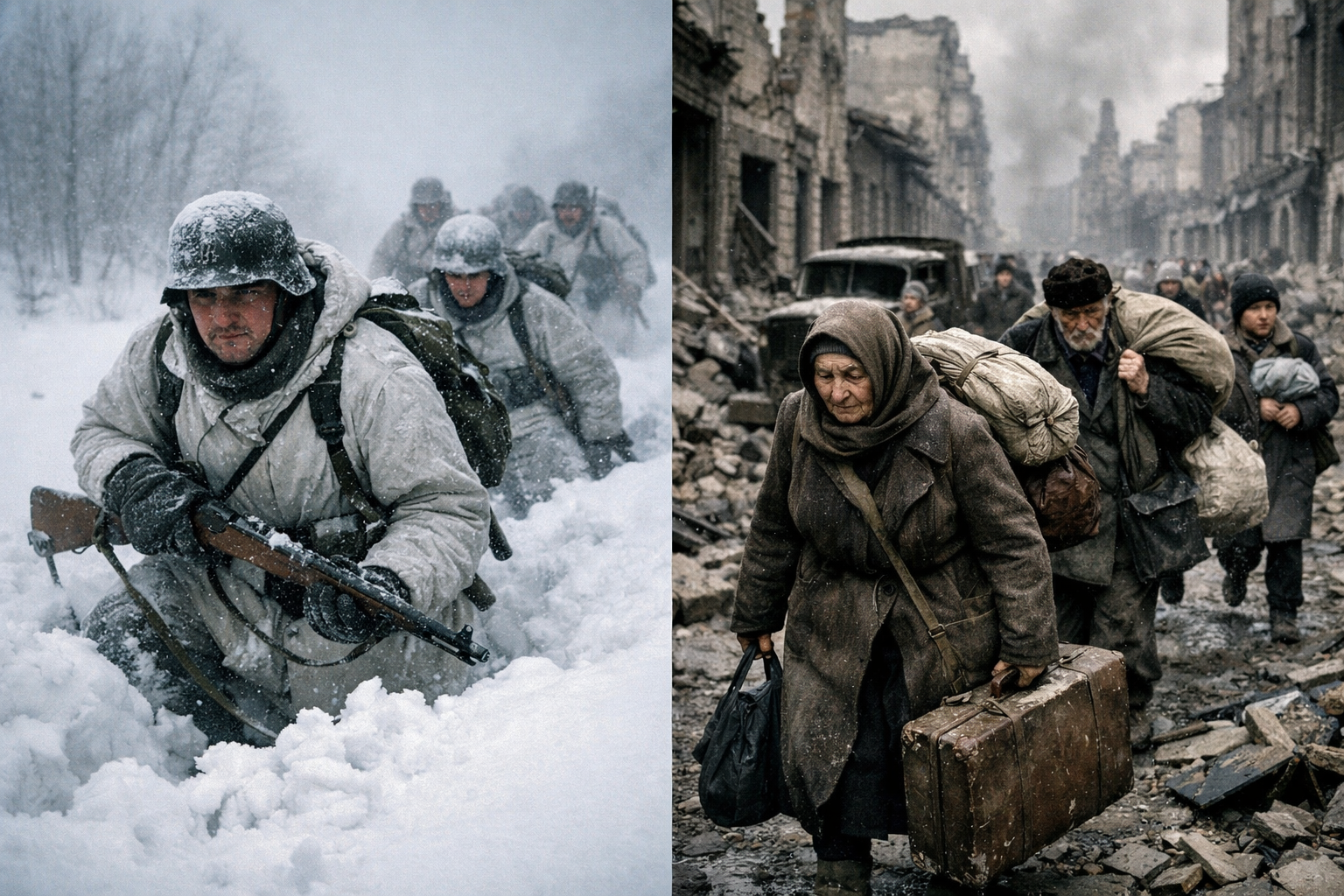
The Eastern Front of World War II presented some of the most brutal conditions in military history. Temperatures plummeted to -40°F (-40°C), yet soldiers continued fighting for months with inadequate clothing and supplies. During the Siege of Leningrad, civilians survived 872 days of blockade, eating sawdust bread and wallpaper paste while temperatures remained below freezing for months.
Physical Endurance Beyond Limits
What these experiences reveal about human strength is that our bodies can function far beyond what we consider normal limits:
• Sleep deprivation: Soldiers often operated on 2-3 hours of sleep for weeks
• Malnutrition: Concentration camp survivors endured on fewer than 500 calories daily
• Extreme temperatures: Pacific theater troops fought in 120°F heat with full gear
• Constant stress: Civilians lived under bombing raids for years without breaking
The key insight: Strength is often discovered, not chosen. When survival becomes the only option, the human body finds ways to continue functioning that defy medical understanding.
Civilian Resilience in Impossible Conditions
The London Blitz demonstrated civilian strength under pressure. For 57 consecutive nights, German bombers attacked London, yet the city never stopped functioning. Factory workers showed up to bombed-out buildings and continued production. Children attended school in Underground stations. Families maintained routines despite losing their homes.
This period shows that strategic process planning becomes instinctive during crisis—people automatically prioritize survival tasks and adapt their daily routines to extreme circumstances.
Mental Resilience in Chaos: The Mind’s Power Over Circumstance
While physical endurance kept people alive, mental resilience determined who thrived versus merely survived. What World War II teaches about human strength includes the mind’s extraordinary ability to process trauma, maintain hope, and find meaning in chaos.
The Psychology of Survival
Prisoners of war in Japanese camps faced systematic psychological torture designed to break their will. Yet many maintained their sanity through mental exercises:
• Memory palaces: Reciting poetry, mathematical formulas, or childhood memories
• Future planning: Detailed mental rehearsals of post-war life
• Spiritual practices: Prayer, meditation, or philosophical reflection
• Humor: Finding absurdity even in the darkest moments
Viktor Frankl, a Holocaust survivor and psychiatrist, observed that those who survived concentration camps shared one trait: they maintained a sense of purpose beyond their immediate suffering.
Cognitive Adaptation Under Stress
The human brain demonstrated remarkable plasticity during wartime. People developed:
- Heightened situational awareness: Instantly recognizing danger signals
- Rapid decision-making: Processing life-or-death choices in seconds
- Emotional regulation: Functioning despite constant grief and loss
- Selective attention: Focusing on survival while blocking out trauma
This mental adaptability connects to how scientists have identified different subtypes of anxiety and depression, showing that psychological resilience operates through multiple pathways.
Courage Isn’t the Absence of Fear: Redefining Bravery
Popular culture often portrays wartime courage as fearless heroism. The reality was different. What World War II teaches about human strength is that true courage means continuing forward when fear is overwhelming, not the absence of fear itself.
Everyday Acts of Extraordinary Courage
The most profound examples of courage came from ordinary people making split-second decisions:
Resistance Fighters: Knowing capture meant torture and death, they continued sabotage operations
Civilian Rescuers: Families hid Jewish neighbors despite risking execution for their entire household
Medical Personnel: Nurses and doctors worked in bombed hospitals while raids continued overhead
Parents: Mothers and fathers maintained calm for their children while internally terrified
The Courage of Persistence
Perhaps the most underestimated form of courage was simply refusing to give up. This included:
• Getting up each morning despite losing everything
• Continuing to care for others while grieving personal losses
• Maintaining hope when no logical reason for optimism existed
• Choosing to rebuild rather than surrender to despair
This type of persistence relates to how strategic mistakes can lose wars—but individual courage can transcend even strategic failures.
Unity and Collective Strength: The Power of Shared Purpose
One of the most striking aspects of What World War II teaches about human strength is how individual resilience multiplied when people united around common goals. Entire nations transformed their societies virtually overnight.
National Mobilization as Collective Strength
The scale of cooperation was unprecedented:
United States:
- Converted automobile factories to aircraft production in months
- Women entered the workforce in massive numbers
- Rationing programs required everyone’s participation
Soviet Union:
- Relocated entire industries beyond German reach
- Civilians worked 12-hour shifts while under siege
- Shared resources despite severe shortages
United Kingdom:
- Organized civilian defense networks
- Maintained morale through shared sacrifice
- Coordinated resistance across occupied territories
Community-Level Resilience
Strength emerged not just nationally but in neighborhoods and small communities:
• Mutual aid networks: Sharing food, shelter, and emotional support
• Collective problem-solving: Communities innovating solutions to local challenges
• Shared risk-taking: Groups protecting vulnerable members together
• Cultural preservation: Maintaining traditions and values under threat
This demonstrates how collective innovation techniques become survival mechanisms when communities face existential threats.
Adaptability in Impossible Conditions: Innovation Through Necessity
What World War II teaches about human strength includes humanity’s remarkable capacity for rapid adaptation. When familiar systems collapsed, people didn’t just endure—they innovated.
Technological and Strategic Innovation
The pace of innovation accelerated dramatically:
Military Technology:
- Radar development compressed decades of research into months
- Medical advances in trauma surgery and infection control
- Communication systems adapted for battlefield conditions
Social Innovation:
- New models of industrial organization
- Revolutionary approaches to logistics and supply chains
- Innovative educational systems for displaced populations
Personal Adaptability
Individuals demonstrated extraordinary flexibility:
• Role transitions: Farmers became factory workers, teachers became nurses
• Skill acquisition: Learning new trades and technologies rapidly
• Cultural adaptation: Refugees integrating into foreign societies
• Resource management: Creating value from minimal materials
This adaptability mirrors how future skills will be essential for children in rapidly changing environments.
Environmental Adaptation
People adapted to radically altered physical environments:
- Urban destruction: Navigating cities reduced to rubble
- Resource scarcity: Functioning with minimal food, fuel, and materials
- Constant mobility: Becoming refugees while maintaining family units
- Underground living: Creating functional communities in bomb shelters
The Power of Meaning and Purpose: What Fuels Human Endurance
Perhaps the most profound lesson in What World War II teaches about human strength is how meaning and purpose can sustain people through unimaginable suffering. Those who survived often shared a common trait: they believed they were part of something larger than themselves.
Fighting for Future Generations
Many found strength in the belief that their sacrifice would create a better world:
Parents endured hardship to protect their children’s future
Soldiers fought for the freedom of people they’d never meet
Resistance fighters risked everything for abstract ideals like liberty and justice
Civilians maintained cultural traditions to preserve them for future generations
Professional and Moral Purpose
Purpose took many forms:
• Medical professionals: Saving lives became a sacred duty
• Teachers: Preserving knowledge and educating children in hiding
• Artists and writers: Documenting truth and maintaining culture
• Religious leaders: Providing spiritual comfort and moral guidance
The Sustaining Power of Belief
Viktor Frankl’s observations from concentration camps revealed that survival often depended on maintaining belief in:
- Personal responsibility: Believing individual choices still mattered
- Future possibilities: Envisioning life beyond current suffering
- Universal values: Holding onto concepts of justice, love, and dignity
- Transcendent meaning: Connecting personal suffering to larger purposes
This connects to broader questions about human consciousness and belief systems that help people endure extreme circumstances.
The Limits of Human Strength: Acknowledging What We Cannot Bear
While celebrating human resilience, What World War II teaches about human strength also includes honest recognition of its limits. Not everyone survived, and survival itself came at tremendous cost.
The Reality of Breaking Points
Human strength has boundaries:
Physical limits: Malnutrition, disease, and exhaustion killed millions
Psychological limits: Many suffered permanent mental trauma
Moral limits: Some people made choices they couldn’t live with
Social limits: Communities and cultures were permanently destroyed
The Cost of Survival
Even those who survived paid prices:
• Lifelong trauma: PTSD affected millions of veterans and civilians
• Survivor guilt: Many struggled with having lived when others died
• Lost innocence: Children grew up too fast and lost their childhood
• Broken relationships: Families and communities never fully recovered
Honoring Both Strength and Vulnerability
Understanding human limits doesn’t diminish human strength—it makes it more remarkable. The fact that anyone survived such conditions demonstrates extraordinary resilience, while acknowledging that many couldn’t survive reminds us that strength alone isn’t always enough.
This balanced perspective helps us understand that resilience isn’t about being invulnerable—it’s about enduring what we can and accepting what we cannot change.
Conclusion
What World War II teaches about human strength extends far beyond historical curiosity. The war revealed that ordinary people possess extraordinary reserves of physical endurance, mental resilience, and moral courage that emerge only when circumstances demand them.
The lessons are clear: strength is discovered under pressure, courage means acting despite fear, unity amplifies individual resilience, adaptability becomes a survival skill, and meaning fuels endurance. Perhaps most importantly, recognizing our limits makes our strength more precious, not less.
These insights remain relevant in 2026 as we face our own challenges—whether personal crises, global pandemics, economic uncertainty, or social upheaval. The same capacity for resilience that carried people through humanity’s darkest hour still exists within us.
Next Steps for Building Personal Resilience
- Identify your sources of meaning: What would you endure hardship to protect or achieve?
- Practice adaptability: Regularly challenge yourself with new situations and skills
- Build community connections: Cultivate relationships that provide mutual support
- Develop mental resilience: Practice mindfulness, stress management, and emotional regulation
- Study historical examples: Learn from others who overcame seemingly impossible circumstances
World War II showed that human strength is not just about power—it’s about enduring when everything says you shouldn’t. That capacity for endurance, adaptation, and hope remains our greatest asset in facing whatever challenges lie ahead.



