
When Herbert Marcuse declared in 1969 that traditional Marxism had failed to predict the revolutionary potential of students and marginalized groups, he unknowingly summarized the core premise that would define an entire intellectual movement. What is Neo-Marxism represents one of the most significant theoretical shifts in 20th-century social and political thought, moving beyond Marx’s original focus on economic class struggle to encompass broader forms of social oppression and cultural critique.
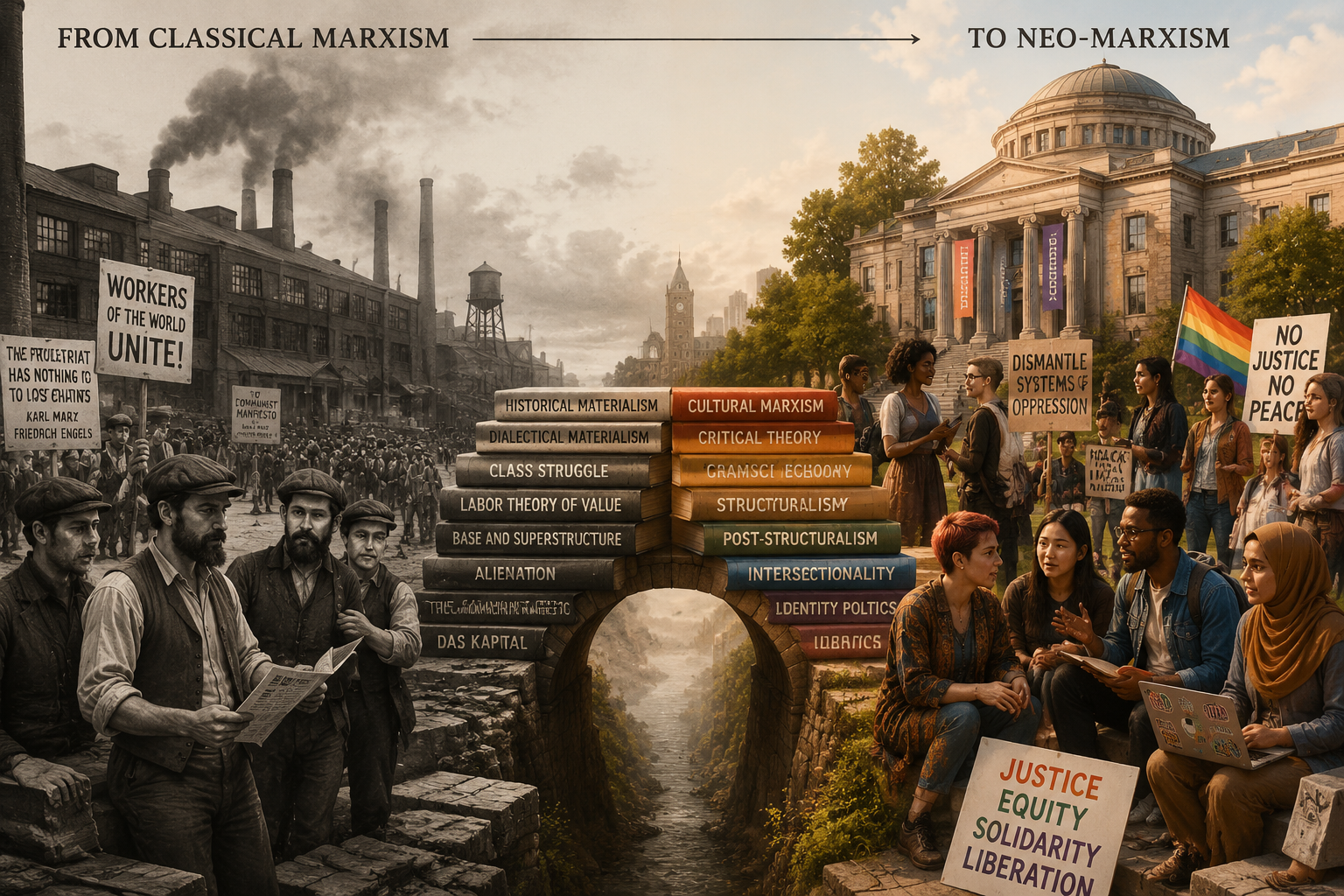
Neo-Marxism emerged as a response to the perceived limitations of classical Marxist theory, particularly its inability to explain why socialist revolutions hadn’t occurred in advanced capitalist societies as Marx predicted. This intellectual evolution has shaped everything from academic discourse to contemporary social movements, making it essential to understand for anyone interested in modern political and social theory.
Key Takeaways
• Neo-Marxism expands classical Marxist theory beyond economic class struggle to include cultural, social, and psychological forms of oppression
• The Frankfurt School pioneered critical theory in the 1930s, laying the groundwork for Neo-Marxist thought through scholars like Adorno, Horkheimer, and Marcuse
• Cultural hegemony and ideology critique became central concepts, explaining how capitalist societies maintain control through cultural rather than purely economic means
• Contemporary applications of Neo-Marxist theory influence fields ranging from media studies to environmental activism and social justice movements
• Key differences from classical Marxism include rejection of economic determinism, emphasis on superstructure over base, and focus on diverse forms of resistance
The Historical Context: From Marx to Neo-Marx
Understanding what is Neo-Marxism requires first grasping why classical Marxism seemed inadequate to many 20th-century thinkers. Karl Marx’s original theory, developed in the 19th century, predicted that capitalism would inevitably collapse due to its internal contradictions, leading to proletarian revolution and the establishment of socialist society.
However, by the early 1900s, several developments challenged this prediction:
- Working-class integration: Instead of becoming increasingly impoverished, workers in advanced capitalist countries experienced rising living standards
- Fascism’s rise: The emergence of fascist movements demonstrated that economic crisis could lead to right-wing rather than left-wing political outcomes
- Soviet authoritarianism: The Russian Revolution’s outcome raised questions about whether Marxist theory truly led to human liberation
These contradictions prompted intellectuals to reconsider Marx’s fundamental assumptions. For those interested in exploring the foundations of Marxist thought, our guide to Marxism for dummies provides essential background, while Marxist ideology explained offers deeper theoretical insights.
The Birth of Critical Theory
The term “critical theory” was coined by Max Horkheimer in 1937 to describe a new approach that would critique society while avoiding the deterministic aspects of orthodox Marxism. This approach emphasized:
🔍 Interdisciplinary Analysis: Combining sociology, psychology, philosophy, and economics rather than focusing solely on economic factors
🧠 Consciousness and Culture: Examining how ideological and cultural forces shape human consciousness and behavior
⚖️ Normative Critique: Not just describing society but actively critiquing it to promote human emancipation
🔄 Dialectical Thinking: Maintaining Marx’s dialectical method while rejecting mechanical materialism
Core Principles: What Makes Neo-Marxism Distinct
What is Neo-Marxism fundamentally about? At its core, Neo-Marxism represents a theoretical framework that maintains Marx’s critical spirit while significantly modifying his analytical approach. The key principles that define Neo-Marxist thought include:

1. Rejection of Economic Determinism
Classical Marxism argued that economic relations (the “base”) ultimately determine all other aspects of society (the “superstructure”). Neo-Marxists reject this deterministic relationship, instead viewing:
- Culture and ideology as having relative autonomy from economic structures
- Multiple forms of oppression operating simultaneously rather than all stemming from economic exploitation
- Human agency playing a crucial role in social change rather than being predetermined by economic forces
2. Expanded Understanding of Oppression
While Marx focused primarily on class-based exploitation, Neo-Marxists recognize various forms of domination:
| Type of Oppression | Classical Marxism | Neo-Marxism |
|---|---|---|
| Economic | Primary focus | One among many |
| Cultural | Secondary | Central concern |
| Psychological | Largely ignored | Key area of study |
| Racial/Gender | Not addressed | Integral to analysis |
| Environmental | Not considered | Increasingly important |
3. Cultural Hegemony Theory
Antonio Gramsci’s concept of cultural hegemony became central to Neo-Marxist thought. This theory explains how dominant classes maintain power not just through force or economic control, but by making their worldview appear natural and inevitable to subordinated groups.
Key aspects include:
- Consent manufacturing: How media, education, and culture create willing compliance with the existing system
- Common sense: The way dominant ideologies become embedded in everyday thinking
- Counter-hegemonic struggle: The process by which oppressed groups develop alternative worldviews
4. The Role of the Superstructure
Neo-Marxists argue that cultural institutions, ideas, and practices don’t merely reflect economic relations but actively shape them. This means:
📚 Education systems don’t just reproduce class relations but actively create forms of consciousness that support or challenge capitalism
🎭 Art and literature become sites of potential resistance rather than mere reflections of economic conditions
📺 Media and popular culture play crucial roles in maintaining or challenging existing power structures
⛪ Religion and philosophy can serve either as “opium of the people” or as sources of liberation theology and critical consciousness
Major Schools and Thinkers in Neo-Marxist Theory
Understanding what is Neo-Marxism requires familiarity with its major intellectual traditions and key figures. Several distinct schools have emerged, each contributing unique insights to the broader Neo-Marxist project.
The Frankfurt School
The Institute for Social Research, established in Frankfurt in 1923, became the most influential center of Neo-Marxist thought. Key figures include:
Max Horkheimer (1895-1973): Developed the concept of critical theory and argued for interdisciplinary approaches to social analysis. His work “Dialectic of Enlightenment” (co-authored with Adorno) critiqued how Enlightenment rationality could lead to domination rather than liberation.
Theodor Adorno (1903-1969): Focused on aesthetic theory and the culture industry. His analysis of how mass media creates standardized, commodified culture remains influential in media studies today.
Herbert Marcuse (1898-1979): Perhaps the most politically engaged Frankfurt School theorist, Marcuse’s “One-Dimensional Man” argued that advanced capitalist societies create false needs that prevent revolutionary consciousness from developing.
Jürgen Habermas (1929-present): The second generation’s leading figure, Habermas developed theories of communicative action and the public sphere that continue to influence democratic theory and media studies.
Italian Marxism
Antonio Gramsci (1891-1937): Though writing before the term “Neo-Marxism” existed, Gramsci’s prison notebooks laid crucial groundwork for later developments. His concepts of hegemony, civil society, and the war of position became central to Neo-Marxist strategy.
British Cultural Studies
The Birmingham School, led by figures like Stuart Hall and Raymond Williams, applied Neo-Marxist insights to the study of popular culture, media, and everyday life. This tradition emphasized:
- How working-class and minority cultures resist dominant ideologies
- The role of media in shaping political consciousness
- The intersection of class, race, and gender in cultural production
Analytical Marxism
Scholars like Jon Elster and John Roemer attempted to reconstruct Marxist theory using analytical philosophy and rational choice theory, creating more rigorous but sometimes less critical versions of Neo-Marxist thought.
Contemporary Applications and Influence
What is Neo-Marxism’s relevance in 2026? Far from being merely historical, Neo-Marxist ideas continue to influence numerous fields and social movements. Understanding these contemporary applications reveals the ongoing vitality of this theoretical tradition.
Academic Disciplines
Neo-Marxist theory has profoundly shaped various academic fields:
🎓 Sociology: Critical sociology examines how power relations shape social institutions, from education to healthcare. Concepts like cultural capital (Pierre Bourdieu) and intersectionality draw heavily on Neo-Marxist insights.
📖 Literary Studies: Critics analyze how literature both reflects and challenges dominant ideologies, examining the politics of representation and the role of cultural production in maintaining or subverting power structures.
🎬 Media Studies: Neo-Marxist media theory examines how news, entertainment, and social media shape public consciousness and political possibilities.
🏫 Education Theory: Critical pedagogy, influenced by Paulo Freire and others, applies Neo-Marxist insights to educational practice, emphasizing education’s role in either reproducing or challenging social inequalities.
Social Movements and Activism
Contemporary social movements often employ Neo-Marxist analytical frameworks, even when not explicitly identifying as Marxist:
✊ Social Justice Movements: Analysis of systemic oppression, intersectionality, and the need for structural rather than merely individual change reflects Neo-Marxist influence.
🌍 Environmental Activism: Eco-socialism and environmental justice movements draw on Neo-Marxist critiques of capitalism’s relationship with nature.
🏛️ Occupy and Anti-Globalization Movements: These movements’ focus on cultural and ideological aspects of capitalism, not just economic inequality, shows Neo-Marxist influence.
The relationship between intellectual discourse and social problems becomes particularly relevant when considering what are social problems today and how theoretical frameworks help us understand contemporary challenges.
Digital Age Applications
Neo-Marxist theory has found new relevance in analyzing digital capitalism:
💻 Platform Capitalism: Analysis of how companies like Facebook and Google extract value from user data and attention
🤖 Algorithmic Control: Examination of how artificial intelligence and algorithms shape consciousness and behavior in ways that serve corporate interests
📱 Digital Labor: Study of how social media use, gig work, and other digital activities constitute new forms of exploitation
For those interested in how technology shapes society more broadly, our analysis of the amazing footprint that technology leaves in our society provides additional context.
Critiques of Neoliberalism
Neo-Marxist thinkers have been prominent critics of neoliberal capitalism, analyzing:
- How market logic penetrates all areas of social life
- The role of debt in maintaining social control
- The way neoliberal ideology presents itself as natural and inevitable
- Resistance strategies that go beyond traditional labor organizing
Criticisms and Debates Surrounding Neo-Marxism
Understanding what is Neo-Marxism requires acknowledging the significant criticisms and internal debates that have shaped its development. These critiques come from various perspectives and have led to important theoretical refinements.
External Criticisms
🏛️ Conservative Critiques: Conservative scholars argue that Neo-Marxism:
- Overemphasizes conflict and oppression while ignoring social cooperation and individual agency
- Promotes a victim mentality that undermines personal responsibility
- Leads to political correctness and suppression of free speech in academic settings
📊 Liberal Criticisms: Liberal theorists contend that Neo-Marxism:
- Underestimates the capacity for democratic institutions to address social problems
- Rejects market mechanisms that can efficiently allocate resources and promote innovation
- Offers critique without viable alternatives to existing institutions
⚖️ Empirical Challenges: Some social scientists argue that Neo-Marxist theories:
- Lack empirical rigor and rely too heavily on interpretive rather than quantitative methods
- Make unfalsifiable claims that cannot be scientifically tested
- Cherry-pick evidence to support predetermined ideological conclusions
The broader context of political discourse and its challenges is explored in our analysis of 3 reasons political discussions are almost impossible, which relates to debates surrounding critical theory.
Internal Debates
Neo-Marxist scholars themselves engage in vigorous debates about theoretical and strategic questions:
🔄 Structure vs. Agency: How much emphasis should be placed on structural constraints versus human agency in creating social change?
🎯 Reform vs. Revolution: Can existing institutions be reformed to achieve Neo-Marxist goals, or is revolutionary transformation necessary?
🌐 Universalism vs. Particularism: Should Neo-Marxist theory focus on universal human emancipation or particular struggles of specific groups?
📚 Theory vs. Practice: How should the relationship between theoretical analysis and political action be understood?
The Postmodern Challenge
The rise of postmodern theory in the late 20th century posed significant challenges to Neo-Marxism:
- Rejection of grand narratives: Postmodernists questioned Neo-Marxism’s claim to provide comprehensive social analysis
- Focus on difference: Emphasis on difference and particularity challenged Neo-Marxist attempts at unified theory
- Linguistic turn: Postmodern focus on language and discourse sometimes displaced Neo-Marxist emphasis on material conditions
Contemporary Relevance Debates
Scholars continue to debate Neo-Marxism’s relevance in the 21st century:
📈 Globalization: Does globalization vindicate Neo-Marxist predictions about capitalism’s contradictions, or does it demonstrate capitalism’s adaptability?
🏛️ Democratic Institutions: Have democratic institutions proven more resilient and reformable than Neo-Marxists predicted?
🌱 Environmental Crisis: Does climate change require Neo-Marxist analysis of capitalism’s relationship with nature, or can market-based solutions address environmental problems?
The question of whether democratic institutions are under threat is explored in our analysis of democracy declining everywhere—even in the United States, which connects to broader debates about Neo-Marxist predictions.
Neo-Marxism vs. Classical Marxism: Key Differences
To fully grasp what is Neo-Marxism, it’s essential to understand how it differs from Marx’s original theory. While Neo-Marxists maintain Marx’s critical spirit and commitment to human emancipation, they’ve significantly modified his analytical framework.
Theoretical Differences
| Aspect | Classical Marxism | Neo-Marxism |
|---|---|---|
| Primary Focus | Economic base determines superstructure | Culture and ideology have relative autonomy |
| Class Analysis | Two primary classes: bourgeoisie and proletariat | Multiple, intersecting forms of oppression |
| Revolution | Inevitable result of economic contradictions | Requires cultural and ideological struggle |
| Agency | Collective class consciousness | Individual and group agency within structures |
| Method | Historical materialism | Interdisciplinary critical theory |
Methodological Shifts
🔬 Scientific Approach: Marx viewed his theory as scientific socialism that discovered objective laws of historical development. Neo-Marxists are more skeptical of claims to scientific objectivity and emphasize the interpretive nature of social analysis.
📊 Empirical Methods: Classical Marxism relied heavily on economic data and historical analysis. Neo-Marxism incorporates insights from psychology, anthropology, cultural studies, and other disciplines.
🎯 Normative Orientation: While Marx claimed to describe rather than prescribe, Neo-Marxists are more explicitly normative in their commitment to human emancipation and social justice.
Strategic Differences
The shift from classical to Neo-Marxism also involves different approaches to political strategy:
⚡ Revolutionary Strategy: Marx expected proletarian revolution to emerge from economic crisis. Neo-Marxists focus on cultural struggle, education, and building counter-hegemonic movements.
🏛️ State Power: Classical Marxism emphasized seizing state power to transform economic relations. Neo-Marxists often focus on civil society and cultural institutions as sites of struggle.
🤝 Alliance Building: Marx focused on working-class unity. Neo-Marxists emphasize coalitions among various oppressed groups, including racial minorities, women, LGBTQ+ individuals, and environmental activists.
Continuing Relevance of Marx
Despite these differences, Neo-Marxists maintain that Marx’s core insights remain valuable:
- Critique of capitalism: Marx’s analysis of capitalism’s tendency toward crisis and inequality remains relevant
- Dialectical method: The emphasis on contradiction and change continues to inform Neo-Marxist analysis
- Commitment to praxis: The unity of theory and practice remains central to Neo-Marxist projects
- Historical consciousness: Understanding society as historically constructed and therefore changeable
The Future of Neo-Marxist Theory
As we look toward the future, what is Neo-Marxism’s trajectory likely to be? Several trends suggest both challenges and opportunities for Neo-Marxist theory in the coming decades.
Emerging Challenges
🤖 Artificial Intelligence and Automation: The rise of AI poses new questions about work, consciousness, and social control that require theoretical innovation. Our exploration of what meaning artificial intelligence provides context for understanding these developments.
🌍 Climate Crisis: Environmental degradation demands new forms of analysis that connect ecological and social concerns in ways that go beyond traditional Neo-Marxist frameworks.
🌐 Global Inequality: Rising inequality within and between nations creates conditions that might vindicate Neo-Marxist predictions while requiring new analytical tools.
📱 Digital Surveillance: The capacity for social control through digital technologies exceeds what earlier Neo-Marxist theorists could have imagined.
Theoretical Innovations
Contemporary Neo-Marxist scholars are developing new concepts and approaches:
🔗 Intersectionality: Building on earlier insights about multiple forms of oppression, intersectional analysis examines how race, class, gender, and other identities interact.
🌿 Eco-Socialism: Connecting environmental and social justice concerns through analysis of capitalism’s relationship with nature.
🏛️ Decolonial Theory: Incorporating insights from postcolonial studies to analyze how colonialism and imperialism continue to shape global relations.
💻 Digital Marxism: Analyzing how digital technologies create new forms of exploitation and resistance.
Institutional Presence
Neo-Marxist ideas continue to influence:
🎓 Universities: Critical theory remains influential in humanities and social science departments, though it faces challenges from budget cuts and political pressure.
🏛️ Think Tanks: Progressive policy organizations often employ Neo-Marxist insights in analyzing social problems and proposing solutions.
📺 Media: Alternative media outlets and some mainstream journalists use Neo-Marxist frameworks to analyze current events.
✊ Activism: Social movements continue to draw on Neo-Marxist concepts, even when not explicitly identifying as Marxist.
Global Perspectives
Neo-Marxist theory is increasingly global, with important contributions from:
- Latin American liberation theology and dependency theory
- African postcolonial and decolonial thought
- Asian perspectives on development and modernization
- Indigenous critiques of capitalism and colonialism
This global expansion enriches Neo-Marxist theory while challenging its European origins and assumptions.
Conclusion
Understanding what is Neo-Marxism reveals a rich intellectual tradition that has evolved far beyond Marx’s original insights while maintaining his critical spirit and commitment to human emancipation. From the Frankfurt School’s pioneering work in the 1930s to contemporary applications in digital media analysis and environmental activism, Neo-Marxist theory continues to provide valuable tools for understanding and critiquing modern society.
The key insight of Neo-Marxism—that oppression operates through cultural and ideological as well as economic means—remains highly relevant in 2026. As societies grapple with rising inequality, environmental crisis, technological disruption, and political polarization, Neo-Marxist analysis offers frameworks for understanding these interconnected challenges.
For those interested in developing critical thinking benefits, engaging with Neo-Marxist theory provides valuable practice in questioning assumptions, analyzing power relations, and thinking systematically about social problems.
Next Steps for Further Learning
📚 Read Primary Sources: Start with accessible works like Herbert Marcuse’s “One-Dimensional Man” or Antonio Gramsci’s “Prison Notebooks” selections.
🎓 Take Academic Courses: Look for courses in critical theory, cultural studies, or political sociology at local universities or online platforms.
🤝 Join Discussion Groups: Participate in book clubs or online forums focused on critical theory and social analysis.
✊ Connect Theory to Practice: Explore how local social movements and activist organizations apply critical insights to contemporary problems.
🌐 Follow Contemporary Debates: Read journals like “New Left Review,” “Critical Sociology,” or “Cultural Studies” to stay current with theoretical developments.
Whether you agree or disagree with Neo-Marxist conclusions, understanding this influential body of thought provides essential tools for navigating our complex social and political landscape. In an era of rapid change and mounting global challenges, the Neo-Marxist commitment to rigorous critique and transformative vision remains as relevant as ever.


