On August 6, 1945, at 8:15 AM, a single bomb killed over 80,000 people in seconds—yet some argue it saved millions more. The question of whether Was the Atomic Bomb Necessary remains one of the most contentious debates in modern history, dividing scholars, ethicists, and military experts for over eight decades.
The decision to drop atomic bombs on Hiroshima and Nagasaki fundamentally changed warfare, international relations, and humanity’s relationship with technology. President Harry Truman called it the most difficult decision of his presidency, while critics label it an unnecessary war crime. Understanding this debate requires examining the complex military, political, and moral factors that shaped one of history’s most consequential moments.
Key Takeaways
- Military estimates suggested Operation Downfall (invasion of Japan) could cost 500,000+ American lives and millions of Japanese casualties
- Alternative options existed, including demonstration bombs, continued blockade, and waiting for Soviet entry into the war
- Japan’s surrender came just days after the Soviet invasion of Manchuria, raising questions about which factor was decisive
- Civilian casualties from both bombs exceeded 200,000, with long-term radiation effects lasting decades
- Historical consensus remains elusive, with valid arguments supporting both necessity and alternatives
The Dire Situation in 1945
By summer 1945, Japan faced an impossible military position. Allied bombing campaigns had devastated major cities, the naval blockade strangled supply lines, and enemy forces controlled the Pacific. Yet Japanese leadership showed no signs of unconditional surrender.
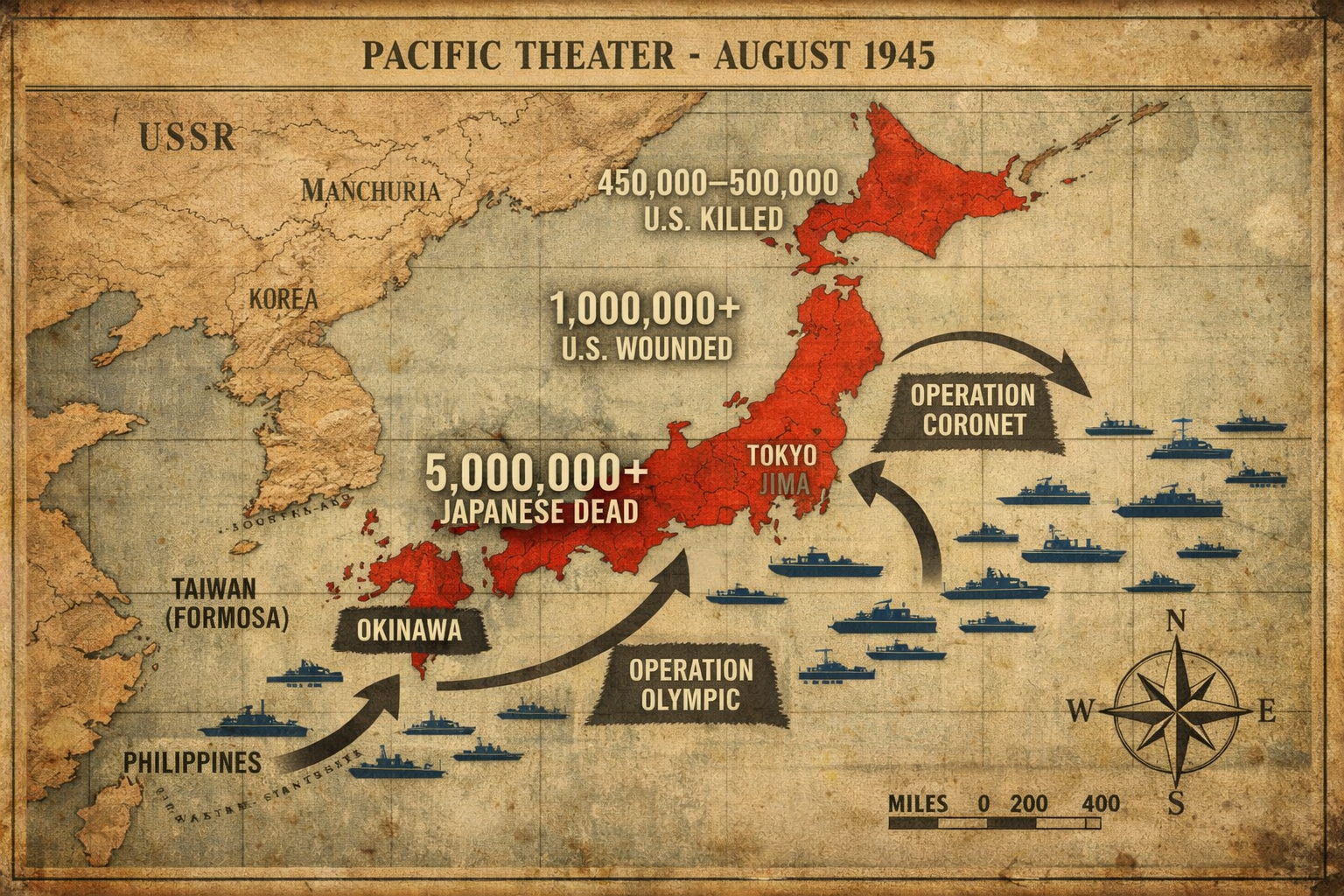
The planned invasion of Japan, Operation Downfall, represented the largest amphibious assault in history. Military planners estimated it would require 1.5 million American troops and cost between 250,000 to 500,000 Allied casualties. Japanese losses could reach into the millions, as civilian populations prepared for suicidal resistance.
The firebombing of Tokyo in March 1945 had already killed more people than either atomic bomb would claim, yet Japan continued fighting. This context shaped American thinking: conventional weapons, no matter how devastating, seemed insufficient to force surrender.
Key factors influencing the decision:
- 🔥 Ongoing resistance despite massive conventional bombing
- ⚔️ Operation Downfall projected enormous casualties
- 🏭 Industrial capacity still functioning in some regions
- 🛡️ Civilian militarization with bamboo spear training programs
The Case FOR: Was the Atomic Bomb Necessary to End the War?
Supporters of the atomic bomb decision present compelling arguments rooted in military necessity and humanitarian calculations. Their position centers on preventing a catastrophic invasion that would have dwarfed the bombs’ destruction.
Avoiding Operation Downfall’s Massive Casualties
Military leaders provided sobering casualty estimates for invading Japan’s home islands. General Douglas MacArthur projected 95,000 casualties in the first 30 days alone. The Joint Chiefs of Staff estimated total American casualties between 267,000 and 394,000 for the complete operation.
Japanese casualties would have been exponentially higher. With 2.3 million military personnel defending the homeland and civilians trained for resistance, some estimates suggested 5-10 million Japanese deaths. The comparison becomes stark: approximately 200,000 atomic bomb casualties versus potentially millions from invasion.
Forcing Immediate Surrender Through Shock
The atomic bomb’s unprecedented destructive power created psychological impact beyond conventional weapons. While firebombing had killed more people, it required hundreds of aircraft over multiple hours. The atomic bomb demonstrated that a single plane could obliterate an entire city instantly.
This technological shock factor aimed to convince Japanese leadership that continued resistance was futile. The psychological impact of new warfare technologies often proves as important as their physical destruction in forcing political decisions.
The Mathematics of Life-Saving
Proponents argue the atomic bombs represented the lesser of two evils. Even accounting for radiation deaths and long-term health effects, total casualties remained far below invasion projections. This utilitarian calculation suggests the bombs ultimately saved more lives than they took.
Casualty comparison estimates:
- Atomic bombs: ~200,000 immediate deaths, ~200,000 radiation-related deaths
- Operation Downfall: 500,000+ Allied casualties, 5-10 million Japanese casualties
- Continued bombing/blockade: Potentially millions from starvation and disease
The Case AGAINST: Unnecessary Destruction and Available Alternatives
Critics argue the atomic bombs were unnecessary, pointing to Japan’s weakening position and unexplored alternatives. Their case rests on evidence that Japan was already near surrender and that other options could have ended the war without atomic weapons.
Japan’s Deteriorating Position
By August 1945, Japan’s military situation had become hopeless. The naval blockade had reduced imports to 10% of prewar levels, causing widespread malnutrition. Industrial production had collapsed, with aircraft manufacturing down 60% from peak levels.
Intelligence intercepts revealed internal Japanese discussions about surrender terms. The primary obstacle was preserving the Emperor’s status—a condition the United States eventually accepted anyway. Some historians argue Japan would have surrendered within weeks regardless of atomic weapons.
Unexplored Alternatives
Several alternatives to using atomic weapons on populated cities existed:
🎯 Demonstration Option: Detonating a bomb in an uninhabited area could have shown Japan the weapon’s power without mass casualties. Some scientists advocated this approach, though military leaders worried about technical failure or insufficient psychological impact.
⏰ Waiting for Soviet Entry: The USSR’s planned entry into the Pacific War could have provided the final push for surrender without atomic weapons. Stalin had committed to attacking Japan within three months of Germany’s defeat.
🏛️ Modified Surrender Terms: Clarifying that Japan could retain the Emperor might have enabled earlier surrender. The eventual surrender terms included this provision anyway.
Moral and Ethical Concerns
The atomic bombs deliberately targeted civilian populations, violating traditional military ethics about distinguishing combatants from non-combatants. Hiroshima and Nagasaki contained military facilities, but the weapons’ indiscriminate destruction killed primarily civilians, including thousands of children.
Long-term radiation effects created suffering that extended decades beyond the war’s end. Survivors faced increased cancer rates, genetic damage, and social stigma. Critics argue these consequences make the bombs morally unjustifiable regardless of military considerations.
The Soviet Factor: The Overlooked Game-Changer
On August 8, 1945—between the two atomic bombs—the Soviet Union declared war on Japan and launched a massive invasion of Manchuria. This development fundamentally altered Japan’s strategic position and may have been more decisive than the atomic weapons in forcing surrender.
Operation August Storm’s Devastating Impact
The Soviet offensive destroyed Japan’s million-man Kwantung Army in just days. This elite force represented Japan’s last significant military reserve and its buffer against Soviet expansion into Asia. The speed and completeness of the defeat shocked Japanese leadership more than many expected.
Soviet entry also eliminated Japan’s last diplomatic option. Japanese leaders had hoped to negotiate surrender terms through Moscow, maintaining some territorial concessions and avoiding occupation. Stalin’s declaration of war closed this final avenue for a negotiated peace.
Racing Against Soviet Occupation
Some historians argue Japan surrendered primarily to avoid Soviet occupation rather than additional atomic attacks. The prospect of communist control over Japan terrified conservative Japanese leaders more than American atomic weapons.
Emperor Hirohito’s surrender announcement mentioned “a new and most cruel bomb,” but also emphasized the changed international situation. The timing suggests both factors influenced the decision, with Soviet entry potentially being decisive.
This interpretation raises profound questions about atomic bomb necessity. If Japan would have surrendered to avoid Soviet occupation anyway, the atomic weapons may have been redundant—a demonstration of American power rather than a military necessity.
The Psychological Warfare Revolution
The atomic bomb represented more than a new weapon—it introduced a revolutionary form of psychological warfare. The concept of instant, total annihilation created terror beyond conventional military experience.
The Power of the Unknown
Unlike conventional bombing, which Japanese civilians had endured for months, atomic weapons introduced unknowable dangers. Radiation sickness developed over days and weeks, creating prolonged uncertainty about survival. This psychological dimension amplified the weapons’ impact beyond their immediate destruction.
The bombs also demonstrated American technological supremacy in ways that conventional weapons could not. Japan had developed defenses against traditional bombing raids, but no protection existed against atomic weapons. This technological gap suggested American capabilities that Japan could not match or counter.
Shaping Post-War Psychology
The atomic bombs’ psychological impact extended far beyond Japan’s surrender decision. They introduced the concept of species-threatening warfare, fundamentally changing how nations approach conflict. The fear of total destruction became a permanent factor in international relations.
This psychological revolution may have been as important as the military outcome. The atomic age created new forms of deterrence based on mutual assured destruction rather than traditional military balance.
Long-Term Consequences: The Nuclear Pandora’s Box
The decision to use atomic weapons initiated consequences that continue shaping global politics in 2026. Understanding whether Was the Atomic Bomb Necessary requires examining these long-term effects alongside immediate military considerations.
The Arms Race Begins
Using atomic weapons in warfare legitimized nuclear weapons as acceptable military tools. This precedent contributed to the Cold War arms race, as nations sought nuclear capabilities to match American power. By 1949, the Soviet Union had developed its own atomic bomb, beginning a competition that brought humanity repeatedly to the brink of extinction.
Changing Warfare Forever
The atomic bombs established new rules for international conflict. Wars between nuclear powers became exercises in brinkmanship rather than total warfare. This change may have prevented larger conflicts, but it also created permanent existential anxiety about human survival.
Scientific and Ethical Debates
The Manhattan Project’s scientists split over using their creation against civilian targets. This division initiated ongoing debates about scientific responsibility and the ethics of weapons research. Many physicists who contributed to the bomb later became advocates for nuclear disarmament and international control.
Long-term global impacts:
- 🌍 Nuclear proliferation to nine confirmed nuclear states
- ⚖️ International law developments regarding weapons of mass destruction
- 🔬 Scientific ethics debates about research responsibility
- 🕊️ Peace movements organized around nuclear disarmament
Why Historians Still Disagree About Atomic Bomb Necessity
Eight decades after Hiroshima and Nagasaki, scholarly consensus on Was the Atomic Bomb Necessary remains elusive. This persistent disagreement reflects the complexity of historical interpretation and the different values historians bring to evidence evaluation.
Interpreting Incomplete Evidence
Historical judgment requires interpreting incomplete and sometimes contradictory evidence. Japanese decision-making records from August 1945 are fragmentary, leaving room for different interpretations of leadership motivations. American records are more complete but reflect the perspectives of decision-makers justifying their choices.
Casualty estimates for Operation Downfall vary wildly depending on assumptions about Japanese resistance, American tactics, and civilian behavior. These uncertainties allow historians to construct different scenarios supporting opposing conclusions.
The Role of Moral Frameworks
Historians approach the atomic bomb question with different ethical frameworks. Consequentialists focus on outcomes—did the bombs save more lives than they took? Deontologists emphasize the inherent rightness or wrongness of targeting civilians, regardless of consequences.
These philosophical differences ensure that even historians examining identical evidence may reach opposite conclusions. The question becomes not just what happened, but what moral standards should apply to wartime decisions.
Political and Cultural Influences
Historical interpretation occurs within contemporary political contexts that shape how scholars approach evidence. American historians during the Cold War emphasized atomic bomb necessity to justify American nuclear policy. Post-Cold War scholarship has been more critical, reflecting changed political circumstances.
Japanese and American historians often emphasize different aspects of the same events, reflecting national perspectives and cultural values. This diversity enriches historical understanding but complicates efforts to reach definitive conclusions.
The ongoing debate about how false beliefs persist despite contradictory evidence applies to historical interpretation as well. Scholars may unconsciously filter evidence through preexisting beliefs about American foreign policy, Japanese militarism, or nuclear weapons.
Conclusion: A Question Without Simple Answers
The question Was the Atomic Bomb Necessary resists simple answers because it encompasses military strategy, moral philosophy, and historical interpretation simultaneously. Both sides present compelling evidence supporting their positions, reflecting the genuine complexity of the August 1945 situation.
The case for necessity rests on preventing massive casualties from Operation Downfall and ending the war quickly through decisive action. The case against emphasizes available alternatives, Japan’s deteriorating position, and the moral costs of targeting civilians. The Soviet factor adds another layer of complexity, suggesting Japan might have surrendered anyway.
Key considerations for understanding this debate:
✅ Examine multiple perspectives rather than seeking a single “correct” answer
✅ Consider the information available to 1945 decision-makers, not just hindsight knowledge
✅ Recognize moral complexity in wartime decisions involving civilian casualties
✅ Understand how political contexts shape historical interpretation
✅ Appreciate the long-term consequences that extend far beyond immediate military outcomes
The atomic bomb debate ultimately reflects broader questions about warfare, morality, and historical responsibility that remain relevant today. As nuclear weapons continue threatening human survival, understanding the origins of the atomic age becomes increasingly important for navigating contemporary challenges.
Rather than seeking definitive answers, readers should engage with the evidence, consider multiple perspectives, and form their own informed judgments. The atomic bomb may have ended World War II, but it began questions about warfare and morality that humanity continues grappling with today.