
A single gunshot in Sarajevo killed two people, but the decisions made in the following weeks would kill over 17 million. The Moment WWI Became Unstoppable wasn’t when Archduke Franz Ferdinand died—it was when Europe’s leaders chose war over diplomacy, mobilization over negotiation, and pride over peace.
What transformed a regional crisis into the deadliest conflict the world had ever seen? The answer lies not in one dramatic moment, but in a series of cascading decisions that created a point of no return. Once certain choices were made, stopping the war machine became impossible.
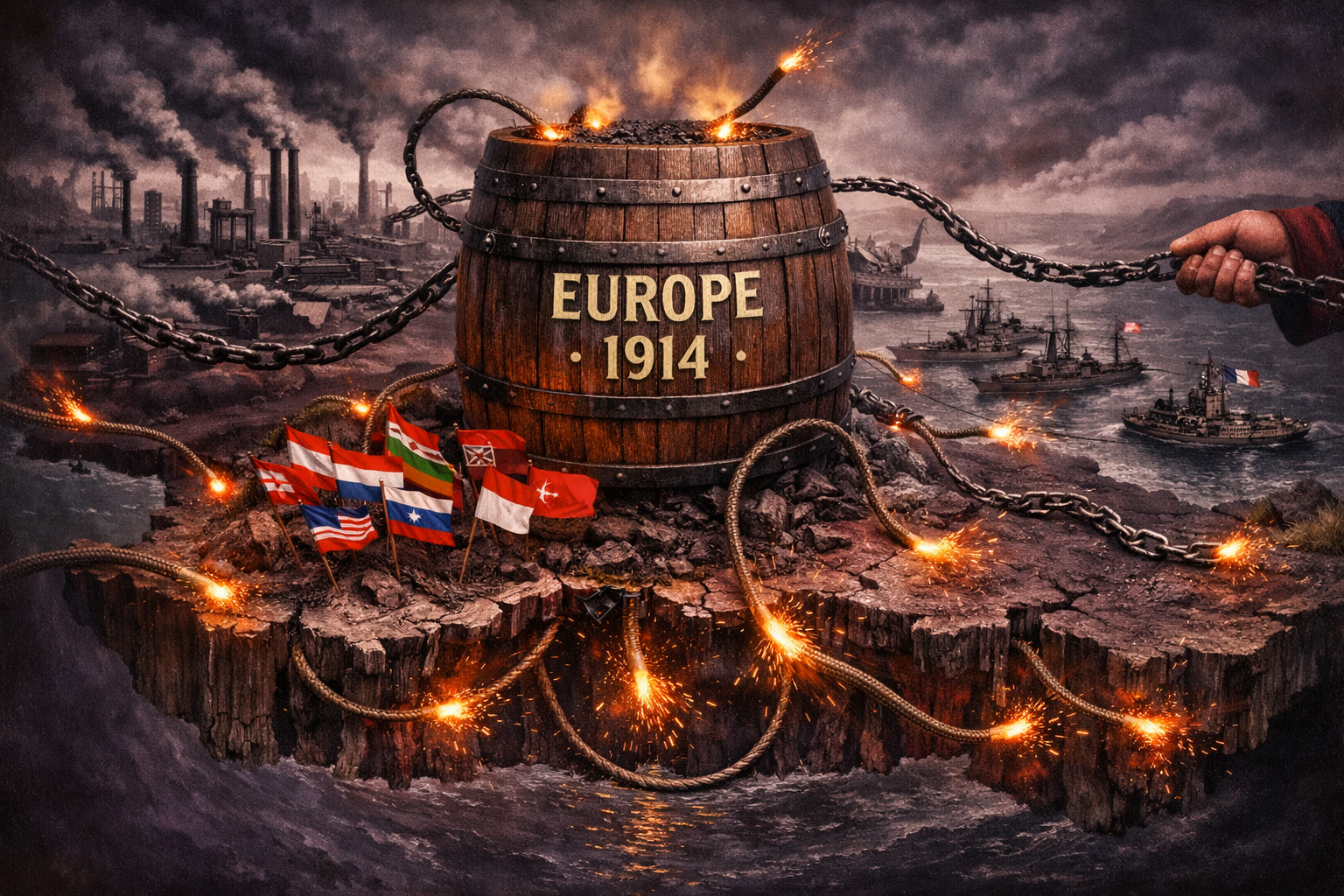
Key Takeaways
• The assassination was just the spark—Europe’s alliance system and military buildup had already created the conditions for continental war
• Mobilization became the point of no return—once armies began moving, backing down meant national humiliation and strategic disaster
• The invasion of Belgium made it global—Germany’s strategic miscalculation brought Britain into the conflict, ensuring a world war
• Leaders were trapped by their own systems—military timetables, alliance obligations, and public pressure left little room for diplomatic solutions
• Multiple missed opportunities existed—the war could have been contained through different choices during the July Crisis
Europe on Edge Before 1914: A Continent Primed for War
Long before Gavrilo Princip pulled the trigger, Europe had become a tinderbox waiting for ignition. Four powerful forces were reshaping the continent and creating dangerous tensions.
Nationalism was tearing apart old empires. In Austria-Hungary, Slavic peoples demanded independence. The Ottoman Empire faced similar pressures from ethnic groups seeking their own nations. Meanwhile, newly unified Germany and Italy were asserting their place among the great powers.
Militarism had created an arms race that consumed national budgets. Germany’s naval expansion challenged British supremacy at sea. France rebuilt its army after the humiliation of 1870. Russia modernized its massive forces. Each nation’s military growth made others feel threatened.
Imperial competition added global dimensions to European rivalries. Germany wanted colonies to match Britain and France. The scramble for Africa created new friction points. Trade routes and naval bases became strategic prizes worth fighting for.
Most dangerously, Europe had divided into two armed camps through competing alliances:
The Triple Entente
- Britain 🇬🇧 – Naval supremacy, global empire
- France 🇫🇷 – Seeking revenge against Germany
- Russia 🇷🇺 – Massive army, Slavic ambitions
The Triple Alliance
- Germany 🇩🇪 – Industrial powerhouse, military excellence
- Austria-Hungary 🇦🇹 – Declining empire, ethnic tensions
- Italy 🇮🇹 – Unreliable partner, territorial disputes
These alliances meant that any conflict between major powers could quickly escalate. A war between Austria-Hungary and Russia would automatically involve Germany and France. Britain’s naval agreements with France made its neutrality unlikely.
“The lamps are going out all over Europe; we shall not see them lit again in our lifetime.” – British Foreign Secretary Sir Edward Grey
Europe in 1914 resembled a room full of gunpowder with multiple people holding lit matches. The question wasn’t whether an explosion would occur, but when and how devastating it would be. This volatile situation helps explain why World War 1 happened and set the stage for the catastrophic events that followed.
The Spark: Assassination of Archduke Franz Ferdinand
On June 28, 1914, Archduke Franz Ferdinand of Austria-Hungary visited Sarajevo, the capital of recently annexed Bosnia-Herzegovina. The visit was meant to demonstrate Austrian control over this restive province, but it would instead trigger the greatest war in human history.
Gavrilo Princip, a 19-year-old Serbian nationalist, was part of a conspiracy to assassinate the heir to the Austrian throne. The group, called the Black Hand, wanted to free Bosnia from Austrian rule and unite all South Slavs under Serbian leadership.
The assassination attempt almost failed. Earlier that morning, another conspirator had thrown a bomb at the Archduke’s car, but it bounced off and exploded behind them. Franz Ferdinand continued with his schedule, even visiting wounded officers in the hospital.
The fatal moment came by pure chance. The Archduke’s driver took a wrong turn, stopped to reverse direction, and found himself directly in front of a café where Princip was eating lunch. The assassin stepped forward and fired two shots—one killing Franz Ferdinand, the other his wife Sophie.
Why This Assassination Mattered
Unlike other political murders of the era, this killing had explosive consequences because:
- Austria-Hungary saw it as an existential threat to their multi-ethnic empire
- Serbia was suspected of supporting the assassins (which was partially true)
- Russia backed Serbia as part of pan-Slavic solidarity
- Germany supported Austria-Hungary through their alliance
The assassination gave Austria-Hungary the justification it had long sought to crush Serbian nationalism. But this was still just a spark. The Moment WWI Became Unstoppable was still weeks away, requiring a series of escalating decisions that would transform a regional crisis into global catastrophe.
What happened next would determine whether this remained a localized conflict or exploded into something far more devastating. The choices made by European leaders in the following month would shape the entire 20th century and beyond, as explored in our analysis of moments that shocked the world.
The July Crisis Begins: Diplomacy’s Last Stand
The month following the assassination became known as the July Crisis—four weeks that would determine the fate of millions. During this period, Europe’s leaders had multiple opportunities to prevent catastrophe, but each chose escalation over compromise.
Austria-Hungary’s response was swift and harsh. With Germany’s backing (the infamous “blank check”), they decided to use the assassination as justification for destroying Serbian independence once and for all.
The Ultimatum That Changed Everything
On July 23, 1914, Austria-Hungary delivered an ultimatum to Serbia with ten demands designed to be unacceptable:
- Suppress anti-Austrian publications ✓ Accepted
- Dissolve nationalist organizations ✓ Accepted
- Remove anti-Austrian teachers ✓ Accepted
- Allow Austrian officials to participate in the investigation ❌ Rejected
- Allow Austrian judges in Serbian courts ❌ Rejected
Serbia accepted eight of the ten demands—a remarkable concession that many European leaders thought should satisfy Austria. But Vienna had already decided that only complete submission or war would do.
The Point of No Return Approaches
July 28, 1914: Austria-Hungary declared war on Serbia, exactly one month after the assassination. This was the moment a local crisis became a continental threat.
But even now, the conflict could have remained limited. Austria-Hungary’s army was not ready for immediate action. Russia was making diplomatic efforts to find a solution. Kaiser Wilhelm II of Germany was having second thoughts about supporting Austrian aggression.
The critical factor was time. Each day of delay allowed military leaders to pressure their governments for mobilization. Each diplomatic failure made war seem more inevitable. Each nation’s preparation made others feel threatened.
“Once the military machine is set in motion, it will be impossible to stop it.” – German General Helmuth von Moltke
The alliance system that was supposed to preserve peace through balance of power was instead creating a domino effect. Russia couldn’t abandon Serbia without losing credibility in the Balkans. France couldn’t abandon Russia without facing Germany alone. Germany couldn’t abandon Austria-Hungary without losing its only reliable ally.
The Moment WWI Became Unstoppable was rapidly approaching as diplomatic solutions gave way to military preparations. The next phase would see Europe’s armies begin to move—and once that happened, the logic of war would overwhelm the possibility of peace.
This escalation pattern shows how quickly regional conflicts can spiral out of control, similar to other historical examples of how powerful societies failed due to poor leadership during critical moments.
The Alliance Chain Reaction: When Loyalty Became Fatal
The alliance system that European leaders believed would prevent war instead guaranteed its expansion. Once Austria-Hungary declared war on Serbia, a cascade of obligations transformed a regional conflict into a continental crisis.
Russia’s Fateful Decision
July 30, 1914: Tsar Nicholas II authorized the mobilization of Russian forces to support Serbia. This decision was driven by several factors:
- Pan-Slavic solidarity with fellow Orthodox Slavs
- Strategic necessity to maintain influence in the Balkans
- Military pressure from generals who feared appearing weak
- Alliance obligations that demanded supporting Serbia
Russia’s mobilization was the first domino to fall in the alliance chain reaction. The Tsar initially ordered only partial mobilization against Austria-Hungary, hoping to avoid provoking Germany. But Russian military leaders convinced him that partial mobilization was impossible—it was all or nothing.
Germany’s Response: The Schlieffen Plan Activated
July 31, 1914: Germany issued an ultimatum demanding Russia halt its mobilization within 12 hours. When Russia refused, Germany had to choose between abandoning Austria-Hungary or implementing its long-planned military strategy.
August 1, 1914: Germany declared war on Russia and began mobilizing its forces. This triggered the infamous Schlieffen Plan—Germany’s strategy for fighting a two-front war by quickly defeating France before Russia could fully mobilize.
France Enters the War
France was automatically drawn in through its alliance with Russia. August 3, 1914: Germany declared war on France, claiming (falsely) that French forces had violated German territory.
The alliance obligations created a tragic irony:
- Each nation honored its commitments to protect allies
- Each mobilization was defensive in its own logic
- Each decision made war more likely while claiming to preserve peace
- Each leader believed others would back down first
The Domino Effect Visualized
| Date | Action | Consequence |
|---|---|---|
| July 28 | Austria declares war on Serbia | Russia feels obligated to respond |
| July 30 | Russia mobilizes | Germany feels threatened |
| August 1 | Germany declares war on Russia | France must honor alliance |
| August 3 | Germany declares war on France | Britain considers intervention |
The alliance system had created a situation where no major power could remain neutral without abandoning its commitments and losing credibility. This was exactly the opposite of what the alliances were supposed to accomplish.
The chain reaction reveals how The Moment WWI Became Unstoppable was approaching rapidly. Military mobilization was creating its own momentum, making diplomatic solutions increasingly impossible. The next critical decision would determine whether the war remained continental or became truly global.
This demonstrates how alliance systems can trap nations in conflicts they never wanted, similar to modern examples of how military strategists throughout history have had to navigate complex political obligations while planning for war.
The Point of No Return: When Mobilization Made Peace Impossible
The Moment WWI Became Unstoppable arrived when Europe’s armies began to move. Mobilization—the process of assembling and preparing military forces for war—created a momentum that made peace negotiations practically impossible.
Why Mobilization Meant War
In 1914, mobilization was not just preparation for potential conflict—it was an irreversible commitment to war. Several factors made this true:
Military Timetables Were Inflexible ⏰
- Armies required weeks to fully assemble and position forces
- Railroad schedules were planned months in advance
- Changing plans mid-mobilization would create chaos and vulnerability
- Delay meant giving enemies a decisive advantage
Economic Costs Were Enormous 💰
- Mobilization consumed massive resources daily
- Civilian economies were disrupted as men left jobs for military service
- Maintaining mobilized forces without fighting was financially ruinous
- Nations couldn’t afford to mobilize and then stand down repeatedly
Political Pressure Became Overwhelming 🏛️
- Military leaders demanded action to justify mobilization costs
- Public opinion expected decisive action once armies were assembled
- Backing down after mobilization appeared weak and invited future aggression
- Politicians faced domestic criticism for “wasting” military preparations
Germany’s Critical Miscalculation
Germany’s mobilization was particularly destabilizing because it was based on the Schlieffen Plan—a rigid strategy that required attacking France through Belgium to avoid French border fortifications.
August 2, 1914: German forces crossed into Luxembourg and demanded passage through Belgium. This decision would prove fatal to Germany’s hopes of limiting the war.
Belgium’s refusal to grant passage meant Germany would have to invade—violating Belgian neutrality that Britain had guaranteed since 1839. German Chancellor Theobald von Bethmann-Hollweg dismissed the Belgian treaty as a “scrap of paper,” not understanding that Britain viewed it as a vital commitment.
The Mobilization Numbers
The scale of mobilization in August 1914 was unprecedented:
| Country | Mobilized Forces | Timeline |
|---|---|---|
| Russia | 5.9 million men | 4-6 weeks |
| Germany | 4.5 million men | 2-3 weeks |
| France | 4.0 million men | 2-3 weeks |
| Austria-Hungary | 3.0 million men | 3-4 weeks |
Over 17 million men were called to arms in the first month of war—a mobilization so massive that stopping it would have required extraordinary political courage that no leader possessed.
The Psychological Trap
Mobilization created a psychological trap for leaders:
- Appearing decisive seemed more important than finding compromise
- Military advice overwhelmed diplomatic counsel
- National honor demanded following through on commitments
- Fear of weakness prevented backing down from confrontation
“The military machine has run away with us all.” – German Kaiser Wilhelm II, August 1914
Once the armies were moving, The Moment WWI Became Unstoppable had arrived. The next critical decision—Germany’s invasion of Belgium—would transform a European war into a global catastrophe, fundamentally changing how World War I changed warfare forever.
The Schlieffen Plan: Germany’s Fatal Strategic Gamble
Germany’s military strategy, known as the Schlieffen Plan, was designed to win a quick victory against France before Russia could fully mobilize. Instead, it guaranteed that The Moment WWI Became Unstoppable would expand the conflict beyond all expectations.
The Logic Behind the Plan
Developed by German General Alfred von Schlieffen, the plan was based on Germany’s geographic nightmare: fighting a two-front war against France and Russia simultaneously. The strategy seemed logical:
Phase 1: Rapid Victory in the West 🇫🇷
- Bypass French border fortifications by attacking through Belgium
- Encircle Paris within 6 weeks
- Force French surrender before Russia could mobilize
- Transfer German forces east to face Russia
Phase 2: Eastern Campaign 🇷🇺
- Use Germany’s superior railroad network for rapid troop movement
- Defeat Russia’s slowly mobilizing forces
- Achieve total victory within 3-4 months
The Fatal Flaw: Belgium
The plan’s critical weakness was its dependence on violating Belgian neutrality. Belgium’s strategic position made it the perfect invasion route into France, but this decision would have catastrophic consequences.
August 3, 1914: Germany invaded Belgium after the Belgian government rejected demands for free passage. This single decision transformed a continental war into a global conflict.
Why Belgium Mattered So Much
Belgium wasn’t just another small country—it was the key to British involvement:
- Treaty of London (1839) guaranteed Belgian neutrality under British protection
- Strategic importance of Belgian ports threatened British naval security
- Moral obligation to protect a neutral nation from aggression
- Balance of power required preventing German control of the Channel coast
August 4, 1914: Britain declared war on Germany, citing the invasion of Belgium as justification. This brought the British Empire—including Canada, Australia, South Africa, and India—into the conflict.
The Domino Effect Continues
Germany’s strategic gamble backfired spectacularly:
| German Expectation | Actual Result |
|---|---|
| Quick victory in France | Stalemate on Western Front |
| British neutrality | British Empire enters war |
| Russian delay | Russia mobilized faster than expected |
| 6-week campaign | 4-year war of attrition |
The Schlieffen Plan’s failure meant Germany would face exactly what it was designed to prevent: a prolonged two-front war against superior numbers and resources.
The Point of No Return
August 4, 1914 marked The Moment WWI Became Unstoppable for several reasons:
- All major European powers were now involved in active combat
- Military momentum had replaced diplomatic negotiation as the driving force
- Strategic commitments made backing down impossible without national defeat
- Public opinion in all countries supported the war effort enthusiastically
The invasion of Belgium revealed how a single strategic decision could transform the entire character of a conflict. What began as an Austrian attempt to punish Serbia had become a global war involving the world’s greatest empires.
This strategic miscalculation demonstrates how military planning can trap nations in conflicts far larger than intended, similar to other historical examples where the impact of wars on US history shows how single decisions can have generational consequences.
Why Leaders Couldn’t Stop the War Machine
Once The Moment WWI Became Unstoppable arrived, Europe’s leaders found themselves trapped by forces beyond their control. The very systems designed to give them power—military hierarchies, alliance networks, and democratic pressures—now constrained their ability to make peace.
The Military Timetable Trap
Generals had become more powerful than politicians in the crucial decisions of August 1914. Military leaders across Europe convinced their civilian governments that any delay or change of plans would be catastrophic.
In Germany, General Helmuth von Moltke told Kaiser Wilhelm II that the mobilization could not be stopped or modified: “Once the lever is pulled, the whole machine moves according to a predetermined plan that cannot be altered.”
The Russian Example 🇷🇺
- Tsar Nicholas II initially ordered partial mobilization
- Military leaders insisted this was impossible
- General staff convinced him that partial mobilization would leave Russia vulnerable
- Full mobilization became “unavoidable” for technical reasons
Fear of Appearing Weak
National prestige had become more important than national interest. In the age of mass media and public opinion, backing down from a confrontation could destroy a leader’s credibility and a nation’s international standing.
Each leader faced the same terrible choice:
- Compromise and appear weak to domestic and foreign audiences
- Escalate and risk catastrophic war
The fear of weakness was particularly powerful because:
- Previous crises had been resolved through shows of strength
- Public opinion demanded decisive action from leaders
- Military advisers warned that hesitation invited aggression
- Alliance partners expected unwavering support
Overconfidence in Quick Victory
Every nation believed the war would be over by Christmas 1914. This fatal miscalculation made the decision for war seem less catastrophic than it actually was.
German Confidence 🇩🇪
- Schlieffen Plan promised victory in 6 weeks
- Superior military organization would overcome numbers
- Economic disruption would be minimal due to short duration
French Confidence 🇫🇷
- Plan XVII would drive Germans back across the Rhine
- Superior morale would defeat German militarism
- Russian alliance guaranteed German defeat
British Confidence 🇬🇧
- Naval blockade would starve Germany quickly
- Small professional army was superior to conscript forces
- Financial power would outlast German resources
The Democracy Problem
Ironically, democratic pressures made peace more difficult in 1914. Leaders had to consider public opinion, which was overwhelmingly enthusiastic for war.
Crowds celebrating in major capitals:
- Berlin: Massive demonstrations supporting the Kaiser
- Paris: “Sacred Union” rallying all political parties
- London: Cheering crowds outside Buckingham Palace
- St. Petersburg: Patriotic fervor for the Tsar
Politicians who advocated caution were accused of cowardice or treason. The few leaders who understood the war’s potential horror—like British Foreign Secretary Sir Edward Grey—found themselves isolated and overruled.
The Institutional Trap
The very institutions that made Europe powerful made peace impossible:
| Institution | How It Prevented Peace |
|---|---|
| Professional militaries | Demanded decisive action once mobilized |
| Alliance systems | Created automatic escalation |
| Railroad networks | Made mobilization irreversible |
| Mass media | Inflamed public opinion |
| Democratic politics | Rewarded aggressive leaders |
The Tragic Irony
The Moment WWI Became Unstoppable revealed a fundamental contradiction in early 20th-century civilization. Europe had created the most sophisticated political, military, and economic systems in human history—but these same systems made rational decision-making impossible during a crisis.
Leaders were trapped by their own success. The institutions that had brought prosperity and power now dragged them into a catastrophe that would destroy the world they were trying to protect.
This institutional trap helps explain why even intelligent, well-intentioned leaders can make decisions that seem obviously wrong in hindsight, similar to modern research on why humans are not equipped to make good decisions under pressure.
Public Support and War Fever: When Nations Demanded Battle
The Moment WWI Became Unstoppable was accelerated by an unexpected force: enthusiastic public support for war across Europe. Far from being dragged reluctantly into conflict, millions of Europeans celebrated the outbreak of hostilities with genuine excitement.
The August Euphoria
August 1914 witnessed scenes that would seem impossible to later generations who knew war’s true cost. In every major European capital, massive crowds gathered to cheer their nations’ entry into war.
Berlin 🇩🇪
- Over 100,000 people gathered outside the Kaiser’s palace
- Crowds sang patriotic songs and waved flags
- Young men rushed to enlist, fearing the war would end before they could participate
- The Kaiser declared: “I no longer see parties or confessions; today I see only Germans!”
Paris 🇫🇷
- Political parties declared a “Sacred Union” suspending all domestic disputes
- Socialist leaders who had opposed militarism now supported the war effort
- Crowds marched down the Champs-Élysées singing “La Marseillaise”
- Reservists reported for duty with flowers in their rifle barrels
London 🇬🇧
- Cheering crowds gathered outside Buckingham Palace and Downing Street
- Recruitment offices were overwhelmed with volunteers
- Even pacifist organizations split over supporting the war
- The mood was described as a “festival of national unity”
Why Populations Wanted War
The enthusiasm for war reflected several powerful social and psychological forces:
Nationalism and Patriotism 🏴
- Decades of nationalist education had prepared populations for this moment
- War was seen as a test of national character and strength
- Defeat would mean national humiliation and loss of great power status
- Victory would prove cultural and racial superiority
Romantic Views of Combat ⚔️
- Most Europeans had no experience of modern industrial warfare
- Popular culture portrayed war as heroic and glorious
- Military parades and ceremonies emphasized pageantry over brutality
- The last major European war (Franco-Prussian, 1870-71) had been relatively brief
Social Unity and Purpose 🤝
- War promised to end class conflicts and political divisions
- Shared sacrifice would create stronger national communities
- Economic problems would be solved through military victory
- War offered escape from routine civilian life
The Media’s Role
Newspapers and popular media amplified war enthusiasm rather than providing sober analysis of the risks involved.
Propaganda Themes:
- Enemy nations were portrayed as barbaric and threatening
- Military leaders were presented as infallible strategic geniuses
- Economic and social benefits of victory were exaggerated
- Costs and risks of war were minimized or ignored entirely
How Public Opinion Trapped Leaders
Democratic accountability became a trap for political leaders who might have preferred diplomatic solutions. Public enthusiasm for war made peace negotiations appear treasonous.
The Political Calculation:
- Leaders who advocated compromise faced accusations of cowardice
- Military preparation was popular and politically safe
- Backing down would likely mean electoral defeat
- War fever made rational cost-benefit analysis impossible
“The nations slithered over the brink into the boiling cauldron of war without any trace of apprehension or dismay.” – British Prime Minister David Lloyd George
The Generational Tragedy
Young men across Europe rushed to enlist, fearing the war would end before they could participate. University students abandoned their studies. Factory workers left their jobs. Professional athletes postponed their careers.
Enlistment Statistics (August-September 1914):
- Britain: 750,000 volunteers in first two months
- Germany: 93% of eligible men reported for duty
- France: Desertion rates were under 1.5%
- Austria-Hungary: Initial enthusiasm even among ethnic minorities
These young men had no way of knowing they were volunteering for:
- 4 years of trench warfare instead of glorious cavalry charges
- Industrial-scale killing using poison gas, machine guns, and artillery
- Casualty rates that would devastate an entire generation
The Moment WWI Became Unstoppable was thus driven not just by political and military factors, but by genuine popular demand for war. This enthusiasm made diplomatic solutions politically impossible and ensured that once fighting began, governments would face enormous pressure to continue until victory was achieved.
The tragic irony was that the populations most eager for war would pay the highest price for their enthusiasm, as explored in our analysis of World War 1 Allied Powers and their ultimate sacrifices.
Could WWI Have Been Stopped? The Roads Not Taken
Even after examining The Moment WWI Became Unstoppable, historians continue debating whether the catastrophe was truly inevitable. Several critical opportunities existed to prevent or limit the conflict, but they required courage and wisdom that Europe’s leaders ultimately lacked.
Missed Diplomatic Opportunities
The July Crisis offered multiple chances for peace that were either ignored or mishandled by key decision-makers.
Kaiser Wilhelm II’s Last-Minute Doubts 🇩🇪
- On July 28, the Kaiser received Serbia’s conciliatory response to Austria’s ultimatum
- He wrote: “This eliminates any reason for war” and proposed accepting Serbia’s terms
- His own government ignored this advice and proceeded with war plans
- Alternative outcome: German pressure could have forced Austria to accept Serbia’s compromise
British Mediation Efforts 🇬🇧
- Foreign Secretary Sir Edward Grey proposed a four-power conference (Britain, France, Germany, Italy)
- The proposal aimed to mediate between Austria-Hungary and Russia
- Germany rejected the conference, fearing it would weaken Austrian resolve
- Alternative outcome: International mediation might have found face-saving compromises
Russian Partial Mobilization 🇷🇺
- Tsar Nicholas II initially ordered mobilization only against Austria-Hungary
- This would have avoided directly threatening Germany
- Military advisers convinced him partial mobilization was technically impossible
- Alternative outcome: Limited mobilization might have avoided triggering German war plans
The Critical Decision Points
Three moments offered the best chances to prevent global war:
| Date | Decision | Alternative |
|---|---|---|
| July 23 | Austria’s ultimatum to Serbia | More moderate demands acceptable to Serbia |
| July 30 | Russian general mobilization | Maintain partial mobilization despite military pressure |
| August 2 | German invasion of Belgium | Respect Belgian neutrality, keep Britain out |
Why Peace Failed
Structural factors made diplomatic solutions extremely difficult:
The Alliance Trap 🔗
- Each nation feared abandoning allies would leave them isolated
- Credibility seemed more important than avoiding war
- Alliance obligations created automatic escalation
- Breaking commitments appeared to invite future aggression
Military Momentum ⚙️
- Mobilization timetables were inflexible once started
- Military leaders dominated civilian decision-making
- Technical requirements overrode political preferences
- Stopping mobilization seemed strategically suicidal
Psychological Factors 🧠
- Leaders overestimated their chances of quick victory
- National honor seemed worth enormous risks
- Public opinion demanded strong action
- Fear of appearing weak paralyzed rational calculation
The Counterfactual Scenarios
What if different choices had been made?
Scenario 1: Limited Balkan War
- Austria accepts Serbia’s partial compliance with ultimatum
- Russia doesn’t mobilize, Germany stays neutral
- Conflict remains between Austria-Hungary and Serbia
- Result: Localized war, no global catastrophe
Scenario 2: Continental War Without Britain
- Germany respects Belgian neutrality
- Britain remains neutral initially
- War limited to France, Germany, Russia, Austria-Hungary
- Result: Shorter war, different outcome, less global impact
Scenario 3: Diplomatic Resolution
- International conference mediates disputes
- Face-saving compromises found for all parties
- Military preparations scaled back gradually
- Result: Crisis resolved, tensions reduced, war postponed or prevented
The Inevitability Debate
Historians remain divided on whether WWI was truly inevitable:
The “Inevitable War” School argues:
- Structural tensions made conflict unavoidable
- Imperial competition required military resolution
- Alliance systems guaranteed escalation
- Economic rivalries demanded decisive action
The “Avoidable War” School contends:
- Specific decisions by individuals caused escalation
- Alternative choices were available at each step
- Structural factors created risk, not inevitability
- Better leadership could have found peaceful solutions
Lessons for Crisis Management
The failure to prevent WWI offers crucial insights for modern crisis management:
Early Intervention ⏰
- Address conflicts before they escalate beyond control
- Maintain diplomatic channels even during military preparations
- Resist pressure for immediate decisive action
Flexible Institutions 🏛️
- Avoid rigid alliance commitments that eliminate options
- Keep military planning subordinate to political goals
- Design systems that reward compromise over confrontation
Public Opinion Management 📢
- Educate populations about war’s true costs
- Resist media pressure for dramatic gestures
- Maintain support for diplomatic solutions
The Moment WWI Became Unstoppable thus represents both a historical tragedy and a continuing warning. The war was not inevitable, but preventing it would have required extraordinary wisdom and courage from leaders who were trapped by the very systems they had created to preserve peace.
Understanding these missed opportunities helps explain both why the war occurred and how similar catastrophes might be prevented in the future, as discussed in our examination of how the US affected the results of World War 1.
The Consequences of That Moment: When the World Changed Forever
The Moment WWI Became Unstoppable in August 1914 unleashed consequences that reshaped human civilization. What European leaders expected to be a brief, limited conflict became a four-year catastrophe that destroyed empires, redrew maps, and fundamentally altered how the world worked.
The Human Cost: A Generation Lost
The scale of destruction exceeded all predictions made by leaders who had confidently expected victory by Christmas 1914.
Total Casualties (1914-1918):
- Military deaths: 8.5 million
- Civilian deaths: 8+ million
- Wounded: 21 million
- Missing/POW: 7.7 million
- Total affected: Over 45 million people
The “Lost Generation” 💀
- France lost 1.4 million men (10% of active male population)
- Britain lost 900,000 men (6% of active male population)
- Germany lost 2 million men (13% of active male population)
- Russia lost 1.7 million men (11% of active male population)
Entire university classes were wiped out. Villages lost all their young men. Families were destroyed across Europe. The demographic impact lasted for generations.
Economic Devastation
The war consumed resources on an unprecedented scale, bankrupting even the wealthiest nations and fundamentally altering the global economy.
Financial Costs:
- Total war expenditure: $208 billion (1919 dollars)
- Equivalent to: $3.3 trillion in 2026 dollars
- Britain’s debt increased: 924% during the war
- Germany’s inflation: Led to economic collapse in 1920s
Economic Transformation:
- United States emerged as global financial center, replacing London
- European colonial empires weakened economically and militarily
- Industrial production shifted from consumer goods to weapons
- Women entered workforce in unprecedented numbers
Political Revolution
The Moment WWI Became Unstoppable triggered political changes that destroyed the old European order and created the modern world system.
Empires That Collapsed:
- Russian Empire → Soviet Union (1917 Revolution)
- German Empire → Weimar Republic (Kaiser abdicated)
- Austro-Hungarian Empire → Multiple new nations
- Ottoman Empire → Modern Turkey and Middle Eastern states
New Nations Created:
- Poland, Czechoslovakia, Yugoslavia
- Finland, Estonia, Latvia, Lithuania
- Hungary, Austria (as separate states)
- Iraq, Syria, Lebanon (under mandates)
Social and Cultural Impact
Traditional European civilization was shattered by the war’s brutality and senselessness.
Social Changes:
- Class systems weakened by shared sacrifice and suffering
- Women’s roles expanded due to wartime necessity
- Religious faith declined among populations traumatized by war
- Traditional authority questioned after leaders’ catastrophic failures
Cultural Transformation:
- Art and literature reflected disillusionment and trauma
- “Shell shock” (PTSD) recognized as widespread psychological damage
- Pacifist movements grew in reaction to war’s horror
- Modernist movements emerged rejecting pre-war values
Technological and Military Revolution
The war accelerated technological development and changed warfare forever, as detailed in our analysis of how World War I changed warfare forever.
Military Innovations:
- Chemical weapons introduced industrial killing methods
- Aircraft warfare evolved from reconnaissance to combat
- Tank warfare broke the stalemate of trench fighting
- Submarine warfare threatened global shipping
Civilian Technology:
- Medical advances in surgery and prosthetics
- Communications improvements (radio, telephone)
- Industrial production techniques
- Transportation and logistics systems
Seeds of Future Conflicts
The peace settlement created new problems that would lead to even greater catastrophes.
Treaty of Versailles Problems:
- German resentment over harsh terms and war guilt clause
- Economic reparations that destabilized European recovery
- Ethnic minorities trapped in new nation-states
- Russian exclusion from post-war settlement
Unresolved Issues:
- Colonial empires maintained despite self-determination rhetoric
- Economic instability from war debts and reparations
- Political extremism grew from post-war disillusionment
- International system remained based on competing nation-states
The Long-Term Legacy
The Moment WWI Became Unstoppable in 1914 set in motion changes that continue to shape our world in 2026:
Political Legacy:
- Democracy vs. authoritarianism became central global conflict
- International organizations developed to prevent future wars
- Decolonization movements gained momentum from European weakness
- Ideological conflicts replaced traditional balance-of-power politics
Social Legacy:
- Total war concept made entire populations military targets
- State power expanded to mobilize national resources completely
- Individual rights became subordinate to collective security needs
- Technological warfare made human courage less decisive than industrial capacity
“This war, like the next war, is a war to end war.” – British author David Lloyd George, reflecting the tragic irony of WWI’s legacy
The Moment WWI Became Unstoppable thus represents far more than a historical turning point—it marks the moment when humanity entered the modern age of total war, ideological conflict, and global interdependence. The decisions made in those crucial weeks of August 1914 continue to influence international relations, military strategy, and political development more than a century later.
Understanding this legacy helps explain not only how the 20th century unfolded, but also why preventing similar moments of escalation remains one of humanity’s most important challenges, as explored in our discussion of 5 remarkable women who led powerful rebellions against the systems that emerged from WWI’s aftermath.
Conclusion
The Moment WWI Became Unstoppable was not a single dramatic event, but rather a cascade of decisions that transformed a regional crisis into global catastrophe. The assassination of Archduke Franz Ferdinand provided the spark, but Europe’s alliance system, military mobilization schedules, and leaders’ fatal miscalculations created the conditions that made peace impossible.
The war became truly unstoppable on August 4, 1914, when Germany’s invasion of Belgium brought Britain into the conflict. At that moment, all of Europe’s great powers were committed to a struggle that none fully understood and that would consume a generation.
Key Lessons for Understanding Historical Crisis
The path to WWI reveals how quickly international situations can spiral beyond control when:
- Rigid alliance systems create automatic escalation
- Military planning dominates diplomatic flexibility
- National pride becomes more important than rational calculation
- Public opinion demands action over compromise
- Leaders fear appearing weak more than catastrophic consequences
Why This History Matters in 2026
Understanding The Moment WWI Became Unstoppable remains crucial because similar dynamics continue to shape international relations. Modern alliance systems, military technologies, and democratic pressures can create comparable traps for contemporary leaders facing international crises.
The tragedy of 1914 demonstrates that even intelligent, well-intentioned leaders can make decisions that seem obviously wrong in hindsight when they are trapped by institutional pressures and psychological biases that make rational calculation impossible.
Next Steps for History Enthusiasts
To deepen your understanding of this pivotal moment in world history:
- Explore the broader context by reading about the alliance systems and imperial rivalries that created the conditions for war
- Study primary sources from the July Crisis to understand how leaders justified their decisions
- Compare WWI’s outbreak to other historical moments when conflicts escalated beyond control
- Examine modern parallels where similar dynamics might create contemporary risks
- Consider counterfactual scenarios to understand which factors were most crucial in making war inevitable
The moment World War I became unstoppable wasn’t just when war began—it was when no one could stop it. Understanding how Europe reached that point of no return provides essential insights into how human institutions, individual psychology, and historical forces can combine to create tragedies that no one intended but everyone helped cause.



