
Empires don’t collapse overnight—but sometimes, one day changes everything. For over a millennium, the Roman Empire dominated the known world with seemingly unstoppable legions and unshakeable confidence. Yet historians continue to debate a crucial question: when exactly did the day the Roman Empire began to fall occur?
While Rome’s decline unfolded over centuries, certain pivotal moments marked the beginning of irreversible decay. Among these, the Battle of Adrianople in 378 AD stands out as perhaps the most significant turning point—the day when Rome’s aura of invincibility shattered forever.
Key Takeaways
• The Battle of Adrianople (378 AD) marked Rome’s first major defeat by barbarian forces, killing Emperor Valens and destroying two-thirds of the Roman army
• Rome’s decline was gradual but accelerated after key defeats that exposed internal weaknesses and encouraged further invasions
• Multiple factors contributed to Rome’s fall, including political corruption, economic troubles, military overextension, and reliance on foreign mercenaries
• The defeat encouraged barbarian invasions across the empire, as tribes realized Rome could be beaten
• Recovery became impossible due to the combination of external pressures and deep-rooted internal problems
Rome at Its Peak: The Height of Imperial Power
Before examining the day the Roman Empire began to fall, understanding Rome’s former glory provides essential context. At its zenith in the 2nd century AD, the Roman Empire stretched from Britain to Mesopotamia, encompassing roughly 5 million square kilometers and governing an estimated 65 million people.
The Pillars of Roman Strength
Rome’s dominance rested on several key foundations:
- 🏛️ Military Superiority: Professional legions with superior training, equipment, and tactics
- 🛣️ Infrastructure Excellence: Roads, aqueducts, and fortifications connecting distant territories
- ⚖️ Administrative Efficiency: Standardized laws, currency, and governance systems
- 🏺 Cultural Integration: Latin language and Roman customs spreading throughout the empire
- 💰 Economic Prosperity: Trade networks generating wealth across three continents
The ancient Roman innovations that emerged during this period continue influencing modern society, demonstrating the empire’s remarkable achievements.
Hidden Cracks in the Foundation
Despite outward strength, Rome harbored dangerous internal weaknesses by the 3rd and 4th centuries:
Political Instability 🏛️
- Frequent civil wars between rival claimants to the throne
- The “Crisis of the Third Century” saw 26 emperors in 50 years
- Praetorian Guard selling the imperial throne to the highest bidder
Economic Strain 💸
- Debasement of currency leading to severe inflation
- Heavy taxation to fund the military and bureaucracy
- Decline in agricultural productivity due to constant warfare
Military Overextension ⚔️
- Borders too vast to defend effectively
- Increasing reliance on barbarian foederati (allied troops)
- Roman citizens avoiding military service
These systemic problems created the perfect storm for the day the Roman Empire began to fall.
The Turning Point: The Battle of Adrianople
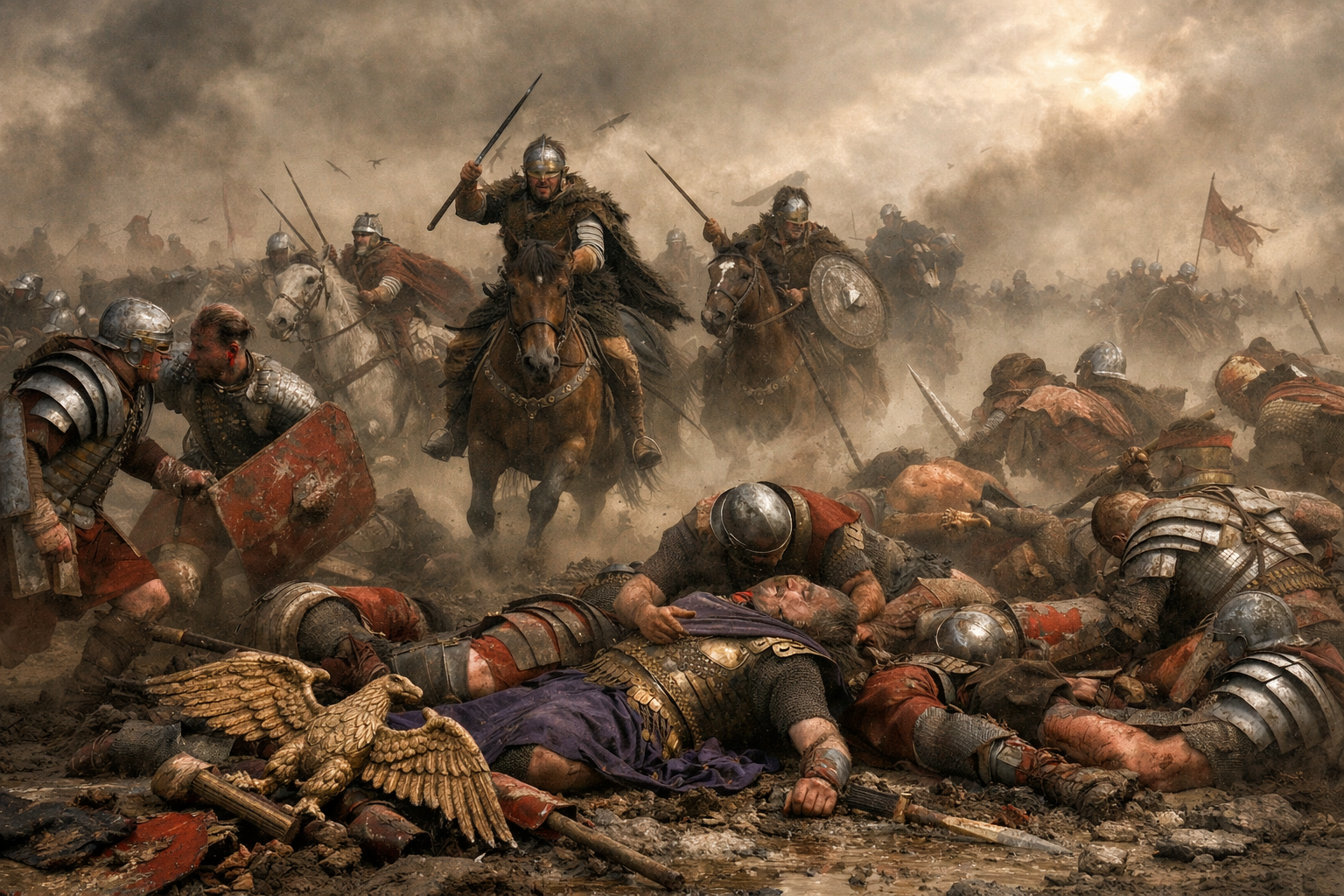
On August 9, 378 AD, the fate of the Roman Empire changed forever near the city of Adrianople (modern-day Edirne, Turkey). This battle represents the strongest candidate for the day the Roman Empire began to fall due to its immediate impact and long-term consequences.
The Road to Disaster
The crisis began when the Visigoths, fleeing the advancing Huns, requested permission to cross the Danube River into Roman territory. Emperor Valens initially welcomed them, seeing an opportunity to recruit new soldiers. However, corrupt Roman officials exploited and mistreated the Gothic refugees, leading to rebellion.
Key Players:
- Emperor Valens: Eastern Roman Emperor seeking military glory
- Fritigern: Visigothic leader commanding the rebel forces
- Gratian: Western Roman Emperor whose reinforcements arrived too late
The Battle Unfolds
Valens, eager for a decisive victory before his nephew Gratian could share the glory, advanced with approximately 40,000 troops. The emperor ignored reconnaissance reports suggesting the Gothic force was much larger than expected.
The battle began disastrously for Rome:
- 🔥 Initial Contact: Roman cavalry attacked prematurely, disrupting battle formations
- ⚡ Gothic Counter-Attack: Visigothic cavalry returned from foraging and struck the Roman flank
- 💀 Complete Collapse: Surrounded Roman legions were systematically destroyed
- 👑 Imperial Death: Emperor Valens perished in the fighting, his body never recovered
The Devastating Outcome
The Battle of Adrianople resulted in catastrophic losses for Rome:
- Two-thirds of the Roman army destroyed (approximately 25,000-30,000 casualties)
- Emperor Valens killed in action – only the second emperor to die in battle against barbarians
- Elite officer corps decimated – irreplaceable military leadership lost
- Entire Balkan frontier collapsed – opening the empire to further invasions
Contemporary historian Ammianus Marcellinus called it “the worst defeat since Cannae,” comparing it to Hannibal’s devastating victory 590 years earlier.
Why Adrianople Marked the Day the Roman Empire Began to Fall
The Battle of Adrianople wasn’t just another military defeat—it fundamentally altered the balance of power between Rome and the barbarian tribes. Here’s why this day marked the beginning of Rome’s irreversible decline:
1. Rome Lost Its Military Superiority 🛡️
For centuries, Roman legions were considered invincible. The systematic destruction of a full Roman army by barbarian forces shattered this perception permanently.
Immediate Impact:
- Barbarian tribes realized Rome could be defeated
- Roman military confidence never fully recovered
- Future battles fought with psychological disadvantage
Long-term Consequences:
- Recruitment became increasingly difficult
- Greater reliance on unreliable barbarian mercenaries
- Military effectiveness continued declining
2. Barbarian Forces Gained Unprecedented Power ⚔️
The victory at Adrianople proved that organized barbarian armies could not only resist Roman expansion but actively defeat Roman forces on the battlefield.
Strategic Advantages Gained:
- Control of the Balkan Peninsula
- Access to Roman military equipment and tactics
- Recruitment of Roman deserters and prisoners
- Psychological momentum for future campaigns
3. Internal Weaknesses Became Fatally Exposed 🏛️
Adrianople revealed that Rome’s internal problems—political division, economic strain, and military overextension—had reached critical levels.
Exposed Vulnerabilities:
- Poor Leadership: Valens’ reckless decision-making
- Communication Failures: Lack of coordination between Eastern and Western armies
- Strategic Mistakes: Underestimating enemy strength and capabilities
- Resource Limitations: Inability to quickly replace losses
The defeat highlighted how powerful societies can fail due to poor leadership, a pattern that would continue plaguing Rome.
Other Candidates for the Day the Roman Empire Began to Fall
While Adrianople represents the strongest case, historians have identified several other pivotal moments that could qualify as the day the Roman Empire began to fall:
The Crisis of the Third Century (235-284 AD) 📉
This 50-year period of near-constant civil war, economic collapse, and barbarian invasions nearly destroyed the empire entirely.
Key Events:
- 26 emperors in 50 years (most died violent deaths)
- Hyperinflation destroyed the Roman currency
- Multiple provinces declared independence
- Plague decimated the population
Why It Matters: Demonstrated Rome’s fundamental instability and inability to maintain unity.
The Sack of Rome by Alaric (410 AD) 🔥
The Visigothic king Alaric’s capture and pillaging of Rome shocked the ancient world and symbolically ended Roman invincibility.
Significance:
- First time in 800 years that Rome had fallen to foreign enemies
- Psychological impact throughout the empire
- Demonstrated the capital’s vulnerability
The Deposition of Romulus Augustulus (476 AD) 👑
Germanic chieftain Odoacer’s removal of the last Western Roman Emperor traditionally marks the “fall” of Rome.
Historical Impact:
- End of the Western Roman Empire as a political entity
- Beginning of the Medieval period in Western Europe
- Transformation of former Roman territories into barbarian kingdoms
However, this event represents the end of Rome’s fall rather than its beginning, making it less relevant to our central question.
The Real Causes Behind Rome’s Decline
Understanding the day the Roman Empire began to fall requires examining the deeper factors that made such a collapse possible. Rome’s decline resulted from multiple interconnected problems that had been building for generations.
Political Corruption and Instability 🏛️
The Roman political system, designed for a city-state, couldn’t effectively govern a vast empire:
- Imperial Succession Crisis: No clear rules for choosing emperors led to constant civil wars
- Praetorian Guard Interference: Elite soldiers frequently assassinated emperors for political gain
- Senate Powerlessness: Traditional governing body lost influence and effectiveness
- Provincial Rebellion: Distant territories declared independence during periods of weakness
Economic Troubles and Inflation 💰
Rome’s economy faced insurmountable challenges:
Currency Debasement
- Silver content in coins dropped from 98% to 5% over two centuries
- Hyperinflation made trade and commerce increasingly difficult
- Barter systems replaced monetary exchange in many regions
Taxation Burden
- Crushing taxes needed to fund the military and bureaucracy
- Agricultural productivity declined as farmers abandoned their land
- Urban populations shrank as economic opportunities disappeared
Military Overextension and Barbarization 🗡️
Rome’s military faced impossible demands:
Frontier Defense
- 9,000 kilometers of borders requiring constant protection
- Limited manpower spread too thin across vast territories
- Communication delays prevented coordinated responses to threats
Reliance on Barbarian Troops
- Roman citizens increasingly avoided military service
- Barbarian foederati became the backbone of Roman armies
- Foreign soldiers had divided loyalties and different motivations
The lessons America can learn from Rome’s fall remain relevant for modern societies facing similar challenges.
External Invasions and Pressure 🌍
Barbarian migrations and invasions accelerated Rome’s decline:
The Hun Migration
- Hunnic expansion displaced Germanic tribes westward
- Displaced populations sought refuge within Roman borders
- Refugee crises strained Roman resources and administration
Organized Barbarian Kingdoms
- Tribes evolved from raiders into organized political entities
- Barbarian leaders adopted Roman military tactics and technology
- Former allies became dangerous enemies
Could Rome Have Recovered After Adrianople?
The question remains: was the day the Roman Empire began to fall truly irreversible, or could Rome have recovered from the disaster at Adrianople?
Theoretical Possibilities for Recovery 🔄
Military Reforms
- Complete reorganization of the Roman army
- Return to citizen-soldiers rather than barbarian mercenaries
- Development of new tactics to counter barbarian cavalry
Political Stabilization
- Establishment of clear succession laws
- Reunification of Eastern and Western empires
- Elimination of corruption in provincial administration
Economic Revival
- Currency reform to restore monetary stability
- Tax reduction to encourage agricultural recovery
- Infrastructure investment to revive trade networks
The Harsh Reality 📉
Despite theoretical possibilities, several factors made recovery virtually impossible:
Scale of the Problems
- Multiple crises occurring simultaneously across the empire
- Centuries of accumulated damage to institutions and infrastructure
- Loss of Roman identity and civic virtue among the population
External Pressures
- Continued barbarian migrations and invasions
- Rise of Sassanid Persia as a major threat in the East
- Loss of tax revenue from occupied territories
Internal Divisions
- Religious conflicts between Christians and pagans
- Regional separatism and declining loyalty to Rome
- Economic inequality and social unrest
The rise and fall of ancient civilizations follows predictable patterns, and Rome had passed the point of no return.
What Happened After the Day the Roman Empire Began to Fall
Following Adrianople, Rome’s decline accelerated rapidly despite occasional temporary recoveries:
Immediate Consequences (378-400 AD) ⚡
Theodosius I’s Temporary Stabilization
- New emperor negotiated peace with the Visigoths
- Settled barbarian tribes within Roman territory as foederati
- Temporarily restored order in the Balkans
Continued Barbarian Pressure
- Other tribes encouraged by Visigothic success
- Increased raids across Rhine and Danube frontiers
- Roman resources stretched even thinner
The Barbarian Invasions (400-476 AD) 🏃♂️
The floodgates opened after Adrianople:
- 406 AD: Vandals, Alans, and Suevi cross the frozen Rhine
- 410 AD: Alaric sacks Rome itself
- 455 AD: Vandals sack Rome again
- 476 AD: Last Western Roman Emperor deposed
Transformation of Europe 🌍
Rome’s collapse led to fundamental changes:
Political Fragmentation
- Former Roman territories became independent barbarian kingdoms
- Feudalism replaced centralized imperial administration
- Local strongmen filled the power vacuum
Cultural Changes
- Latin evolved into Romance languages
- Christianity became the dominant unifying force
- Classical learning preserved in monasteries
Economic Decline
- Long-distance trade networks collapsed
- Urban centers shrank dramatically
- Agricultural subsistence replaced commercial economy
This period marked the transition from the ancient world to what historians call the Middle Ages.
The Real Answer: When Did the Roman Empire Begin to Fall?
After examining the evidence, what can we conclude about the day the Roman Empire began to fall?
A Balanced Historical Perspective ⚖️
No Single Day Caused Rome’s Fall
Rome’s decline resulted from centuries of accumulated problems rather than a single catastrophic event. Political instability, economic troubles, military overextension, and external pressures all contributed to the empire’s eventual collapse.
But Some Days Were More Significant Than Others
While Rome’s fall was a gradual process, certain events accelerated the decline and made recovery increasingly difficult. The Battle of Adrianople stands out as the most significant of these turning points.
Why Adrianople Deserves Recognition 🏆
The Battle of Adrianople on August 9, 378 AD, represents the day the Roman Empire began to fall because it:
- Shattered Roman military supremacy for the first time in centuries
- Encouraged barbarian invasions across the entire frontier
- Exposed fatal internal weaknesses in Roman leadership and strategy
- Created psychological momentum that Rome never recovered from
- Marked the beginning of irreversible territorial losses in the Balkans
The Symbolic Importance 🎭
Even if Rome’s decline was inevitable due to systemic problems, Adrianople symbolizes the moment when:
- Roman invincibility became a myth rather than reality
- Barbarian tribes realized they could defeat Rome in open battle
- The empire’s internal weaknesses became fatally exposed
- Recovery became virtually impossible due to cascading failures
The battle represents the tipping point where Rome’s decline became irreversible, making it the strongest candidate for the day the Roman Empire began to fall.
Conclusion
The question of the day the Roman Empire began to fall reveals the complex nature of historical causation. While empires rarely collapse due to single events, certain moments can trigger irreversible decline that makes recovery impossible.
The Battle of Adrianople on August 9, 378 AD, stands as the most compelling answer to this question. This devastating defeat didn’t just cost Rome an army and an emperor—it shattered the psychological foundations of Roman power and encouraged the barbarian invasions that would ultimately destroy the Western Empire.
Understanding Rome’s decline offers valuable lessons for modern societies. The combination of political corruption, economic strain, military overextension, and external pressure that destroyed Rome remains relevant today. As we face our own challenges in 2026, Rome’s example reminds us that even the mightiest civilizations can fall when internal weaknesses meet external threats.
Next Steps for History Enthusiasts 📚
To deepen your understanding of Rome’s fall:
- Study primary sources like Ammianus Marcellinus’s account of Adrianople
- Explore archaeological evidence from 4th-century battlefields and settlements
- Compare Rome’s decline with other historical empire collapses
- Examine modern parallels between Rome’s challenges and contemporary issues
- Visit historical sites in Turkey, Italy, and the Balkans to see where these events unfolded
Rome didn’t fall in a day—but August 9, 378 AD made its fall inevitable. The echoes of that distant battle continue to shape our understanding of power, decline, and the fragility of even the greatest civilizations.



