
Imagine a world where aging scholars had to abandon their life’s work simply because their vision failed. 📚 For centuries, this was the harsh reality until a revolutionary invention emerged in medieval Europe that would forever change how humanity dealt with vision problems. Spectacles in the Middle Ages represented one of the most significant technological breakthroughs of the era, allowing monks, scholars, and craftsmen to continue their vital work well into old age.
The development of early eyeglasses during the late medieval period marked a turning point in human productivity and learning. These simple yet ingenious devices enabled the preservation and transmission of knowledge that might otherwise have been lost when scribes and scholars could no longer see clearly enough to read and write.
Key Takeaways
- Spectacles were invented in the late 13th century in northern Italy, revolutionizing how people managed vision problems
- Medieval eyeglasses primarily served scholars and clergy who needed clear vision for reading and copying manuscripts
- Early spectacles featured simple designs with glass lenses held together by rivets, without the side arms we know today
- The invention supported intellectual growth by allowing aging scholars to continue their work and contribute to medieval learning
- Glassmaking advances in Italy provided the technical foundation necessary for creating the first functional eyeglasses
When Were Spectacles Invented?
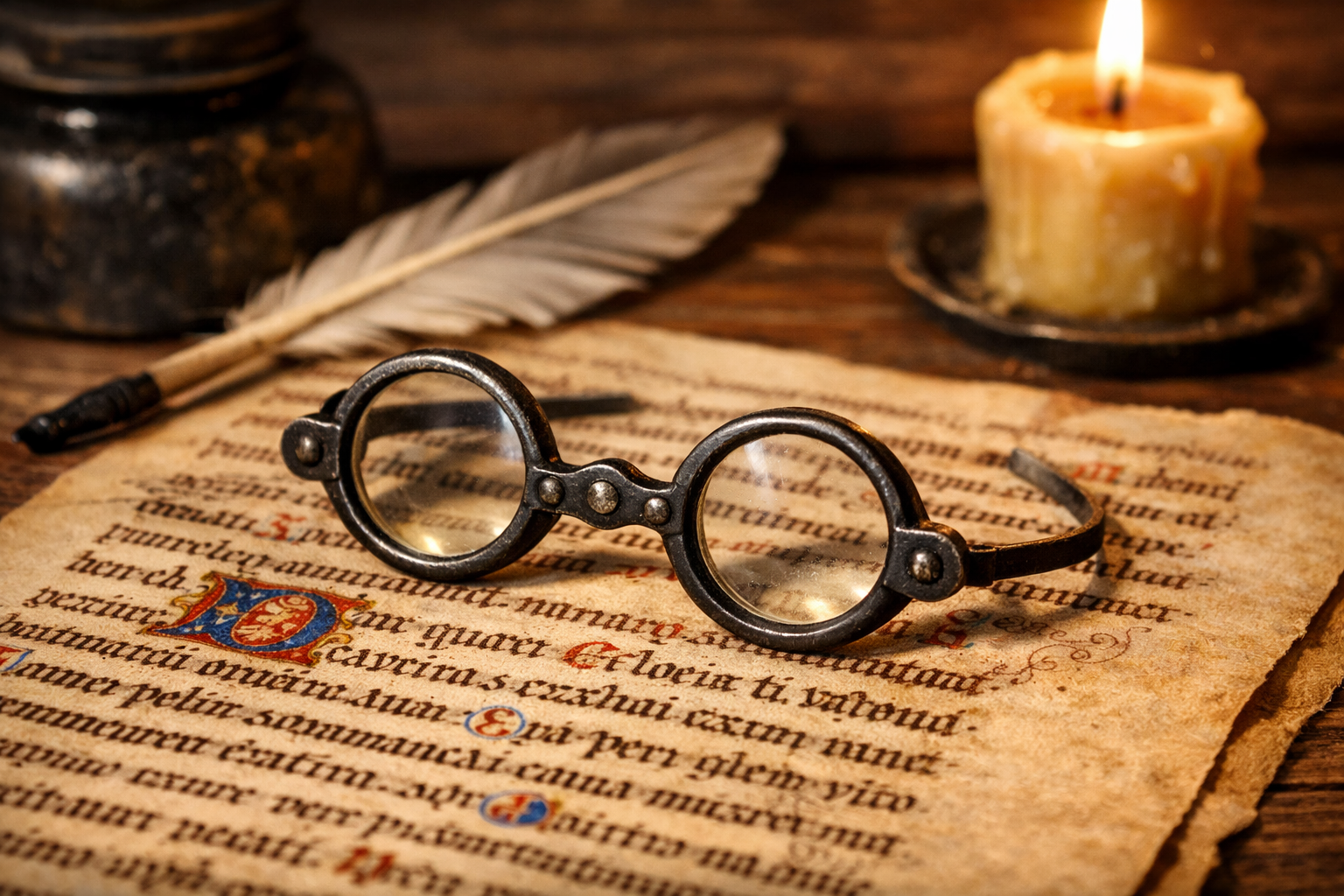
The precise origins of spectacles in the Middle Ages remain somewhat mysterious, but historians generally agree that the first eyeglasses appeared in northern Italy during the late 13th century, around 1280-1290. This timing coincides with significant advances in glassmaking technology and growing literacy rates among the educated classes.
Several Italian cities claim to be the birthplace of spectacles, including:
- Venice – Known for its advanced glassmaking industry
- Pisa – Home to influential scholars and craftsmen
- Florence – A center of learning and artistic innovation
The earliest spectacles were designed specifically for reading and close work. Unlike modern glasses that correct various vision problems, these medieval eyeglasses primarily helped with presbyopia – the age-related difficulty in seeing close objects clearly. This made them particularly valuable for scholars and scribes who spent countless hours reading and copying texts.
Early references to spectacles appear in Italian documents from the 1280s, with one famous account describing them as “glasses for the eyes” that helped people see letters and small objects more clearly. The rapid spread of this technology suggests that spectacles filled a crucial need in medieval society.
Why Spectacles Became Important in Medieval Society
The rise of spectacles in the Middle Ages coincided with several important social and cultural developments that created a perfect storm of demand for vision correction:
Growing Literacy and Scholarship
During the late medieval period, Europe experienced a significant expansion in education and literacy. Universities were established across the continent, and more people than ever before were learning to read and write. This intellectual renaissance created a large population of scholars who needed clear vision to continue their work.
Manuscript Production
Monasteries served as the primary centers for copying and preserving written knowledge. Monks spent decades carefully transcribing religious texts, classical works, and scholarly treatises. As these dedicated scribes aged, their declining vision threatened the continuation of this vital cultural work.
Economic Factors
The medieval economy increasingly relied on detailed record-keeping, contracts, and written documentation. Merchants, bankers, and craftsmen all needed good vision to:
- ✅ Read contracts and legal documents
- ✅ Keep accurate financial records
- ✅ Examine fine details in their craft work
- ✅ Correspond with business partners
Religious Motivations
Many medieval scholars viewed their ability to read and study religious texts as a sacred duty. Spectacles allowed aging monks and theologians to continue their spiritual work, which they saw as serving God through the preservation and study of divine knowledge.
How Early Medieval Spectacles Were Made
The creation of spectacles in the Middle Ages required sophisticated craftsmanship and represented the cutting edge of medieval technology. The process involved several specialized skills and materials:
Glass Lens Production
Medieval glassmakers used techniques that had been refined over centuries:
Raw Materials:
- Sand (silica)
- Ash from burned plants (potash)
- Lime for stability
- Metal oxides for clarity
Manufacturing Process:
- Heating – Glass was melted in furnaces at extremely high temperatures
- Shaping – Molten glass was blown or pressed into rough lens shapes
- Grinding – Lenses were carefully ground and polished to achieve the correct curvature
- Polishing – Final finishing created smooth, clear surfaces
Frame Construction
Early spectacle frames were made from various materials available to medieval craftsmen:
| Material | Advantages | Common Uses |
|---|---|---|
| Wood | Lightweight, easy to carve | Simple frames for clergy |
| Bone | Durable, readily available | Everyday spectacles |
| Leather | Flexible, comfortable | Protective cases and hinges |
| Metal | Strong, precise fitting | High-quality frames for wealthy users |
Assembly Techniques
The most common early design was the rivet spectacle, where two lenses were connected by a small metal pin or rivet. This simple but effective design allowed the spectacles to:
- Fold for easy storage
- Adjust to different nose shapes
- Balance properly when worn
Types of Early Spectacles
Rivet Spectacles
Rivet spectacles represented the most common design of spectacles in the Middle Ages. These ingenious devices consisted of two circular lenses connected by a small metal rivet that allowed them to fold like scissors.
Key Features:
- 🔍 Two convex lenses for magnification
- 🔗 Central rivet joint for folding
- 👃 Nose bridge design that rested on the nose
- 📏 No side arms – held in place by nose pressure alone
The rivet design solved several practical problems. When not in use, the spectacles could be folded flat for storage. The adjustable angle allowed users to find the most comfortable position for their nose shape.
Reading Stones
Before the invention of true spectacles, medieval scholars used reading stones – simple magnifying devices that represented an important stepping stone toward eyeglasses.
Characteristics of Reading Stones:
- Single piece of polished crystal or glass
- Dome or hemisphere shape
- Placed directly on text for magnification
- No frame or mounting system
Reading stones were particularly popular among revolutionary medieval scientists who needed to examine detailed diagrams and small text in scientific manuscripts. While effective, they were cumbersome to use and required one hand to hold them in place.
Limitations:
- Required constant hand positioning
- Limited field of view
- Difficult to use for writing
- Easy to lose or misplace
Who Used Spectacles in the Middle Ages
The early adoption of spectacles in the Middle Ages was limited to specific groups who had both the need for vision correction and the means to obtain these expensive devices:
Monks and Clergy
Monasteries became the primary market for early spectacles. Monks who dedicated their lives to copying manuscripts found spectacles essential for continuing their work into old age. The Church’s role in preserving knowledge made clear vision a practical necessity for religious communities.
Typical monastic users included:
- Scribes copying religious texts
- Illuminators creating detailed manuscript decorations
- Librarians cataloging and maintaining book collections
- Scholars studying theology and philosophy
University Scholars and Teachers
As universities expanded across Europe during medieval times, aging professors and students needed spectacles to continue their academic work. These institutions became important centers for spectacle adoption and improvement.
Wealthy Merchants and Craftsmen
Successful merchants who could afford spectacles found them valuable for:
- Reading contracts and correspondence
- Examining fine goods and materials
- Keeping detailed financial records
- Quality control in manufacturing
Skilled Artisans
Certain crafts required exceptional visual precision, making spectacles particularly valuable:
Jewelry makers – Examining precious stones and metals
Manuscript illuminators – Creating intricate decorative details
Clockmakers – Working with tiny mechanical components
Textile workers – Inspecting fine fabrics and embroidery
The Role of Glassmaking in the Development of Spectacles
The emergence of spectacles in the Middle Ages was only possible due to significant advances in medieval glassmaking technology. Italian glassmakers, particularly those in Venice and surrounding regions, developed the skills necessary to create clear, properly curved lenses.
Venice: The Glassmaking Capital
Venice dominated European glassmaking during the medieval period. The city’s glassmakers, concentrated on the island of Murano, developed techniques that remained trade secrets for centuries:
Venetian Innovations:
- Crystal glass – Clearer than previous glass types
- Precise temperature control – Better consistency in lens quality
- Advanced grinding techniques – More accurate lens curvature
- Quality standards – Systematic approaches to lens testing
Technical Challenges
Creating functional spectacle lenses required overcoming several technical obstacles:
Optical Precision:
- Lenses needed consistent curvature for proper magnification
- Surface quality had to be smooth enough for clear vision
- Thickness variations could cause distortion
Material Quality:
- Glass had to be free from bubbles and impurities
- Color consistency was important for user comfort
- Durability was essential for daily use
Guild System and Quality Control
Medieval glassmaking operated under strict guild regulations that helped maintain quality standards. The guild system ensured that:
- ✅ Apprentices received proper training
- ✅ Materials met established standards
- ✅ Techniques were preserved and improved
- ✅ Competition maintained reasonable prices
The Spread of Spectacles Across Europe
From their origins in Italy, spectacles in the Middle Ages gradually spread throughout Europe, following trade routes and centers of learning. This diffusion process took several decades and was influenced by various social and economic factors.
Northern European Adoption
Germany and the Low Countries became early adopters of spectacle technology, particularly in cities with strong connections to Italian trade:
Key Centers:
- Nuremberg – Major trading hub with Italy
- Bruges – Wealthy merchant city
- Paris – Center of university learning
- London – Growing commercial center
Factors Influencing Spread
Several factors determined how quickly spectacles were adopted in different regions:
Economic Prosperity – Wealthier regions could afford the expensive imported glasses
Educational Centers – Universities and monasteries created natural demand
Trade Connections – Cities with Italian trade links gained earlier access
Local Glassmaking – Regions that developed their own glass industries saw faster adoption
Resistance and Acceptance
Not everyone welcomed the new technology. Some resistance came from:
- Religious concerns about altering God-given vision
- Social stigma associated with visible signs of aging
- Cost barriers that limited access to wealthy elites
- Technical limitations of early designs
However, the practical benefits of spectacles generally overcame initial resistance, especially among educated classes who depended on reading for their livelihood.
Impact of Spectacles on Learning and Culture
The introduction of spectacles in the Middle Ages had profound effects on intellectual life and cultural development that extended far beyond simple vision correction:
Extended Scholarly Careers
Spectacles dramatically lengthened the productive careers of medieval scholars. Before eyeglasses, aging academics often had to retire from active scholarship when their vision declined, typically in their 40s or 50s. With spectacles, many could continue working well into their 60s and beyond.
This extension of scholarly careers meant:
- 📚 More books and manuscripts were produced
- 🎓 Experienced teachers could train more students
- 🔬 Research projects could be completed over longer periods
- 📜 Knowledge preservation improved significantly
Acceleration of Learning
The availability of spectacles contributed to what historians call the “intellectual acceleration” of the late medieval period. Key developments included:
Increased Manuscript Production:
- Monasteries could maintain larger copying operations
- More texts became available for study
- Classical works were preserved more systematically
Educational Expansion:
- Universities could retain experienced faculty longer
- More complex curricula became feasible
- Advanced studies in law, medicine, and theology flourished
Cultural Preservation
Spectacles played a crucial role in preserving medieval culture and knowledge. Aging scribes and scholars who might have lost their ability to work could continue:
- Copying important historical documents
- Teaching traditional crafts and skills
- Maintaining libraries and archives
- Translating texts between languages
This preservation effort proved essential during periods of social upheaval and helped maintain continuity of learning through difficult times.
The Evolution Toward Modern Eyeglasses
While spectacles in the Middle Ages were revolutionary for their time, they represented just the beginning of optical technology development. The transition from medieval eyeglasses to modern spectacles involved several important innovations:
Renaissance Improvements
During the Renaissance period (roughly 1400-1600), spectacle design underwent significant refinements:
Lens Technology:
- Concave lenses were developed for nearsightedness
- Lens grinding became more precise
- Optical theory began to influence design
Frame Innovations:
- Side arms (temples) were gradually introduced
- Better materials improved durability and comfort
- Adjustable features enhanced fit and usability
Scientific Understanding
The development of optical science during the Renaissance provided a theoretical foundation for improving spectacles:
Key Advances:
- Understanding of how lenses bend light
- Mathematical principles of magnification
- Recognition of different types of vision problems
- Systematic approaches to lens prescription
Toward Mass Production
As demand for spectacles grew, production methods evolved:
- Standardized designs reduced manufacturing costs
- Improved distribution made spectacles more widely available
- Quality control systems ensured consistent performance
- Specialized craftsmen focused exclusively on optical work
Conclusion
Spectacles in the Middle Ages represent one of the most significant technological innovations of the medieval period, fundamentally changing how society dealt with vision problems and aging. From their origins in 13th-century Italy to their gradual spread across Europe, these early eyeglasses enabled countless scholars, monks, and craftsmen to continue their vital work well beyond what was previously possible.
The impact of medieval spectacles extended far beyond individual convenience. They supported the preservation and transmission of knowledge, contributed to the intellectual growth of the late medieval period, and laid the foundation for modern optical science. The ingenious rivet designs and careful craftsmanship of medieval spectacle makers solved practical problems that had limited human productivity for centuries.
Understanding this history helps us appreciate how a seemingly simple invention could have such profound cultural and intellectual consequences. The monks copying manuscripts, the scholars studying ancient texts, and the craftsmen creating beautiful works of art all benefited from this remarkable medieval innovation.
Ready to explore more medieval innovations? Discover how revolutionary medieval scientists contributed to human knowledge, or learn about the broader context of medieval times and the remarkable achievements of this often misunderstood period in history.



