
Understanding History’s Most Formidable Military Machine
In the annals of military history, few forces have captured the attention of historians and strategists quite like the powerful German Wehrmacht. This formidable military organization, which dominated European battlefields from 1939 to 1945, revolutionized modern warfare through innovative tactics, advanced technology, and unprecedented organizational efficiency. Understanding the Wehrmacht’s rise, capabilities, and ultimate downfall provides crucial insights into one of the most significant periods in human history.
The Wehrmacht’s impact extended far beyond the battlefield, reshaping military doctrine, technological development, and geopolitical landscapes across the globe. From the lightning-fast Blitzkrieg campaigns that stunned the world to the massive Eastern Front operations that would ultimately seal Germany’s fate, this military machine left an indelible mark on the 20th century.
Key Takeaways
• Revolutionary Military Doctrine: The Wehrmacht pioneered Blitzkrieg tactics, combining tanks, aircraft, and infantry in coordinated lightning strikes that redefined modern warfare
• Technological Innovation: German forces introduced groundbreaking military technologies including advanced tank designs, jet aircraft, and rocket weapons that influenced post-war development
• Organizational Excellence: The Wehrmacht’s command structure and training programs created one of history’s most efficient military organizations
• Strategic Overreach: Despite early successes, the Wehrmacht’s expansion across multiple fronts ultimately led to resource depletion and strategic failure
• Historical Legacy: The Wehrmacht’s tactics and technologies continue to influence modern military doctrine and strategic thinking in 2026
Origins and Formation of the Powerful German Wehrmacht
From Reichswehr to Wehrmacht
The transformation from Germany’s limited Reichswehr to the powerful German Wehrmacht began in earnest following Adolf Hitler’s rise to power in 1933. The Treaty of Versailles had severely restricted German military capabilities, limiting the army to just 100,000 men and prohibiting tanks, aircraft, and submarines. However, secret rearmament programs and innovative training methods had already begun laying the groundwork for military expansion.
The official establishment of the Wehrmacht on May 21, 1935, marked a dramatic shift in European military balance. This new armed force consisted of three branches:
- Heer (Army) – The largest component, responsible for land-based operations
- Kriegsmarine (Navy) – Focused on naval warfare and submarine operations
- Luftwaffe (Air Force) – The world’s most advanced air force at the time
Early Expansion and Modernization
The Wehrmacht’s rapid expansion between 1935 and 1939 was nothing short of remarkable. Military spending increased by over 2,000%, transforming Germany from a militarily constrained nation into Europe’s dominant military power. This expansion included:
Personnel Growth: From 100,000 to over 3.7 million active personnel by 1939
Equipment Production: Mass production of tanks, aircraft, and artillery
Training Programs: Comprehensive military education emphasizing combined arms tactics
Infrastructure Development: Construction of military bases, training facilities, and defensive positions
The Wehrmacht’s leadership understood that future conflicts would require more than just numerical superiority. They emphasized quality training, technological advancement, and tactical innovation. This approach to making a powerful impression on the battlefield would prove devastatingly effective in the war’s early years.
Revolutionary Military Tactics of the Powerful German Wehrmacht
The Blitzkrieg Doctrine
The Wehrmacht’s most significant contribution to military science was the development and perfection of Blitzkrieg (lightning war) tactics. This revolutionary approach combined several key elements:
🚀 Speed and Surprise: Rapid movement to catch enemies off-guard
⚔️ Combined Arms: Coordinated use of tanks, aircraft, and infantry
📡 Communication: Advanced radio systems for real-time coordination
🎯 Concentration of Force: Massing strength at decisive points
The effectiveness of these tactics was demonstrated dramatically during the 1940 campaign in France, where the powerful German Wehrmacht achieved in six weeks what had eluded Germany for four years during World War I.
Tactical Innovations
The Wehrmacht introduced numerous tactical innovations that revolutionized battlefield operations:
| Innovation | Description | Impact |
|---|---|---|
| Schwerpunkt | Concentration of maximum force at the decisive point | Enabled breakthrough operations |
| Auftragstaktik | Mission-type orders allowing subordinate initiative | Increased tactical flexibility |
| Combined Arms | Integration of different military branches | Enhanced operational effectiveness |
| Air-Land Integration | Close coordination between ground and air forces | Dominated early war campaigns |
Operational Excellence
The Wehrmacht’s operational capabilities stemmed from rigorous training programs and innovative organizational structures. Officer education emphasized:
- Tactical Flexibility: Adapting to changing battlefield conditions
- Independent Decision-Making: Empowering field commanders
- Combined Operations: Coordinating multiple military branches
- Rapid Deployment: Achieving strategic surprise through speed
These principles created a military culture that prized initiative, adaptability, and aggressive action. The results were evident in the Wehrmacht’s stunning early victories across Europe.
Technological Superiority and Innovation
Advanced Weaponry Systems
The powerful German Wehrmacht gained significant advantages through technological innovation and advanced weaponry systems. German engineers and military planners developed cutting-edge equipment that often surpassed Allied capabilities, particularly in the war’s early years.
Tank Technology
German tank development represented a quantum leap in armored warfare:
Panzer IV: The Wehrmacht’s workhorse tank, continuously upgraded throughout the war
Tiger I: Heavy tank with superior armor and firepower
Panther: Advanced medium tank combining mobility with protection
Tiger II: The most heavily armored tank of WWII
These vehicles incorporated advanced features including:
- Superior optics and targeting systems
- Innovative transmission designs
- Advanced metallurgy and armor composition
- Integrated communication equipment
Aviation Advances
The Luftwaffe pioneered numerous aviation technologies:
- Messerschmitt Bf 109: One of the most advanced fighter aircraft of its era
- Junkers Ju 88: Versatile multi-role aircraft
- Messerschmitt Me 262: The world’s first operational jet fighter
- V-1 and V-2 Rockets: Precursors to modern missile technology
Communication and Coordination
The Wehrmacht’s technological edge extended beyond weapons to include sophisticated communication systems. Advanced radio equipment enabled:
✅ Real-time Battlefield Coordination
✅ Rapid Information Transmission
✅ Decentralized Command and Control
✅ Enhanced Tactical Flexibility
This technological infrastructure allowed the Wehrmacht to execute complex operations with unprecedented precision and speed.
Research and Development
German military research programs during this period produced innovations that would influence military technology for decades. The emphasis on technological advancement reflected a broader understanding that future warfare would be won through superior equipment and innovative tactics rather than mere numerical superiority.
Organizational Structure and Command
Command Hierarchy of the Powerful German Wehrmacht
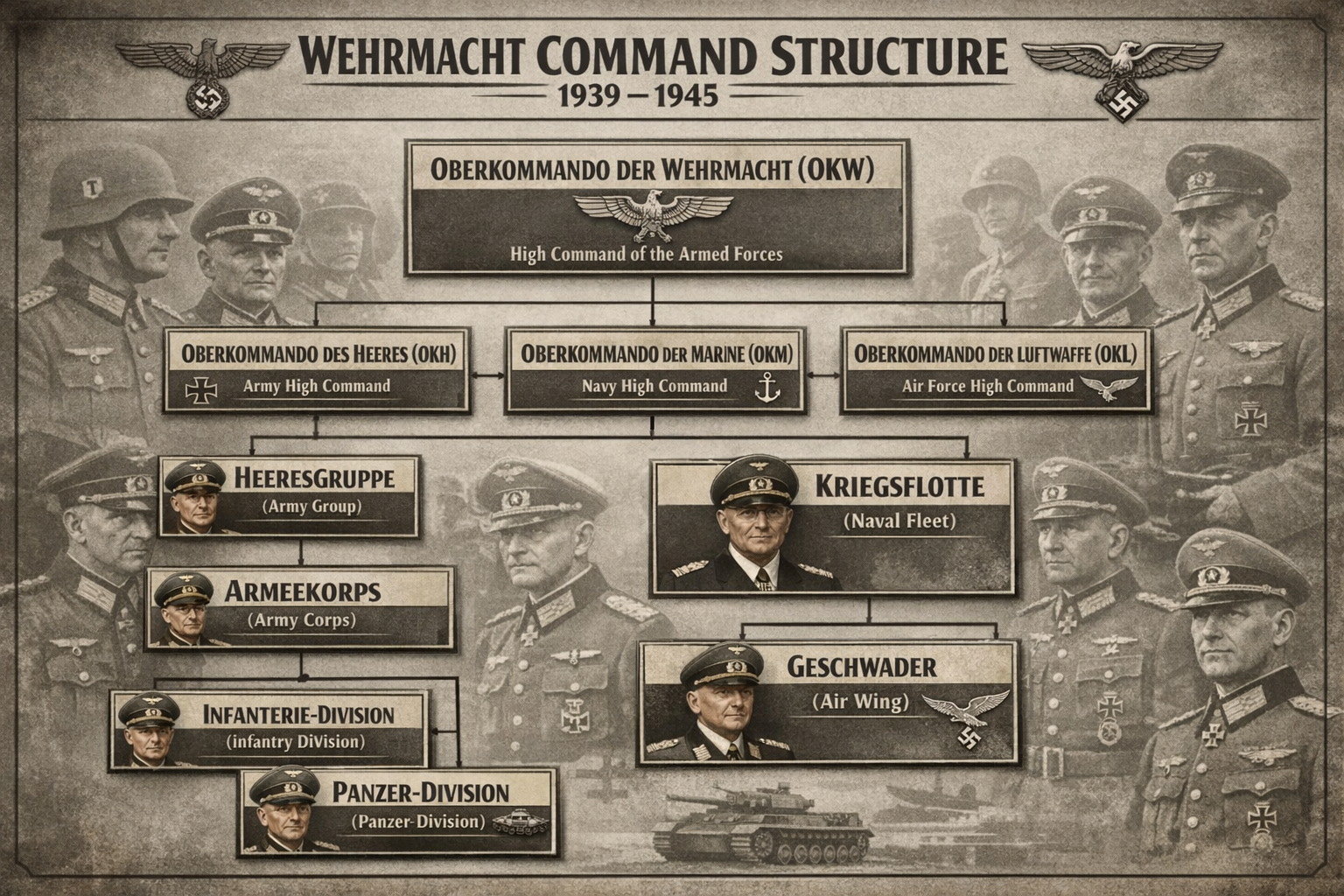
The Wehrmacht’s organizational structure represented a carefully designed system optimizing efficiency and effectiveness. At the apex stood the Oberkommando der Wehrmacht (OKW), which coordinated overall military strategy and resource allocation.
High Command Structure
Oberkommando der Wehrmacht (OKW)
- Supreme military command
- Strategic planning and coordination
- Resource allocation and logistics
Branch Commands
- Oberkommando des Heeres (OKH): Army command
- Oberkommando der Marine (OKM): Naval command
- Oberkommando der Luftwaffe (OKL): Air force command
Operational Organization
The Wehrmacht’s field organization emphasized flexibility and rapid response:
Army Groups: Large formations for major operations
Armies: Primary operational units
Corps: Tactical coordination level
Divisions: Basic combat formations
Regiments/Battalions: Tactical execution units
Training and Professional Development
The Wehrmacht’s effectiveness stemmed largely from comprehensive training programs that emphasized:
🎓 Officer Education: Rigorous military academy programs
🏃 Physical Conditioning: Intensive fitness requirements
🧠 Tactical Training: Realistic combat simulations
🤝 Leadership Development: Cultivating independent decision-making
This systematic approach to military education created a professional officer corps capable of adapting to rapidly changing battlefield conditions.
Logistics and Supply Systems
The Wehrmacht developed sophisticated logistics networks supporting operations across vast distances. Key components included:
- Supply Chain Management: Efficient resource distribution
- Transportation Networks: Rail and motor transport coordination
- Maintenance Systems: Field repair and equipment servicing
- Medical Services: Combat casualty care and evacuation
These systems enabled the Wehrmacht to sustain operations far from German industrial centers, though they would ultimately prove inadequate for the massive scale of the Eastern Front.
Major Campaigns and Military Achievements
Early Victories and Expansion
The powerful German Wehrmacht achieved a series of stunning military victories between 1939 and 1942 that demonstrated the effectiveness of its revolutionary tactics and superior organization. These campaigns reshaped the European political landscape and established Germany as the continent’s dominant military power.
The Polish Campaign (1939)
The Wehrmacht’s first major test came with the invasion of Poland on September 1, 1939. This campaign showcased:
- Blitzkrieg Effectiveness: Rapid penetration of Polish defenses
- Air Superiority: Luftwaffe dominance over Polish aviation
- Combined Operations: Seamless coordination between military branches
- Strategic Encirclement: Classic pincer movements trapping Polish forces
The campaign concluded within five weeks, demonstrating the Wehrmacht’s revolutionary approach to modern warfare.
The Western Campaign (1940)
Perhaps the Wehrmacht’s most impressive achievement was the rapid defeat of France and the Low Countries in 1940. This campaign featured:
Strategic Innovation: The Ardennes breakthrough that bypassed the Maginot Line
Operational Speed: Reaching the English Channel in just ten days
Tactical Superiority: Overwhelming Allied forces through superior coordination
Psychological Impact: Shattering French morale and military confidence
The Eastern Front Operations
The invasion of the Soviet Union in 1941 represented the Wehrmacht’s largest and most ambitious operation. Operation Barbarossa initially achieved remarkable success:
📊 Territorial Gains: Advancing over 400 miles in the first week
🏭 Industrial Disruption: Capturing major Soviet production centers
👥 Prisoner Numbers: Taking millions of Soviet soldiers prisoner
⚡ Speed of Advance: Outpacing Soviet defensive preparations
However, the Eastern Front would ultimately prove to be the Wehrmacht’s greatest challenge and the beginning of its decline.
Mediterranean and North African Operations
The Wehrmacht’s involvement in North Africa and the Mediterranean demonstrated its global reach and adaptability. The Afrika Korps under Erwin Rommel achieved significant successes despite limited resources, showcasing the Wehrmacht’s tactical flexibility and professional competence.
These operations highlighted both the Wehrmacht’s strengths and the limitations imposed by Germany’s strategic overextension across multiple fronts.
Challenges and Ultimate Decline
Strategic Overextension
Despite its early successes, the powerful German Wehrmacht faced insurmountable challenges that would ultimately lead to its defeat. The primary issue was strategic overextension – attempting to fight on multiple fronts simultaneously while lacking the resources for sustained global warfare.
Resource Limitations
Germany’s industrial capacity, while impressive, could not match the combined production of its enemies:
| Resource | Germany | Allied Powers | Ratio |
|---|---|---|---|
| Steel Production | 32 million tons | 89 million tons | 1:2.8 |
| Oil Production | 4 million tons | 234 million tons | 1:58.5 |
| Aircraft Production | 40,000 annually | 167,000 annually | 1:4.2 |
| Tank Production | 27,000 total | 227,000 total | 1:8.4 |
These disparities made long-term victory virtually impossible once the conflict became a war of attrition.
Manpower Constraints
The Wehrmacht faced increasing manpower shortages as the war progressed:
- Casualties: Heavy losses on the Eastern Front
- Multiple Fronts: Forces spread across Europe, North Africa, and the Atlantic
- Quality Decline: Replacement of experienced personnel with hastily trained recruits
- Allied Pressure: Increasing effectiveness of enemy forces
Technological Stagnation
While the Wehrmacht initially enjoyed technological superiority, this advantage eroded as the war progressed. Allied nations, particularly the United States and Soviet Union, rapidly closed the technology gap and began producing superior equipment in greater quantities.
Allied Technological Advances
By 1943-1944, Allied forces had developed:
🛡️ Superior Tank Designs: Sherman, T-34, and other effective armored vehicles
✈️ Air Superiority: Advanced fighters and strategic bombers
📡 Electronic Warfare: Radar and communication technologies
🚢 Naval Dominance: Advanced naval vessels and anti-submarine warfare
Strategic Failures
Several strategic decisions severely weakened the Wehrmacht’s position:
Declaration of War on the United States: Bringing America’s industrial might into the conflict
Failure to Capture Moscow: Missing the opportunity to knock out the Soviet Union quickly
Stalingrad Obsession: Wasting resources on a symbolic rather than strategic objective
Atlantic Wall: Misallocating resources to defensive positions
These decisions reflected fundamental misunderstandings about the nature of modern industrial warfare and the importance of economic resources in sustained conflict.
Legacy and Historical Impact
Military Doctrine Evolution
The powerful German Wehrmacht’s influence on military thinking extends far beyond World War II. Modern military doctrines worldwide incorporate lessons learned from Wehrmacht innovations:
Enduring Tactical Principles
Combined Arms Operations: Integration of different military branches remains fundamental to modern warfare
Mission Command: Decentralized decision-making empowering field commanders
Rapid Deployment: Speed and surprise continue to be crucial tactical elements
Air-Land Integration: Coordination between ground and air forces is standard practice
These principles, refined and adapted for contemporary conditions, form the backbone of military doctrine in 2026.
Technological Legacy
Wehrmacht innovations laid the groundwork for numerous post-war technological developments:
- Jet Propulsion: German jet technology influenced post-war aviation development
- Rocket Technology: V-2 rockets became the foundation for space exploration programs
- Tank Design: German armored vehicle concepts influenced Cold War tank development
- Electronic Systems: Early computer and radar technologies
Many of these innovations continue to influence modern military technology, demonstrating the Wehrmacht’s lasting impact on technological development.
Strategic Lessons
The Wehrmacht’s rise and fall provides crucial insights for modern military planners and political leaders:
Key Strategic Insights
✅ Industrial Capacity Matters: Long-term military success requires adequate industrial support
✅ Coalition Warfare: Fighting multiple powerful enemies simultaneously is extremely difficult
✅ Logistics Are Critical: Supply lines and resource management determine operational sustainability
✅ Technology Alone Isn’t Enough: Superior equipment must be combined with adequate resources and sound strategy
These lessons remain relevant for understanding modern conflicts and strategic planning.
Historical Analysis
Modern historians continue to study the Wehrmacht to understand:
- Operational Art: How military operations are planned and executed
- Civil-Military Relations: The relationship between political leadership and military command
- Technological Innovation: How military technology develops and spreads
- Strategic Decision-Making: The factors that influence high-level military and political choices
This ongoing analysis helps scholars and practitioners better understand the complexities of modern warfare and international relations.
The Wehrmacht’s story serves as both a testament to human organizational capability and a warning about the dangers of unchecked military power. Understanding this history helps contemporary societies make better decisions about military policy, international relations, and the role of armed forces in democratic societies.
Just as researchers today use artificial intelligence to predict political outcomes, military historians continue to analyze Wehrmacht operations to understand patterns of success and failure in large-scale military operations.
Conclusion
The powerful German Wehrmacht represents one of history’s most significant military organizations, whose innovations in tactics, technology, and organization fundamentally changed the nature of modern warfare. From its revolutionary Blitzkrieg doctrine to its sophisticated command structure, the Wehrmacht demonstrated how military excellence could achieve remarkable short-term success even against seemingly overwhelming odds.
However, the Wehrmacht’s ultimate defeat also illustrates crucial lessons about the limitations of military power. Despite tactical brilliance and technological innovation, the Wehrmacht could not overcome the fundamental strategic disadvantages of fighting a multi-front war against enemies with superior industrial capacity and human resources.
For students of military history and strategy in 2026, the Wehrmacht’s legacy offers valuable insights into:
- The importance of combining tactical innovation with strategic wisdom
- The critical role of industrial capacity in modern warfare
- The dangers of strategic overextension and resource limitations
- The enduring value of professional military education and training
Next Steps for Further Learning
To deepen your understanding of this fascinating period in military history, consider these actionable steps:
📚 Read Primary Sources: Examine Wehrmacht field manuals, operational reports, and commander memoirs to understand their thinking and methods
🎥 Study Documentary Materials: Watch historical documentaries and analysis programs that provide visual context for Wehrmacht operations
🗺️ Analyze Campaign Maps: Study detailed maps of major Wehrmacht campaigns to understand their strategic and tactical approaches
🏛️ Visit Museums: Explore military history museums that feature Wehrmacht equipment and exhibits
📖 Explore Academic Research: Read scholarly works by military historians who have analyzed Wehrmacht operations and their broader implications
Understanding the Wehrmacht’s history helps us better comprehend not only World War II but also the evolution of modern military thought and the complex relationship between military capability and political objectives. This knowledge remains relevant for anyone seeking to understand contemporary international relations, military strategy, or the lessons of 20th-century history.



