
On June 6, 1944, over 156,000 Allied soldiers stormed the beaches of Normandy in the largest seaborne invasion in history—but did D-Day decide the war, or was it simply the final nail in Nazi Germany’s coffin? This question has sparked decades of historical debate among scholars, military strategists, and World War II enthusiasts.
The conventional narrative paints D-Day as the decisive turning point that sealed Germany’s fate. Yet a growing number of historians argue that by June 1944, Germany was already on an irreversible path to defeat. The truth behind whether did D-Day decide the war lies somewhere between these perspectives, revealing a complex web of strategic, psychological, and geopolitical factors that shaped the conflict’s outcome.
Understanding D-Day’s true impact requires examining not just what happened on those blood-soaked beaches, but what was already unfolding across the broader theater of World War II. The answer to did D-Day decide the war ultimately determines how we view one of history’s most celebrated military operations.
Key Takeaways
• D-Day opened a crucial second front that forced Germany to divide its already stretched military resources between Eastern and Western Europe
• The Eastern Front was already decisive by 1944, with the Soviet Union inflicting 80% of German military casualties and advancing steadily westward
• D-Day’s primary impact was acceleration – it shortened the war by 6-12 months and prevented total Soviet domination of post-war Europe
• Strategic bombing and resource depletion had already crippled Germany’s war machine before the Normandy landings began
• The operation’s true significance lies in shaping post-war geopolitics rather than determining the war’s ultimate outcome
What Was D-Day? Understanding Operation Overlord
The Basics of History’s Largest Invasion
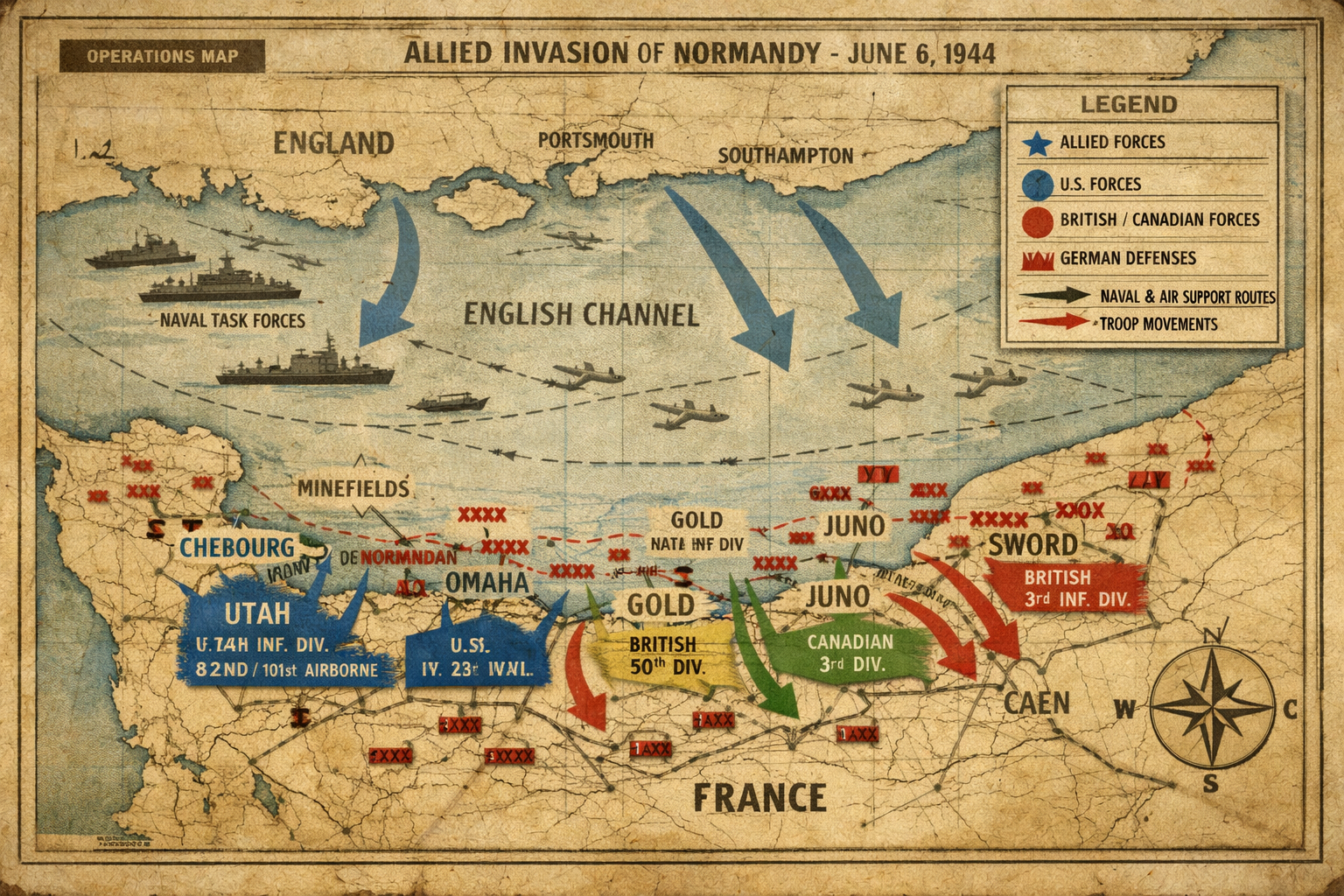
Operation Overlord, commonly known as D-Day, launched on June 6, 1944, when Allied forces executed the largest amphibious invasion in military history. The operation involved coordinated landings across five Normandy beaches: Utah, Omaha, Gold, Juno, and Sword. Over 5,000 ships, 11,000 aircraft, and 156,000 troops participated in the initial assault.
The invasion’s scale was unprecedented. Allied planners had spent two years developing deception operations, including the famous Operation Fortitude, which convinced German commanders that the main invasion would target Pas-de-Calais rather than Normandy. This strategic misdirection proved crucial to the operation’s success.
Key Objectives That Shaped the War’s End
The Allied command established three primary objectives for D-Day:
- Establish a permanent Western Front in continental Europe
- Begin the systematic liberation of Nazi-occupied Western Europe
- Create a direct route for advancing toward Germany’s industrial heartland
These objectives reflected broader strategic goals beyond mere territorial gains. The military strategies that shaped US history demonstrate how D-Day represented the culmination of years of strategic planning and resource allocation.
The operation’s success depended on maintaining the element of surprise, securing adequate supplies through the artificial Mulberry harbors, and establishing air superiority over the invasion beaches. Each factor contributed to answering whether did D-Day decide the war by examining the operation’s immediate and long-term strategic impacts.
Why D-Day Was Strategically Critical
Opening the Western Front 🎯
D-Day’s most immediate strategic impact was forcing Germany to fight a true two-front war. Prior to June 1944, Germany could concentrate the majority of its forces against the Soviet Union while maintaining relatively light defensive positions in Western Europe. The Normandy invasion fundamentally changed this calculus.
Within weeks of the landings, Germany was compelled to transfer significant forces from the Eastern Front to contain the Allied breakout. This redeployment came at a critical moment when the Red Army was launching its massive summer offensive, Operation Bagration, which destroyed an entire German army group.
The Western Front’s establishment also relieved crucial pressure on the Soviet Union. Stalin had repeatedly demanded a second front since 1942, arguing that the Soviet people were bearing the brunt of the war against fascism. D-Day finally delivered on this promise, though some historians argue it came too late to significantly alter the Eastern Front’s trajectory.
Beginning the Liberation of Western Europe
The psychological and political impact of D-Day extended far beyond its immediate military consequences. Paris was liberated within 11 weeks of the Normandy landings, providing a powerful symbol of Nazi Germany’s crumbling empire. The rapid Allied advance through France demonstrated that German defensive capabilities in the west had been fatally compromised.
This liberation process had profound implications for post-war Europe. Without D-Day, the Soviet Union would likely have been the sole liberator of Western European nations, fundamentally altering the continent’s political landscape. The evolution of democracy in post-war Europe was directly influenced by which Allied forces liberated specific territories.
Psychological Warfare and Morale
D-Day delivered a devastating psychological blow to German confidence while simultaneously energizing Allied populations worldwide. German propaganda had promised that Atlantic Wall fortifications would repel any invasion attempt. The successful establishment of Allied beachheads shattered this narrative and exposed the Wehrmacht’s declining capabilities.
Conversely, the operation provided a massive morale boost to resistance movements across occupied Europe. Sabotage activities increased dramatically following D-Day, as local populations gained confidence that liberation was imminent. This psychological dimension often gets overlooked when analyzing whether did D-Day decide the war, yet it played a crucial role in accelerating Germany’s collapse.
The Case for D-Day as the War’s Decisive Moment
Germany Could Not Sustain a Two-Front War
Proponents of D-Day’s decisive importance argue that Germany lacked the resources to fight effectively on multiple fronts simultaneously. By June 1944, the Wehrmacht had already suffered enormous casualties on the Eastern Front—over 3 million dead, wounded, or missing since 1941. Adding a major Western Front stretched German capabilities beyond their breaking point.
The numbers support this argument. Within six months of D-Day, Germany was forced to maintain 59 divisions in Western Europe while simultaneously defending against Soviet offensives that involved over 400 divisions. This force dispersion prevented Germany from concentrating sufficient strength to halt either Allied advance.
Accelerated Timeline to Victory
Without D-Day, the war in Europe would likely have continued well into 1946 or beyond. The Soviet Union, fighting alone against Germany, faced significant logistical challenges in sustaining offensives across Eastern Europe. D-Day shortened the war by an estimated 6-12 months, saving hundreds of thousands of lives and preventing further destruction across Europe.
The operation also ensured that Western Allied forces would participate in Germany’s occupation, preventing total Soviet domination of Central Europe. This outcome proved crucial for post-war stability and the eventual growth of American political culture in Western Europe.
Strategic Bombing Effectiveness
D-Day enabled the Allies to establish advanced airbases in France, dramatically increasing the effectiveness of strategic bombing campaigns against German industry. The shortened distance to targets allowed for more frequent raids with heavier bomb loads, accelerating the destruction of Germany’s war-making capacity.
The Case Against: The War Was Already Decided
The Eastern Front Was the Real Decider
Critics of D-Day’s decisive importance point to the Eastern Front as the war’s true determining factor. By June 1944, the Soviet Union had already inflicted catastrophic defeats on German forces at Stalingrad (1942-1943) and Kursk (1943). These battles eliminated Germany’s offensive capabilities and initiated a steady retreat that continued until Berlin’s fall.
The Battle of Stalingrad marked the beginning of Germany’s irreversible decline. The destruction of the Sixth Army and associated Axis forces eliminated over 800,000 troops—losses that Germany could never fully replace. More importantly, Stalingrad demonstrated that the Wehrmacht was not invincible, shattering the myth of German military superiority.
The Battle of Kursk in summer 1943 represented Germany’s last major offensive operation on the Eastern Front. The failure of Operation Citadel consumed Germany’s strategic reserves and marked the permanent shift to defensive operations. From Kursk onward, the initiative belonged entirely to the Red Army.
Soviet Momentum Was Unstoppable
By 1944, the Red Army was advancing rapidly westward regardless of Western Allied actions. Operation Bagration, launched just weeks after D-Day, destroyed German Army Group Center and advanced Soviet forces 450 miles in five weeks. This offensive demonstrated that the Soviet Union possessed both the capability and momentum to defeat Germany independently.
The statistics are overwhelming: the Soviet Union inflicted approximately 80% of all German military casualties during World War II. The Eastern Front consumed the vast majority of German resources, manpower, and equipment throughout the conflict. Western historians examining what World War II teaches about human strength often underestimate the Eastern Front’s decisive nature.
Allied Strategic Bombing Had Already Crippled Germany
Even before D-Day, Allied bombing campaigns had severely damaged German industrial capacity. The Combined Bomber Offensive, launched in 1943, targeted crucial industries including aircraft production, synthetic fuel plants, and transportation networks. By June 1944, German fuel production had declined by over 60%, severely limiting military operations.
The destruction of Germany’s transportation infrastructure proved particularly decisive. Bombing campaigns against railways, bridges, and canals disrupted the movement of troops, supplies, and raw materials. This logistical strangulation would have eventually paralyzed German resistance regardless of ground operations in Western Europe.
What If D-Day Had Failed? Alternative Scenarios
Delayed Western Allied Involvement
If D-Day had failed catastrophically, forcing a Western Allied withdrawal, the Soviet Union would likely have continued its westward advance alone. Historical analysis suggests that the Red Army possessed sufficient strength to reach the Atlantic coast, though the timeline would have extended significantly.
A failed D-Day might have delayed Allied victory by 12-18 months, allowing the Soviet Union to occupy all of Germany and potentially France. This scenario would have created a dramatically different post-war Europe, with communist governments extending to the Atlantic Ocean.
Different Cold War Dynamics
The geopolitical implications of D-Day’s failure would have fundamentally altered the Cold War’s development. Without Western Allied presence in Central Europe, the United States would have faced a Soviet-dominated continent with vastly different strategic implications for global politics.
This alternative timeline connects to broader patterns in military history, where successful operations often determine not just immediate outcomes but long-term geopolitical arrangements. The question of did D-Day decide the war becomes less important than whether it decided the peace.
Extended War Duration and Casualties
A failed Normandy invasion would have resulted in significantly higher casualties on all sides. Extended fighting would have allowed Germany more time to deploy advanced weapons, including jet aircraft and potentially nuclear weapons if their atomic program had succeeded.
The human cost of delayed victory cannot be understated. Each additional month of war meant continued Holocaust operations, increased civilian casualties from bombing, and prolonged suffering across occupied territories.
What D-Day Really Accomplished
Acceleration Rather Than Determination
The most balanced analysis suggests that D-Day served as a crucial accelerant rather than the war’s determining factor. The operation compressed the timeline of German defeat while ensuring Western Allied participation in victory. This acceleration proved vital for limiting Soviet expansion and shaping post-war European politics.
D-Day’s true significance lies in its strategic timing and geopolitical consequences. The operation occurred at the optimal moment when German forces were fully committed on the Eastern Front, maximizing its impact while minimizing Allied casualties.
Shaping Post-War Europe
Beyond military considerations, D-Day ensured that democratic values would compete with communist ideology in post-war Europe. The presence of Western Allied forces prevented total Soviet domination and created the conditions for NATO’s eventual formation.
The operation’s success also validated Anglo-American military cooperation and strategic planning capabilities. Lessons learned from D-Day influenced subsequent military operations and alliance structures throughout the Cold War period.
Limiting Soviet Expansion
Perhaps D-Day’s most important long-term impact was preventing Soviet control of Western Europe. While the Red Army might have eventually defeated Germany alone, the resulting European map would have looked dramatically different. D-Day ensured that democratic governments could emerge in France, Belgium, Netherlands, and eventually West Germany.
This outcome connects to broader themes about how military strategies shape modern conflicts and the relationship between military success and political objectives.
The Real Answer: D-Day’s True Historical Significance
A Decisive Accelerant, Not a Sole Decider
The question did D-Day decide the war requires a nuanced answer that acknowledges both the operation’s importance and its limitations. D-Day did not single-handedly determine Germany’s defeat, but it played a crucial role in accelerating that defeat while shaping its consequences.
The evidence suggests that Germany was already on an irreversible path to defeat by June 1944. The Eastern Front had consumed the Wehrmacht’s offensive capabilities, strategic bombing had crippled German industry, and resource shortages were becoming critical. However, D-Day transformed a slow strangulation into rapid collapse.
The Importance of Timing and Context
D-Day’s success depended on precise timing within the broader strategic context of World War II. The operation succeeded because it occurred when German forces were fully committed elsewhere, when Allied air superiority was overwhelming, and when German reserves were depleted.
This timing factor explains why earlier cross-channel operations would likely have failed while later operations might have been unnecessary. The strategic lessons from major military operations demonstrate how timing often determines success or failure in complex military campaigns.
Beyond Military Victory to Political Outcome
Ultimately, D-Day’s greatest significance lies in determining how victory would shape the world rather than whether victory would occur. The operation ensured Western Allied participation in Germany’s defeat and occupation, creating the foundation for post-war democratic institutions in Western Europe.
This perspective shifts the focus from purely military analysis to broader questions about war aims and political objectives. D-Day succeeded not just as a military operation but as a geopolitical intervention that shaped the post-war international order.
Conclusion
The question of whether did D-Day decide the war reveals the complexity of historical causation and the danger of oversimplifying pivotal events. While D-Day was undoubtedly one of World War II’s most important operations, it functioned more as a crucial accelerant than as the sole determining factor in Germany’s defeat.
The evidence strongly suggests that Germany was already on an irreversible path to defeat by June 1944. The Eastern Front had consumed the Wehrmacht’s offensive capabilities, strategic bombing had crippled German industry, and resource shortages were becoming critical. The Soviet Union’s momentum appeared unstoppable, with or without Western Allied ground operations in Europe.
However, D-Day’s importance cannot be diminished simply because it didn’t single-handedly decide the war’s outcome. The operation shortened the conflict by 6-12 months, saved hundreds of thousands of lives, and most crucially, ensured that Western democratic values would compete with Soviet communism in shaping post-war Europe.
Perhaps most significantly, D-Day determined not whether the Allies would win, but how that victory would reshape the world. Without the Normandy invasion, Soviet forces might have advanced to the Atlantic, creating a dramatically different Cold War dynamic and potentially preventing the emergence of democratic governments in Western Europe.
The lesson for 2026 and beyond is that historical turning points rarely operate in isolation. D-Day succeeded because it occurred at the precise moment when multiple factors—German weakness, Allied strength, and strategic timing—converged to maximum effect. Understanding this complexity helps us better analyze contemporary conflicts and strategic decisions.
For those seeking to understand World War II’s broader lessons, the key insight is that history is shaped by chains of interconnected events rather than single decisive moments. D-Day didn’t decide the war, but it decided how that victory would shape the world we inhabit today.



