World War I killed over 16 million people and reshaped the global order forever—but mounting evidence suggests this catastrophic conflict was far from inevitable. The question of whether Could WWI Have Been Avoided has captivated historians for over a century, revealing a complex web of diplomatic failures, rigid military planning, and crucial missed opportunities that transformed a regional crisis into humanity’s first global war.
The Great War emerged not from unstoppable historical forces, but from a series of escalating decisions made by fallible leaders under intense pressure. While Europe in 1914 certainly faced significant tensions, the path from a single assassination in Sarajevo to four years of unprecedented carnage was neither predetermined nor unavoidable.
Key Takeaways
• The assassination of Archduke Franz Ferdinand was a spark, not the inevitable cause – it triggered a crisis that could have been contained through different diplomatic responses
• Europe’s rigid alliance system and military mobilization plans created a dangerous domino effect – but leaders still had choices at critical moments to step back from war
• Multiple diplomatic off-ramps existed during the July Crisis of 1914 – different decisions by key leaders could have prevented escalation to world war
• Human error, miscommunication, and fear of appearing weak drove many crucial decisions – suggesting that better leadership might have avoided the conflict entirely
• While war may have been likely given existing tensions, it was not inevitable – the specific timing, scale, and participants of WWI resulted from preventable choices
The Spark That Ignited Europe
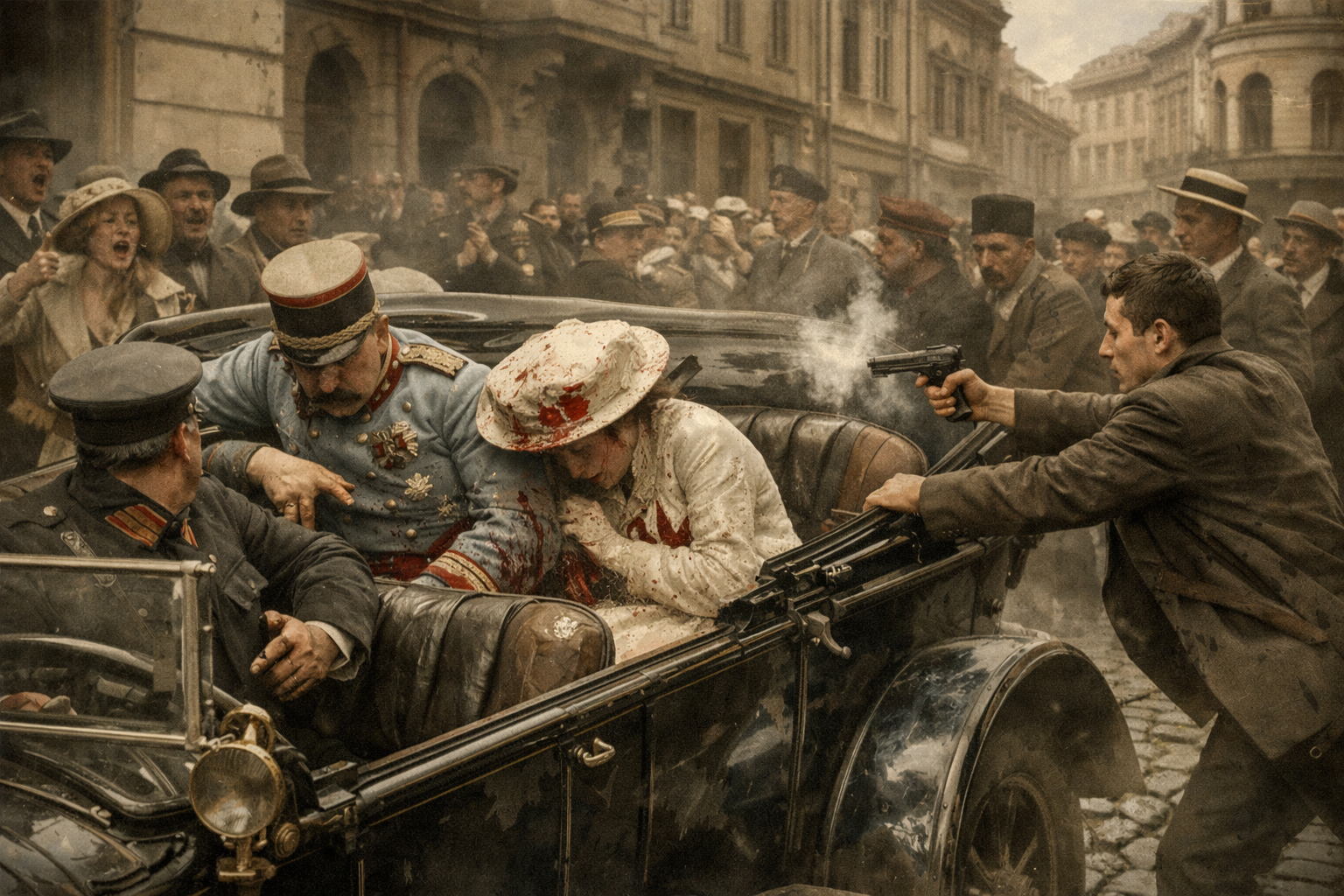
The immediate trigger for World War I came on June 28, 1914, when Gavrilo Princip, a 19-year-old Serbian nationalist, assassinated Archduke Franz Ferdinand of Austria-Hungary in Sarajevo. This single act of terrorism set off a chain reaction that would engulf the world in war within six weeks.
However, the assassination alone did not make world war inevitable. Similar political murders had occurred throughout Europe in previous decades without triggering global conflict. The 1881 assassination of Tsar Alexander II of Russia, the 1894 killing of French President Sadi Carnot, and the 1900 murder of King Umberto I of Italy all failed to spark international wars.
What made 1914 different was Austria-Hungary’s response. Rather than treating the assassination as a criminal act requiring police investigation, Austrian leaders chose to frame it as an act of Serbian state terrorism requiring military retaliation. This decision transformed a tragic but localized incident into an international crisis.
The Austrian government’s ultimatum to Serbia on July 23, 1914 contained deliberately unacceptable demands designed to justify war rather than resolve the crisis diplomatically. When examining whether Could WWI Have Been Avoided, this moment stands out as the first critical juncture where different choices might have prevented escalation.
The Dangerous Foundation: Europe’s Underlying Tensions
The Alliance System: A Recipe for Escalation
By 1914, Europe had divided itself into two opposing alliance blocs that transformed any regional conflict into a potential world war. The Triple Alliance linked Germany, Austria-Hungary, and Italy, while the Triple Entente connected France, Russia, and Britain. These alliances meant that a conflict between any two major powers risked pulling in their allies automatically.
This system created what historians call a “security dilemma” – measures taken by one alliance to increase security inevitably threatened the other side, leading to an escalating cycle of military preparations and diplomatic tensions. The alliance system didn’t cause WWI directly, but it provided the mechanism through which a Balkan crisis could become a global war.
Key Alliance Obligations:
- Germany pledged to support Austria-Hungary against Russia
- France was bound to assist Russia if attacked by Germany
- Britain committed to defend France and Belgium
- Russia promised to protect Serbia’s interests
Militarism and the Arms Race
The decades before 1914 witnessed an unprecedented military buildup across Europe. Germany and Britain engaged in a naval arms race, building increasingly powerful battleships. France and Germany expanded their armies and developed detailed mobilization plans. Russia modernized its military following defeat in the Russo-Japanese War of 1905.
This militarization created rigid war plans that reduced diplomatic flexibility. Germany’s Schlieffen Plan required immediate attack on France through Belgium if war began with Russia. France’s Plan XVII called for immediate offensive action against Germany. Once these mobilization schedules began, military leaders argued they could not be stopped without leaving the nation defenseless.
The question of whether Could WWI Have Been Avoided often hinges on these military timetables. The pressure to mobilize quickly, combined with the difficulty of halting mobilization once begun, severely constrained diplomatic options during the July Crisis.
Nationalism and Imperial Rivalries
Rising nationalism created additional friction, particularly in the volatile Balkans where Slavic peoples sought independence from the Austro-Hungarian Empire. Pan-Slavism in Russia supported these nationalist movements, while Austria-Hungary viewed them as existential threats to its multi-ethnic empire.
Imperial competition for colonies and global influence further strained relationships between European powers. Germany’s challenge to British naval supremacy, competition for influence in the Ottoman Empire, and rival colonial claims in Africa all contributed to an atmosphere of suspicion and hostility.
The Case for Prevention: Yes, WWI Could Have Been Avoided
Diplomatic Solutions Were Available
Multiple diplomatic alternatives existed throughout the July Crisis that could have prevented world war. Austria-Hungary could have accepted Serbia’s conciliatory response to their ultimatum, which agreed to most demands while requesting international arbitration for the most extreme requirements.
Germany held the key to preventing escalation through its relationship with Austria-Hungary. Rather than providing the infamous “blank check” of unconditional support, German leaders could have counseled restraint and pushed for a diplomatic solution. Kaiser Wilhelm II actually attempted this approach briefly but was overruled by his military advisors.
Russia’s mobilization decision proved crucial to the war’s outbreak. Tsar Nicholas II initially ordered only partial mobilization against Austria-Hungary, hoping to pressure Vienna without provoking Germany. However, military leaders convinced him that partial mobilization was impossible, leading to full mobilization that triggered German war plans.
The July Crisis: A Study in Mismanagement
The six weeks between the assassination and the outbreak of war featured a series of miscommunications, assumptions, and rushed decisions that transformed a manageable crisis into catastrophic conflict.
Critical mistakes included:
- Austria-Hungary’s delay in responding to the assassination, allowing tensions to build
- Germany’s failure to restrain its ally during the crisis
- Russia’s decision to support Serbia unconditionally
- Britain’s unclear position until the invasion of Belgium
- France’s encouragement of Russian mobilization
Each of these decisions reflected choices made by individual leaders rather than inevitable historical forces. Different personalities or better communication might have produced different outcomes.
The Mobilization Trap
Military mobilization created a point of no return, but this process was initiated by human decisions, not automatic mechanisms. Leaders chose to prioritize military advice over diplomatic alternatives, often against their own initial instincts.
Tsar Nicholas II and Kaiser Wilhelm II, who were cousins, exchanged personal telegrams trying to prevent war even as their armies mobilized. This “Willy-Nicky correspondence” demonstrates that even at the last moment, leaders recognized alternatives to war existed.
The Inevitability Argument: Why War Seemed Unavoidable
Europe as a Powder Keg
Some historians argue that by 1914, European tensions had reached unsustainable levels that made major war inevitable, if not in 1914 then soon after. The Balkan Wars of 1912-1913 had already demonstrated the region’s instability. The arms race showed no signs of slowing. Imperial competition continued to intensify.
Structural factors supporting inevitability:
- Declining Ottoman Empire created power vacuum
- Austria-Hungary’s internal ethnic tensions threatened stability
- German challenge to British global dominance
- Russian recovery from 1905 revolution increased confidence
- French desire to reclaim Alsace-Lorraine from Germany
The Alliance System as a Trap
The alliance system that was supposed to preserve peace through deterrence instead created automatic escalation mechanisms. Once Austria-Hungary declared war on Serbia, Russian support for Serbia triggered German support for Austria-Hungary, which activated French obligations to Russia and British commitments to France.
This “chain-ganging” effect meant that leaders felt they had no choice but to honor alliance commitments or risk losing credibility and leaving their nations isolated in a dangerous international system.
Expectations of War
Many European leaders and intellectuals expected major war eventually and some even welcomed it as a way to resolve mounting tensions. The German concept of “preventive war” suggested striking Russia before it completed military modernization. Some French leaders saw war as the only way to recover lost territories.
This psychological preparation for war created what historians call a “cult of the offensive” – the belief that aggressive military action would prove decisive and that defensive strategies were futile.
Critical Turning Points: Moments When History Hung in Balance
The Austrian Ultimatum Decision
July 5-6, 1914: Austria-Hungary’s decision to seek German support before acting against Serbia represented the first major escalation. Had Austrian leaders chosen immediate police cooperation with Serbia to investigate the assassination, or accepted international mediation, the crisis might have remained localized.
Germany’s “Blank Check”
July 5, 1914: Germany’s promise of unconditional support to Austria-Hungary removed the main constraint on Austrian action. If Germany had instead counseled moderation and threatened to withdraw support for aggressive action, Austria-Hungary would likely have pursued diplomatic solutions.
The Russian Mobilization Decision
July 30, 1914: Tsar Nicholas II’s decision to authorize full military mobilization triggered German war plans and made conflict nearly inevitable. Had Russia maintained only partial mobilization or delayed the decision for further diplomacy, war might have been averted.
Britain’s Entry Decision
August 4, 1914: Britain’s declaration of war following Germany’s invasion of Belgium transformed a continental conflict into a world war. If Britain had remained neutral initially, Germany might have achieved quick victory in the west, potentially ending the war before it became a global catastrophe.
The Human Element: Leadership Failures Under Pressure
Miscommunication and Assumptions
The July Crisis featured numerous communication failures that worsened the situation. Leaders made assumptions about others’ intentions without verification. Time pressure led to hasty decisions without full consideration of alternatives.
Kaiser Wilhelm II assumed Russia wouldn’t fight for Serbia and that Britain would remain neutral. Tsar Nicholas II believed Germany was bluffing about war. Austrian leaders assumed German support guaranteed success against Russia.
Fear of Appearing Weak
Many crucial decisions reflected leaders’ fears of losing credibility rather than rational calculation of national interests. Austria-Hungary felt it had to respond forcefully to the assassination or risk appearing weak to internal ethnic minorities and external enemies.
Russia couldn’t abandon Serbia without losing influence in the Balkans. Germany couldn’t abandon Austria-Hungary without losing its only reliable ally. These prestige considerations often outweighed practical concerns about the costs of war.
The Pressure of Public Opinion
Nationalist public opinion in many countries pressured leaders toward aggressive action. Austrian newspapers demanded war against Serbia. Russian papers called for support of Slavic brothers. German publications urged support for Austria-Hungary.
However, leaders helped shape this opinion through their own statements and could have chosen to emphasize diplomatic alternatives rather than military solutions.
Alternative History: What If WWI Never Happened?
Political Consequences
Without World War I, the major European empires might have survived much longer. The Austro-Hungarian, German, Russian, and Ottoman empires all collapsed due to wartime pressures. Their survival would have created a very different 20th century.
Potential outcomes:
- Gradual democratic reform rather than revolutionary change
- Different decolonization timeline
- Alternative solutions to ethnic tensions in multi-national empires
- Continued balance of power rather than American global dominance
Economic and Social Impact
The enormous costs of WWI – estimated at over $200 billion in 1919 dollars – could have funded massive infrastructure, education, and social programs instead. The “lost generation” of young men killed in the war would have contributed to economic and cultural development.
Technological development might have followed different paths without wartime pressures driving military innovation. Medical advances, aviation development, and industrial techniques might have evolved more gradually toward civilian rather than military applications.
The Question of Future Conflicts
Would avoiding WWI have prevented World War II? Many historians argue that WWII resulted directly from WWI’s aftermath – the harsh Treaty of Versailles, Russian Revolution, and economic disruption that enabled fascist movements.
However, underlying tensions about fascism and authoritarianism might have manifested differently without the specific grievances created by WWI and its settlement.
The Verdict: Could WWI Have Been Avoided?
The evidence suggests that World War I was highly probable but not inevitable. The combination of alliance systems, military planning, nationalism, and imperial competition created conditions where a major European war was likely to occur eventually.
However, the specific war that began in 1914 resulted from a series of choices made by individual leaders during the July Crisis. Different decisions at key moments could have:
- Localized the Austro-Serbian conflict
- Delayed war until conditions changed
- Produced a different configuration of participants
- Led to a shorter, less devastating conflict
The Role of Contingency
Historical contingency – the role of chance, individual decisions, and unforeseeable events – played a crucial role in WWI’s outbreak. Understanding how human choices shape history helps explain why the war was avoidable despite seeming inevitable in retrospect.
The assassination of Archduke Franz Ferdinand succeeded only because his driver took a wrong turn, putting the car directly in front of Princip after an earlier assassination attempt had failed. This element of chance initiated the entire crisis.
Lessons for Understanding Historical Causation
The question of whether Could WWI Have Been Avoided illustrates important principles about historical causation:
- Multiple factors typically contribute to major historical events
- Individual decisions matter even within larger structural constraints
- Communication and leadership quality can determine outcomes during crises
- Rigid systems (like alliance networks and military plans) reduce flexibility during emergencies
Conclusion
World War I represents one of history’s great tragic ironies – a catastrophic war that few wanted but many felt powerless to prevent. The evidence strongly suggests that different leadership decisions during the July Crisis of 1914 could have avoided the global conflict that reshaped the modern world.
While Europe faced significant tensions that made some form of major conflict likely, the specific war that began in August 1914 resulted from a cascade of preventable choices. Austria-Hungary’s aggressive response to the assassination, Germany’s unconditional support, Russia’s decision to mobilize, and other nations’ failure to restrain their allies all contributed to an avoidable catastrophe.
Understanding why WWI occurred despite being preventable offers crucial lessons for modern international relations. The importance of effective communication during crises, the dangers of rigid alliance systems, and the need for leaders to resist pressure for hasty military action remain relevant today.
The tragedy of World War I lies not just in its devastating human cost, but in the recognition that this “war to end all wars” need never have happened at all. By studying how warfare evolved during this conflict and examining the decisions of history’s military leaders, we gain insights that might help prevent similar catastrophes in the future.
Your next step: Explore how the lessons of WWI’s avoidable outbreak apply to modern international crises. Consider how better diplomatic communication, flexible alliance structures, and resistance to military timetables might prevent future conflicts that seem inevitable but remain preventable through wise leadership and careful decision-making.