At their peak, the British Empire controlled nearly 25% of the world’s landmass and population—but it wasn’t the only superpower to dominate vast territories and millions of people. Throughout history, extraordinary civilizations have risen to command continents, reshape cultures, and leave permanent marks on human civilization. These Most Powerful Empires Ever didn’t just conquer land; they transformed the very fabric of society, economics, and governance across the globe.
Power in historical empires came from multiple sources: territorial control, military supremacy, economic dominance, and cultural influence. Some empires excelled through innovative military tactics, others through sophisticated administration, and many through strategic geographic positioning that controlled vital trade routes.
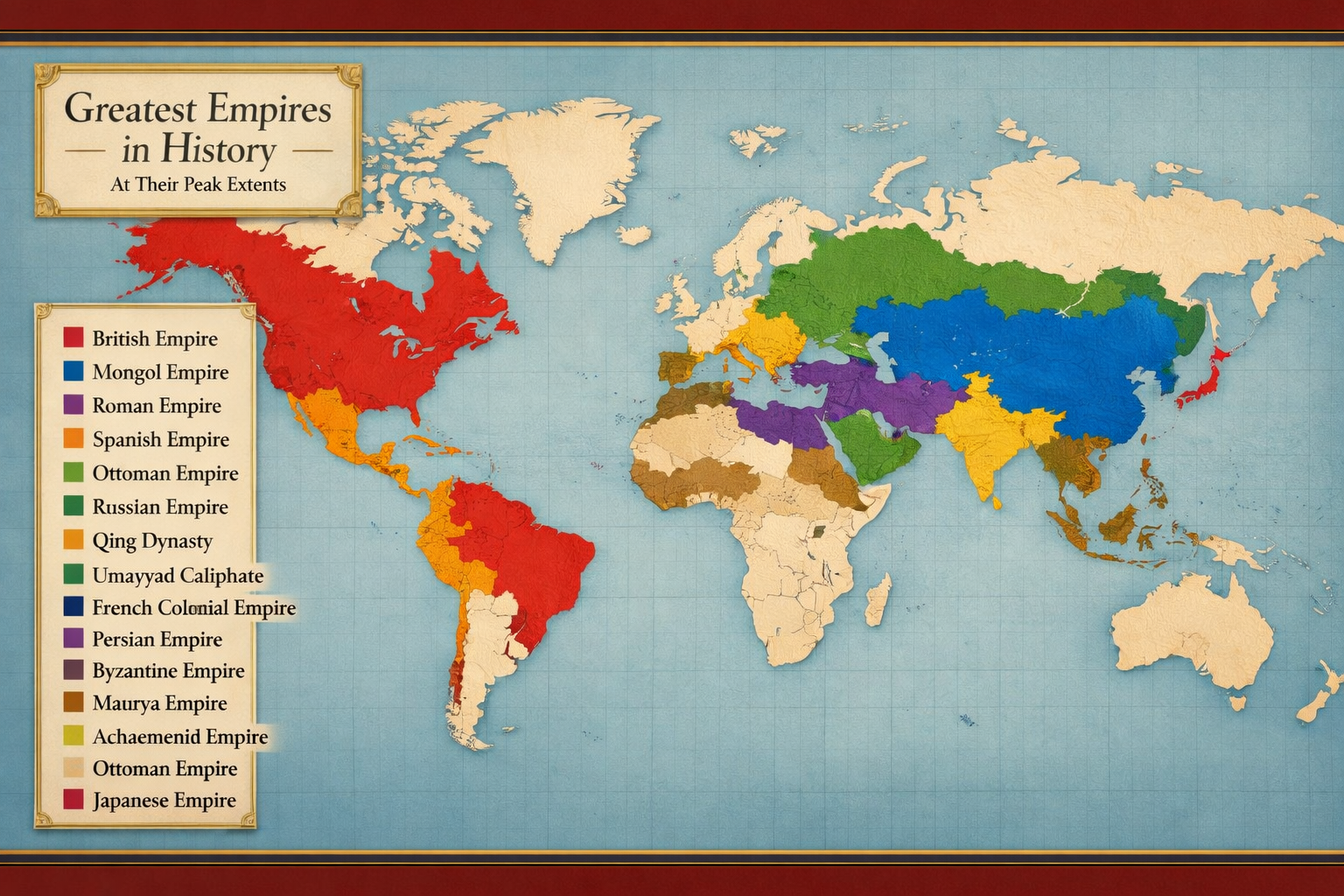
This comprehensive examination reveals the 15 Most Powerful Empires Ever that dominated their eras and continue to influence our world today. From the vast steppes controlled by Mongol horsemen to the global maritime networks of European colonial powers, these civilizations represent the pinnacle of human organization and ambition.
Key Takeaways
• The British Empire remains the largest empire in history, controlling 35.5 million square kilometers at its peak
• Military innovation and mobility enabled the Mongol Empire to create the largest contiguous land empire ever
• Geographic positioning and control of trade routes were crucial factors in imperial success
• Administrative efficiency and cultural tolerance often determined an empire’s longevity
• Overexpansion and internal conflicts were primary causes of imperial decline across all civilizations
The British Empire (1583-1997): The Sun Never Sets
The British Empire stands as the most extensive empire in human history, spanning 35.5 million square kilometers and governing over 400 million people at its 1920s peak. This maritime superpower controlled territories on every continent, earning the famous phrase “the empire on which the sun never sets.”
What Made It Powerful:
- Naval supremacy: The Royal Navy dominated global seas for centuries
- Industrial Revolution: Britain’s early industrialization provided technological advantages
- Strategic colonies: Control of India, Canada, Australia, and numerous islands
- Economic networks: Global trade systems and financial institutions
The British Empire’s strength lay in its ability to project power across vast oceanic distances. The East India Company initially established British presence in Asia, while settler colonies in North America and Australia provided resources and strategic bases. The empire’s administrative system, though often exploitative, created lasting governmental and legal frameworks still used today.
Decline Factors:
The empire began fragmenting after World War II due to economic exhaustion, rising nationalism in colonies, and changing global power dynamics. India’s independence in 1947 marked the beginning of rapid decolonization, though British cultural and linguistic influence persists globally.
The Mongol Empire (1206-1368): Masters of the Steppes
Under Genghis Khan and his successors, the Mongol Empire became the largest contiguous land empire in history, stretching 24 million square kilometers from Eastern Europe to the Pacific Ocean. This nomadic confederation revolutionized warfare and connected East and West through unprecedented trade networks.
What Made It Powerful:
- Superior cavalry tactics: Mongol horsemen were unmatched in mobility and archery
- Psychological warfare: Reputation for ruthlessness often led to surrender without battle
- Adaptability: Absorbed technologies and administrative practices from conquered peoples
- Communication systems: The Yam postal relay system enabled efficient long-distance governance
The Mongols succeeded through remarkable military organization and strategic flexibility. They conquered the Jin Dynasty, Khwarazmian Empire, and reached into Europe, defeating Polish and Hungarian armies. Their military strategies influenced warfare for centuries.
Cultural Impact:
Despite their fearsome reputation, Mongols promoted religious tolerance and cultural exchange along the Silk Road. They facilitated unprecedented trade between Asia and Europe, spreading technologies, ideas, and diseases that reshaped both continents.
The Roman Empire (27 BC – 1453 AD): Eternal City’s Legacy
The Roman Empire controlled the Mediterranean world for over a millennium, governing territories from Britain to Mesopotamia. At its peak under Emperor Trajan (117 AD), Rome commanded 5 million square kilometers and 65 million people through sophisticated military organization and administrative genius.
What Made It Powerful:
- Professional legions: Disciplined, well-equipped armies with standardized training
- Engineering excellence: Roads, aqueducts, and fortifications that lasted centuries
- Legal systems: Roman law became the foundation for Western legal traditions
- Cultural assimilation: Integration of conquered peoples through citizenship and romanization
Rome’s success stemmed from its ability to absorb and integrate diverse cultures while maintaining military superiority. The Roman road network facilitated rapid troop movement and trade, while standardized currency and legal systems unified diverse territories. The empire’s impact on governance continues influencing modern nations.
Administrative Innovation:
Roman bureaucracy created efficient provincial governance, allowing local customs while enforcing imperial authority. The extension of citizenship to conquered peoples created loyalty and reduced rebellion, a strategy later empires attempted to replicate.
The Ottoman Empire (1299-1922): Bridge Between Continents
The Ottoman Empire dominated southeastern Europe, western Asia, and northern Africa for over six centuries, controlling crucial trade routes between Europe and Asia. At its 17th-century zenith, the empire spanned 5.2 million square kilometers and threatened European capitals.
What Made It Powerful:
- Strategic location: Control of Bosphorus strait and eastern Mediterranean trade
- Janissary corps: Elite infantry units recruited through devshirme system
- Religious tolerance: Millet system allowed religious communities self-governance
- Naval power: Dominated Mediterranean and Black Sea regions
The Ottomans succeeded through military innovation, including early adoption of gunpowder weapons and artillery. Their siege of Constantinople in 1453 marked the end of the Byzantine Empire and established Ottoman dominance in the eastern Mediterranean. The empire’s administrative flexibility allowed diverse populations to coexist while contributing to imperial strength.
Economic Foundation:
Ottoman control of trade routes between Asia and Europe generated enormous wealth. The empire’s position allowed it to tax goods flowing between continents, funding military expansion and architectural projects that still define Istanbul’s skyline.
The Spanish Empire (1492-1976): First Global Empire
The Spanish Empire became the first truly global empire, controlling territories across four continents and establishing the foundation for European colonialism. At its peak in the 18th century, Spanish territories covered 20 million square kilometers, making it one of the largest empires in history.
What Made It Powerful:
- Maritime exploration: Advanced navigation and shipbuilding technologies
- Colonial wealth: Massive silver and gold extraction from the Americas
- Religious motivation: Catholic missionary zeal provided ideological unity
- Military technology: Superior weapons and horses against indigenous peoples
Spain’s empire began with Columbus’s 1492 voyage and expanded rapidly through conquistador expeditions. The conquest of Aztec and Inca empires provided unprecedented wealth that funded European wars and global expansion. Spanish galleons carried American silver across the Pacific to Manila, creating the first global trade network.
Cultural Legacy:
Spanish colonization spread the Spanish language and Catholic Christianity across the Americas. The encomienda system, though exploitative, created administrative frameworks that influenced Latin American governance for centuries. Modern Spanish-speaking nations still reflect colonial administrative boundaries and cultural patterns.
The Persian Empire (550-331 BC): First Superpower
The Persian Empire, founded by Cyrus the Great, became the ancient world’s largest empire, stretching 5.5 million square kilometers from India to Greece. This Achaemenid dynasty created the first multi-ethnic empire with sophisticated administrative systems that influenced later civilizations.
What Made It Powerful:
- Administrative efficiency: Satrap system provided local governance with central oversight
- Cultural tolerance: Respect for local customs and religions reduced rebellion
- Royal Road: 2,700-kilometer highway system enabled rapid communication
- Professional military: Combined Persian cavalry with infantry from subject peoples
The Persians succeeded through innovative governance rather than just military conquest. Cyrus’s cylinder, often called the first charter of human rights, proclaimed religious freedom and cultural tolerance. This approach created loyalty among diverse populations and reduced administrative costs compared to oppressive rule.
Technological Innovation:
Persian engineering achievements included qanat irrigation systems and impressive architectural projects like Persepolis. The empire’s road network and postal system influenced later Roman and Islamic administrative practices, demonstrating how powerful societies could maintain control through infrastructure rather than force alone.
The Chinese Empire (221 BC – 1912 AD): Middle Kingdom’s Continuity
The Chinese Empire, beginning with Qin unification, represents the world’s longest continuous imperial tradition, spanning over two millennia. Various dynasties controlled territories ranging from 3 to 11 million square kilometers, governing the world’s largest population through sophisticated bureaucratic systems.
What Made It Powerful:
- Technological innovation: Gunpowder, printing, compass, and paper
- Bureaucratic meritocracy: Civil service examinations based on Confucian classics
- Agricultural productivity: Advanced farming techniques supported large populations
- Cultural unity: Shared writing system and philosophical traditions
Chinese empires succeeded through administrative sophistication and technological advancement. The Mandate of Heaven provided ideological justification for imperial rule, while Confucian bureaucracy created efficient governance. The Great Wall symbolized Chinese defensive capabilities, though the empire’s true strength lay in cultural cohesion and economic productivity.
Global Influence:
Chinese innovations spread globally through trade networks. The Tang and Ming dynasties projected power across Asia, while Chinese cultural influence shaped neighboring civilizations. The tribute system created diplomatic networks that acknowledged Chinese superiority while maintaining regional stability.
The French Empire (1804-1814, 1852-1870): Napoleon’s Legacy
The French Empire under Napoleon Bonaparte briefly dominated Europe and established a second colonial empire that lasted into the 20th century. At its peak, Napoleonic France controlled much of continental Europe, while the later colonial empire spanned 12 million square kilometers.
What Made It Powerful:
- Military genius: Napoleon’s tactical innovations revolutionized warfare
- Administrative reform: Napoleonic Code influenced legal systems worldwide
- Revolutionary ideology: Concepts of nationalism and popular sovereignty
- Colonial expansion: Strategic territories in Africa, Asia, and the Pacific
Napoleon’s empire succeeded through military brilliance and administrative efficiency. The Grande Armée’s mobility and artillery tactics defeated traditional European armies, while the Continental System attempted to economically isolate Britain. French revolutionary ideals inspired nationalist movements across Europe, though they eventually contributed to Napoleon’s downfall.
Lasting Impact:
The Napoleonic Code became the foundation for legal systems in numerous countries. French colonial influence in Africa and Indochina created lasting linguistic and cultural connections, while Napoleon’s administrative reforms influenced modern European governance structures.
The Russian Empire (1721-1917): Expansion Across Eurasia
The Russian Empire became the world’s largest contiguous empire after the Mongols, spanning 22.8 million square kilometers across Europe, Asia, and North America. This autocratic state expanded steadily for centuries, controlling territories from Poland to Alaska.
What Made It Powerful:
- Geographic advantages: Harsh climate hindered invaders
- Military expansion: Gradual conquest of neighboring territories
- Natural resources: Vast forests, minerals, and agricultural land
- Autocratic control: Centralized authority under the Tsar
Russia’s empire grew through systematic expansion rather than rapid conquest. The conquest of Siberia provided enormous resources and strategic depth, while expansion into Central Asia and the Caucasus created buffer zones against potential enemies. Russian serfdom provided agricultural labor, though it eventually became an economic liability.
Strategic Depth:
Russia’s enormous size became its greatest defensive asset. Napoleon’s 1812 invasion and Hitler’s 1941 attack both failed partly due to Russian winter and vast distances. This geographic advantage allowed Russia to trade space for time while mobilizing resources for counterattacks.
The Umayyad Caliphate (661-750 AD): Rapid Islamic Expansion
The Umayyad Caliphate created one of history’s most rapidly expanding empires, stretching 15 million square kilometers from Spain to Central Asia within a century. This Islamic empire unified diverse populations under religious and political authority, creating lasting cultural and architectural legacies.
What Made It Powerful:
- Religious motivation: Islamic faith provided unity and expansion drive
- Military mobility: Fast-moving cavalry armies
- Administrative adaptation: Incorporated Byzantine and Persian governmental systems
- Trade networks: Control of lucrative commercial routes
The Umayyads succeeded through combining religious zeal with practical governance. Arab armies conquered the Sassanid Empire and much of the Byzantine Empire, while expansion into North Africa and Spain created a Mediterranean Islamic empire. The caliphate’s administrative system balanced Arab leadership with local administrative traditions.
Cultural Synthesis:
Umayyad rule facilitated cultural exchange between conquered peoples. Islamic architecture, science, and philosophy flourished through synthesis of Greek, Persian, and Indian traditions. The Arabic language became a unifying force across diverse territories, creating lasting linguistic influence.
The Aztec Empire (1428-1521): Mesoamerican Powerhouse
The Aztec Empire dominated central Mexico through a sophisticated tribute system and military organization. Controlling approximately 200,000 square kilometers and 15 million people, this Mesoamerican empire created impressive urban centers and agricultural innovations before Spanish conquest.
What Made It Powerful:
- Tribute system: Systematic extraction of wealth from subject peoples
- Military organization: Warrior societies and advanced weaponry
- Agricultural innovation: Chinampas (floating gardens) supported large populations
- Urban planning: Tenochtitlan rivaled contemporary European cities
The Aztecs built their empire through military conquest and diplomatic alliances. The Triple Alliance between Tenochtitlan, Texcoco, and Tlacopan created a power base for expansion across central Mexico. Aztec military tactics and weapons proved effective against regional enemies, though they couldn’t match Spanish firearms and cavalry.
Technological Achievements:
Aztec engineering created impressive architectural projects and agricultural systems. Tenochtitlan’s causeways, canals, and temples amazed Spanish conquistadors, while chinampas agriculture supported dense urban populations. Aztec astronomical knowledge and calendar systems demonstrated sophisticated mathematical understanding.
The Inca Empire (1438-1572): Masters of the Andes
The Inca Empire (Tawantinsuyu) became the largest empire in pre-Columbian America, stretching 2 million square kilometers along the Andes Mountains. This highly organized state governed 12 million people through sophisticated administrative and engineering systems.
What Made It Powerful:
- Road networks: 40,000 kilometers of mountain highways
- Administrative efficiency: Decimal-based organizational system
- Agricultural terracing: Maximized food production in mountainous terrain
- Cultural integration: Quechua language and religious practices
The Incas succeeded through remarkable organizational abilities and engineering expertise. The road system enabled rapid communication and troop movement across difficult terrain, while agricultural terraces and storage systems prevented famine. The mit’a labor system mobilized population for public works projects.
Engineering Marvels:
Inca architecture and engineering remain impressive today. Machu Picchu and other sites demonstrate sophisticated stone-cutting techniques, while the road system rivals Roman engineering achievements. Inca agricultural terraces still support Andean communities, showing the lasting value of their innovations.
The Byzantine Empire (330-1453 AD): Rome’s Eastern Heir
The Byzantine Empire preserved Roman imperial traditions for over a millennium after the Western Empire’s fall. Controlling territories around the eastern Mediterranean, this Christian empire maintained Greek culture and Orthodox Christianity while adapting to changing political circumstances.
What Made It Powerful:
- Strategic location: Constantinople controlled trade between Europe and Asia
- Diplomatic skill: Complex alliances and political maneuvering
- Cultural preservation: Maintained Greek and Roman knowledge
- Military adaptation: Greek fire and professional armies
Byzantium succeeded through diplomatic flexibility and strategic positioning. Constantinople’s location made it nearly impregnable while controlling lucrative trade routes. Byzantine diplomacy balanced relationships with western European powers, Islamic caliphates, and various barbarian groups through complex alliance systems.
Cultural Legacy:
The Byzantine Empire preserved classical Greek and Roman texts that might otherwise have been lost. Orthodox Christianity spread through Byzantine influence to Russia and the Balkans, creating lasting religious and cultural connections. Byzantine art and architecture influenced both Islamic and Western European traditions.
The Maurya Empire (322-185 BC): India’s First Empire
The Maurya Empire unified most of the Indian subcontinent for the first time, controlling 5 million square kilometers under Chandragupta Maurya and his successors. This centralized state created administrative systems that influenced Indian governance for centuries.
What Made It Powerful:
- Military organization: Large armies with elephants, cavalry, and infantry
- Administrative efficiency: Sophisticated bureaucracy and taxation
- Economic control: Regulation of trade and agriculture
- Cultural patronage: Support for Buddhism and other religious traditions
The Mauryas succeeded through combining military conquest with administrative innovation. Chandragupta’s alliance with Chanakya (Kautilya) created governmental systems described in the Arthashastra. Emperor Ashoka’s conversion to Buddhism after the Kalinga War demonstrated how powerful revolutions in thinking could transform imperial policy.
Religious Influence:
Under Ashoka, the Maurya Empire became a major patron of Buddhism, spreading the religion across Asia. Ashoka’s edicts, carved on rocks and pillars throughout the empire, promoted religious tolerance and moral governance. This approach influenced later Indian rulers and demonstrated alternatives to purely military-based imperial control.
The Japanese Empire (1868-1947): Rising Sun’s Ambitions
The Japanese Empire rapidly modernized during the Meiji Restoration and became a major Pacific power within decades. At its peak during World War II, Japanese territories spanned 8.5 million square kilometers across the Pacific, demonstrating how quickly industrial modernization could create imperial power.
What Made It Powerful:
- Rapid industrialization: Meiji reforms transformed feudal society
- Military modernization: Advanced naval and air forces
- Strategic expansion: Control of key Pacific islands and resources
- Cultural unity: Emperor worship and bushido ideology
Japan succeeded through systematic adoption of Western technology while maintaining cultural identity. The Meiji Restoration created modern governmental, educational, and military institutions that enabled rapid economic growth. Japanese expansion into Korea, Manchuria, and Southeast Asia sought resources and strategic depth for the island nation.
Technological Innovation:
Japanese industrial development emphasized military technology and heavy industry. The Zero fighter and advanced naval vessels demonstrated Japanese engineering capabilities, while efficient production methods supported sustained warfare. However, resource limitations and overextension ultimately led to imperial collapse.
What Made These Most Powerful Empires Ever Dominate History
The Most Powerful Empires Ever shared several crucial characteristics that enabled their rise to dominance. Understanding these common factors reveals why certain civilizations achieved unprecedented power while others remained regional forces.
Strong Leadership and Vision
Exceptional leaders like Alexander, Caesar, Genghis Khan, and Napoleon provided the vision and organizational ability necessary for imperial expansion. These figures combined military genius with administrative skill, creating institutions that outlasted their personal rule.
Military Innovation and Superiority
Technological or tactical advantages often determined imperial success. Roman legions, Mongol cavalry, British naval power, and Spanish firearms provided decisive advantages over enemies. Military innovation required not just weapons but also training, logistics, and strategic thinking.
Economic Foundations
Sustainable empires required strong economic bases. British industrial production, Spanish American silver, Chinese agricultural surplus, and Roman trade networks provided the wealth necessary for military expansion and administrative control. Economic strength enabled empires to maintain large armies and bureaucracies.
Geographic Advantages
Strategic locations often determined imperial potential. Britain’s island position, Constantinople’s control of trade routes, China’s river valleys, and Rome’s Mediterranean centrality provided natural advantages that skilled leaders could exploit for expansion.
Cultural and Administrative Flexibility
Successful empires often absorbed rather than destroyed conquered cultures. Persian tolerance, Roman citizenship extension, and Chinese bureaucratic adaptation created loyalty among diverse populations while reducing administrative costs.
Why Even the Most Powerful Empires Ever Eventually Fall
Despite their enormous strength, all empires eventually decline and fall. Understanding these patterns reveals the inherent challenges of maintaining imperial power across vast territories and diverse populations.
Overexpansion and Resource Strain
Many empires collapsed under the weight of their own success. Roman frontiers became too extensive to defend effectively, while Napoleon’s empire stretched French resources beyond sustainable limits. The costs of maintaining control over vast territories often exceeded the benefits of conquest.
Internal Conflicts and Succession Crises
Imperial succession frequently created civil wars that weakened central authority. The Mongol Empire fragmented after Möngke Khan’s death, while Roman civil wars repeatedly devastated the empire’s strength. Succession disputes allowed external enemies to exploit internal divisions.
Economic Decline and Fiscal Crisis
Empires required enormous resources for military and administrative expenses. Spanish inflation from American silver, Ottoman fiscal crises, and British post-war debt demonstrated how economic problems could undermine imperial power. Taxation often created resentment among subject populations.
External Pressures and Military Challenges
New military technologies or tactics could rapidly obsolete imperial advantages. Gunpowder weapons undermined traditional cavalry superiority, while industrial warfare required resources many empires couldn’t match. Rising powers often challenged established empires with superior organization or technology.
Nationalism and Independence Movements
The spread of nationalist ideologies, often ironically promoted by empires themselves, eventually undermined imperial control. French revolutionary concepts, British education systems, and improved communications allowed subject peoples to organize resistance movements that empires couldn’t suppress indefinitely.
The Lasting Impact of History’s Most Powerful Empires Ever
The Most Powerful Empires Ever continue shaping our modern world through their political, cultural, and technological legacies. Contemporary nations, international borders, legal systems, and cultural practices often reflect imperial influences that persist centuries after these empires fell.
Modern Political Boundaries
Many current national borders originated from imperial administrative divisions. British colonial boundaries created modern India, Pakistan, and numerous African nations, while Spanish colonial administration influenced Latin American countries. Ottoman provincial divisions affected Middle Eastern borders, demonstrating how imperial organization creates lasting political structures.
Language and Cultural Diffusion
Imperial expansion spread languages, religions, and cultural practices across continents. English became a global lingua franca through British imperial influence, while Spanish and Portuguese colonization created the modern Hispanic world. Arabic spread through Islamic conquests, and Chinese characters influenced East Asian writing systems.
Legal and Governmental Systems
Roman law provided foundations for European legal traditions, while British common law influenced former colonial territories. The Napoleonic Code shaped legal systems worldwide, and Chinese bureaucratic traditions influenced East Asian governance. These imperial legacies continue affecting how modern nations organize their governments and legal systems.
Technological and Scientific Knowledge
Empires facilitated knowledge transfer between different civilizations. Islamic empires preserved and transmitted Greek scientific knowledge, while Chinese innovations spread through Mongol trade networks. European colonial empires, despite their exploitative nature, created global communication networks that accelerated scientific and technological exchange.
Economic and Trade Patterns
Imperial trade networks established economic relationships that persist today. The Silk Road connected Asia and Europe, while Atlantic trade triangles linked Europe, Africa, and the Americas. These imperial economic patterns influenced modern global trade relationships and economic development patterns.
Which Empire Was Truly the Most Powerful?
Determining the single Most Powerful Empire Ever requires weighing different measures of imperial strength. Size, duration, influence, and military capability all provide valid criteria, but they often point toward different conclusions.
By Territorial Control
The British Empire controlled the largest total area (35.5 million km²), while the Mongol Empire held the largest contiguous territory (24 million km²). The Russian Empire eventually surpassed Mongol territorial extent, demonstrating how geographic expansion could continue for centuries under favorable conditions.
By Population and Economic Impact
The Chinese Empire governed the world’s largest population for most of its existence, while the British Empire controlled global trade networks during the Industrial Revolution. Roman economic integration of the Mediterranean created prosperity that wasn’t matched for centuries after the empire’s fall.
By Military Innovation and Conquest Speed
The Mongol Empire achieved the fastest expansion in history, conquering vast territories within decades. Alexander’s empire, though short-lived, demonstrated unprecedented military genius, while Napoleon’s tactical innovations influenced warfare for generations.
By Cultural and Lasting Influence
The Roman Empire’s legal, governmental, and cultural influences persist most strongly in modern Western civilization. Chinese imperial traditions shaped East Asian culture for millennia, while Islamic empires created lasting religious and cultural patterns across Africa and Asia.
The Verdict: Multiple Measures of Power
Rather than identifying a single “most powerful” empire, it’s more accurate to recognize that different empires excelled in different aspects of power. The British Empire achieved the greatest global reach, the Mongols demonstrated unmatched military expansion, Rome created the most lasting institutional legacies, and China maintained the longest continuous imperial tradition.
Each empire’s power reflected its historical context, available technologies, and geographic opportunities. Modern nations can learn from both the successes and failures of these imperial predecessors, understanding how power can be built, maintained, and ultimately lost through changing circumstances and internal developments.
Conclusion
The Most Powerful Empires Ever demonstrate humanity’s remarkable capacity for organization, conquest, and cultural creation. From the Mongol horsemen who connected continents to the British naval networks that created the first global economy, these civilizations achieved unprecedented power through military innovation, administrative genius, and strategic vision.
Yet their eventual decline reveals the inherent challenges of maintaining imperial control across diverse populations and vast territories. Overexpansion, internal conflicts, economic strain, and rising nationalism repeatedly undermined even the mightiest empires. These patterns offer valuable lessons for understanding both historical developments and contemporary global power dynamics.
The legacies of these empires continue shaping our modern world through political boundaries, cultural practices, legal systems, and economic relationships. Understanding their rise and fall provides crucial insights into how power operates across different societies and historical periods.
For those interested in exploring more about historical power and influence, consider examining how powerful societies failed due to poor leadership or learning about brilliant military commanders who shaped these imperial legacies.
The greatest empires didn’t just conquer territory—they created lasting changes that continue influencing human civilization centuries after their fall, proving that true power lies not just in military might, but in the ability to transform the world itself.