
World War I killed more people in four years than any conflict before it—yet most of what we think we know about the Great War barely scratches the surface. Beyond the familiar images of muddy trenches and gas masks lies a conflict so bizarre, innovative, and transformative that it reads more like science fiction than history.
These surprising facts about WWI reveal a war that was stranger, deadlier, and more revolutionary than textbooks typically portray. From underground cities to Christmas truces, from failed predictions to technological breakthroughs that changed warfare forever, the First World War was full of moments that defied expectations and altered the course of human civilization.
The conflict that was supposed to end all wars instead became the laboratory where modern warfare was born—and where the seeds of future conflicts were planted.
Key Takeaways
• WWI introduced revolutionary military technologies including tanks, aircraft combat, and chemical weapons that transformed warfare permanently
• The war’s human cost was staggering with minimal territorial gains, challenging traditional military strategies and tactics
• A single assassination triggered a global conflict through complex alliance systems that pulled entire empires into war
• The peace treaty that ended WWI contained provisions that directly contributed to the outbreak of World War II
• Soldiers created elaborate underground civilizations in trench systems that became permanent communities during the four-year stalemate
The Assassination That Changed Everything
The surprising facts about WWI begin with its origin story. On June 28, 1914, a 19-year-old Serbian nationalist named Gavrilo Princip fired two shots in Sarajevo that would ultimately kill 17 million people. The assassination of Archduke Franz Ferdinand wasn’t even supposed to succeed—Princip only got his chance because the Archduke’s driver took a wrong turn and stopped the car directly in front of the young assassin.
Why this matters: One moment of opportunity, one wrong turn, and one teenager with a pistol triggered the most devastating conflict in human history up to that point. The intricate web of European alliances meant that Austria-Hungary’s declaration of war on Serbia pulled in Russia, Germany, France, and Britain within weeks.
This demonstrates how fragile the balance of power was in 1914 Europe, where political tensions and alliances created a powder keg waiting for the smallest spark.
The War Everyone Thought Would End by Christmas
Military leaders, politicians, and citizens across Europe shared a dangerous delusion in August 1914: this would be a short war. Kaiser Wilhelm II told German troops they would be “home before the leaves fall.” French soldiers packed light, expecting to march into Berlin within months. British recruitment posters promised adventure and glory in what seemed like it would be a brief, decisive conflict.
The shocking reality: The war lasted 1,568 days—over four brutal years. What military strategists expected to resolve in months became the longest, most destructive stalemate in military history. The impact of wars on modern history shows how dramatically these miscalculations shaped the 20th century.
This massive miscalculation occurred because military leaders were still thinking in terms of 19th-century warfare, where armies met in decisive battles and wars ended with clear victories. They hadn’t anticipated how new technologies would create defensive advantages that made quick victories nearly impossible.
Underground Cities Beneath the Battlefields
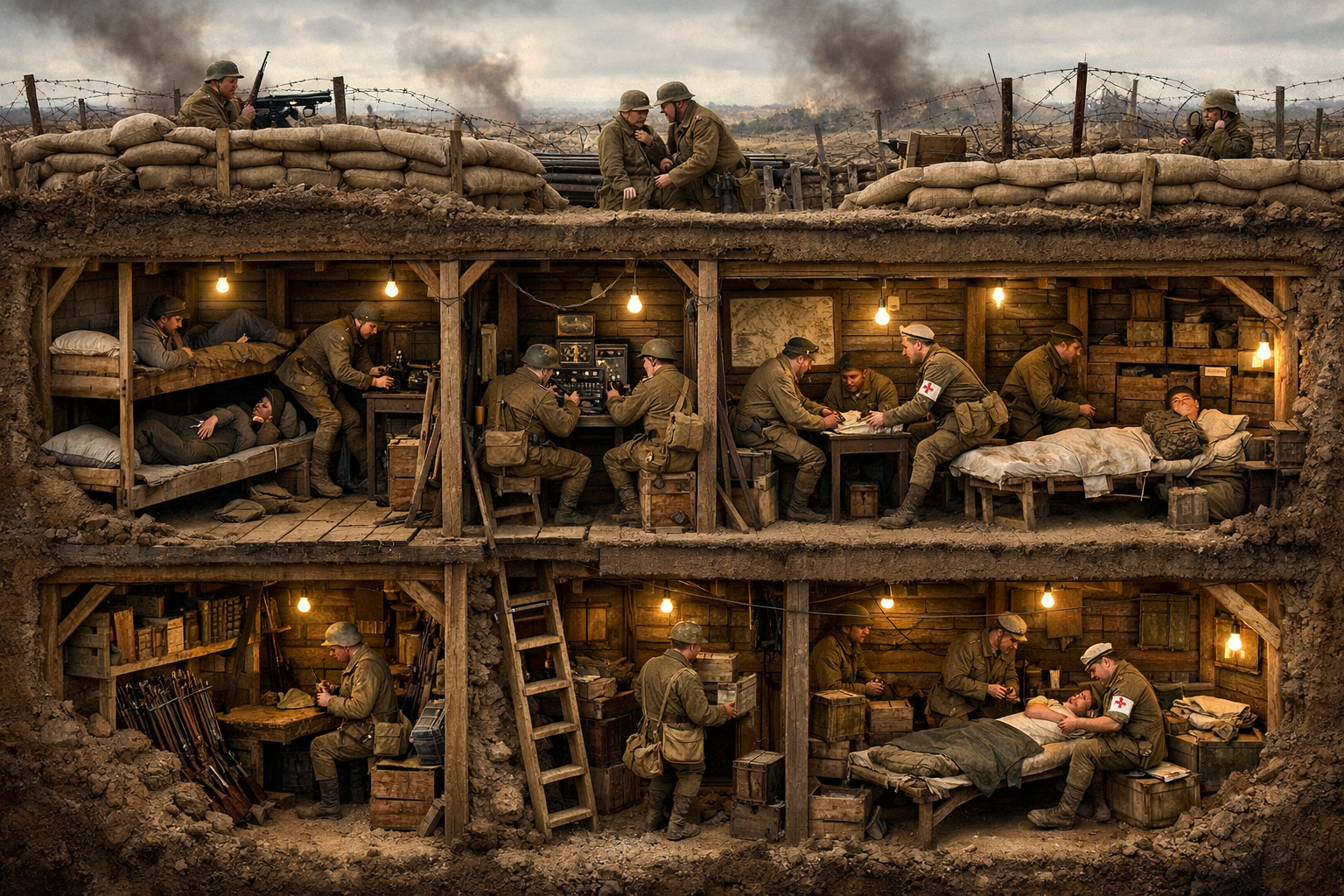
The Western Front’s trench systems weren’t just ditches—they were elaborate underground civilizations. Soldiers carved out multi-level complexes that included sleeping quarters, hospitals, kitchens, communication centers, and even recreational areas. Some German bunkers went down 40 feet and could house entire battalions.
These subterranean worlds featured:
- Ventilation systems to prevent gas attacks
- Electric lighting powered by generators
- Underground railways for moving supplies
- Telephone networks connecting different sectors
- Medical facilities for treating wounded soldiers
Why this surprises: War became a way of life rather than a temporary conflict. Soldiers lived in these underground communities for years, creating their own societies beneath the battlefield. The fascinating historical structures that emerged from necessity rivaled any planned architecture.
When Machine Guns Made Cavalry Obsolete Overnight
The machine gun fundamentally broke traditional military tactics. A single Maxim gun could fire 600 rounds per minute—the equivalent firepower of 60 riflemen. When cavalry charges and infantry advances that had worked for centuries met this new technology, the results were catastrophic.
The numbers tell the story:
- Battle of the Somme: 60,000 British casualties on the first day alone
- Passchendaele: 325,000 casualties for five miles of territory
- Verdun: 700,000 total casualties in one battle
Military commanders were slow to adapt, continuing to order frontal assaults against entrenched machine gun positions. This technological revolution in warfare parallels how modern military innovations have consistently changed the nature of conflict throughout history.
Chemical Warfare: The New Face of Terror
On April 22, 1915, German forces released 168 tons of chlorine gas at the Second Battle of Ypres, introducing a horrifying new dimension to warfare. This marked the first large-scale use of chemical weapons, creating terror that went beyond physical damage to psychological devastation.
The escalation was rapid:
- Chlorine gas (1915): Caused drowning in one’s own fluids
- Phosgene (1915): Delayed effects made it particularly deadly
- Mustard gas (1917): Caused severe burns and blindness
- Protective measures: Gas masks became standard equipment
The psychological impact was as significant as the physical casualties. Soldiers lived in constant fear of invisible death that could drift across no man’s land with the changing wind. This introduction of chemical warfare violated previous conventions about “civilized” combat and established precedents that continue to influence international law today.
Aviation: From Reconnaissance to Dogfights
When WWI began, airplanes were barely a decade old and considered experimental curiosities. The Wright brothers had achieved powered flight only in 1903. Military leaders initially saw aircraft as useful only for reconnaissance—essentially flying scouts to observe enemy positions.
The rapid evolution was extraordinary:
- 1914: Unarmed observation planes
- 1915: Pilots carried pistols and rifles for aerial combat
- 1916: Purpose-built fighter aircraft with synchronized machine guns
- 1917: Large-scale bombing raids and air superiority battles
Famous aces like the Red Baron (Manfred von Richthofen) became international celebrities, transforming aerial combat into a romanticized form of individual heroism amid the industrial slaughter below. The war that began with horses and ended with air forces demonstrated how technological advancement could accelerate under the pressure of conflict.
The Christmas Truce That Defied Orders
On Christmas Eve 1914, something unprecedented happened along the Western Front. British and German soldiers began singing Christmas carols across no man’s land. What started as songs became conversations, then meetings in the middle of the battlefield. Soldiers exchanged gifts, played football, and buried their dead together.
What made this remarkable:
- It was spontaneous and unauthorized by military command
- It occurred along multiple sections of the front lines
- Soldiers shared food, cigarettes, and photographs of families
- Some units refused to resume fighting for days afterward
Military commanders were horrified and issued strict orders preventing future truces. The incident demonstrated that even in the midst of industrial warfare, human connections could transcend national boundaries and military orders. This moment of humanity breaking through the machinery of war remains one of the most powerful examples of civil disobedience in military history.
America’s Late Entry Changed Everything
While Europe bled for nearly three years, the United States maintained neutrality under President Woodrow Wilson’s policy of keeping America out of European conflicts. The U.S. didn’t enter the war until April 6, 1917—almost three years after it began.
What triggered American involvement:
- Unrestricted submarine warfare by Germany
- The Zimmermann Telegram proposing a German-Mexican alliance
- Economic interests in Allied victory due to war loans
- Public opinion shift after civilian ship sinkings
When America finally joined, it brought 2 million fresh troops and massive industrial capacity to the exhausted Allies. The timing was crucial—Russia had just exited the war due to revolution, freeing up German forces for the Western Front. American entry provided the decisive advantage that broke the stalemate.
This late but crucial intervention established America’s role as a global superpower and demonstrated how U.S. involvement shaped WWI’s outcome in ways that continue to influence international relations today.
Massive Casualties for Minimal Gains
The mathematics of WWI were horrifying: millions of lives lost for yards of territory. The Battle of Verdun lasted 302 days and resulted in 700,000 casualties—for a battlefield that measured roughly 20 square miles. At Passchendaele, British forces advanced five miles at a cost of 325,000 casualties.
The staggering human cost:
- Total military deaths: 8.5 million
- Civilian deaths: 8 million
- Wounded: Over 21 million
- Missing/prisoners: 7.7 million
These numbers represent not just statistics but entire generations wiped out. France lost 1.4 million men—nearly 4% of its total population. Some British units suffered 90% casualties in single battles. The war’s industrial nature meant that human beings were fed into the machinery of conflict at an unprecedented rate.
The disconnect between enormous sacrifice and minimal territorial gains challenged fundamental assumptions about military strategy and the value of human life in warfare.
Tanks: The Solution to Trench Warfare
Frustrated by the stalemate of trench warfare, British engineers developed an armored vehicle that could cross trenches, crush barbed wire, and provide mobile firepower. The first tanks appeared at the Battle of Cambrai in 1917, initially called “land ships” or “moving fortresses.”
Early tank characteristics:
- Speed: 3-4 miles per hour (walking pace)
- Reliability: Frequent mechanical breakdowns
- Crew conditions: Extreme heat, noise, and carbon monoxide poisoning
- Effectiveness: Mixed results but psychological impact was significant
Despite their limitations, tanks represented a revolutionary approach to breaking defensive lines. They could cross the shell-torn landscape of no man’s land and provide infantry with mobile cover. The concept evolved rapidly, and by war’s end, tanks were being mass-produced and refined into the armored vehicles that would dominate WWII battlefields.
The Collapse of Ancient Empires
WWI didn’t just redraw borders—it destroyed empires that had existed for centuries. Four major imperial powers completely collapsed as direct results of the war, ending political systems that had dominated Europe and the Middle East for hundreds of years.
Empires that fell:
- Ottoman Empire (600+ years): Became modern Turkey and Middle Eastern mandates
- Austro-Hungarian Empire (400+ years): Split into multiple new nations
- German Empire (47 years): Became the Weimar Republic
- Russian Empire (300+ years): Became the Soviet Union after revolution
These collapses created entirely new countries including Poland, Czechoslovakia, Yugoslavia, and modern Middle Eastern states. The political upheaval reshaped the global balance of power and created instabilities that persisted throughout the 20th century.
The war that began as a conflict between empires ended by destroying the imperial system itself, replacing it with nation-states and ideological movements that would define modern politics.
The Peace Treaty That Guaranteed Another War
The Treaty of Versailles, signed on June 28, 1919 (exactly five years after the assassination that started the war), was supposed to ensure lasting peace. Instead, it created conditions that made World War II almost inevitable.
Harsh provisions imposed on Germany:
- War guilt clause: Germany accepted full responsibility
- Massive reparations: 132 billion gold marks (roughly $400 billion today)
- Military restrictions: Army limited to 100,000 men, no air force
- Territory losses: 13% of European territory, all colonies
These punitive measures devastated the German economy and created resentment that Adolf Hitler would later exploit. The treaty was harsh enough to humiliate Germany but not severe enough to prevent its recovery. French Marshal Ferdinand Foch predicted accurately: “This is not a peace. It is an armistice for twenty years.”
The lessons about how peace treaties can fail demonstrate the importance of creating sustainable post-conflict settlements rather than purely punitive ones.
What These Surprising Facts About WWI Reveal
These surprising facts about WWI illuminate several crucial themes that explain why the Great War was such a transformative event in human history.
Rapid Technological Change
The war accelerated technological development at an unprecedented pace. In four years, warfare evolved from horses and rifles to tanks, aircraft, and chemical weapons. This rapid innovation established the pattern of technology-driven conflict that characterizes modern warfare.
Human Resilience and Suffering
The scale of human endurance displayed in WWI was extraordinary. Soldiers lived in conditions that would have been considered uninhabitable, yet maintained fighting effectiveness for years. The underground trench cities and the Christmas Truce both demonstrate humanity’s ability to adapt and maintain dignity under extreme circumstances.
Miscalculations by Leaders
From the initial belief in a short war to the harsh peace treaty, WWI was marked by massive misjudgments by political and military leaders. These errors had consequences that lasted generations and shaped the entire 20th century.
Long-term Global Consequences
The war’s effects extended far beyond the battlefield. It destroyed empires, created new nations, established America as a global power, and set up conditions for future conflicts. The historical patterns of political violence that emerged from WWI continue to influence international relations today.
Why WWI Still Matters in 2026
Understanding these surprising facts about WWI remains crucial because the war’s consequences continue to shape our world today.
Modern connections include:
- Middle Eastern borders drawn after WWI still define regional conflicts
- International institutions like the League of Nations (predecessor to the UN) emerged from WWI
- Military technologies developed in WWI became foundations for modern warfare
- Political ideologies that arose from WWI’s aftermath continue to influence global politics
The war also established precedents for international law, human rights, and the conduct of warfare that remain relevant. Chemical weapons bans, rules for treating prisoners of war, and concepts of war crimes all trace back to WWI experiences.
Perhaps most importantly, WWI demonstrated how quickly the modern world can descend into catastrophic conflict, making its lessons about preventing political violence and maintaining international stability eternally relevant.
Conclusion
These twelve surprising facts about WWI reveal that the Great War was far more complex, innovative, and consequential than most people realize. From the single gunshot that triggered global catastrophe to the peace treaty that guaranteed future conflict, WWI defied expectations at every turn.
The war that was supposed to last months stretched into years. The conflict that promised glory delivered industrial slaughter. The peace that was meant to end all wars instead planted seeds for an even more devastating conflict two decades later.
Yet within this tragedy, we also find remarkable examples of human ingenuity, resilience, and compassion—from the underground cities soldiers built to survive, to the Christmas truce that proved humanity could transcend even the most brutal circumstances.
Take action to deepen your understanding:
- Explore additional historical mysteries that challenge conventional narratives
- Research how modern conflicts echo WWI patterns
- Visit WWI museums and battlefields to connect with this history personally
- Read primary sources like soldier diaries and letters to understand the human experience
The more you learn about World War I, the more you realize—it didn’t just shape the past, it shaped the world we live in today.



