Between September 1939 and September 1945, over 70 million people lost their lives in the deadliest conflict in human history. Yet for the first two years, it seemed the Axis powers might actually win. Germany had conquered most of Europe, Japan dominated the Pacific, and the Allies appeared to be fighting a losing battle on multiple fronts.
What transformed this seemingly inevitable Axis victory into total defeat? The answer lies not in a single decisive moment, but in a series of critical turning points that changed World War II forever. These pivotal battles and strategic decisions didn’t just alter the course of individual campaigns—they fundamentally shifted the momentum of the entire global conflict.
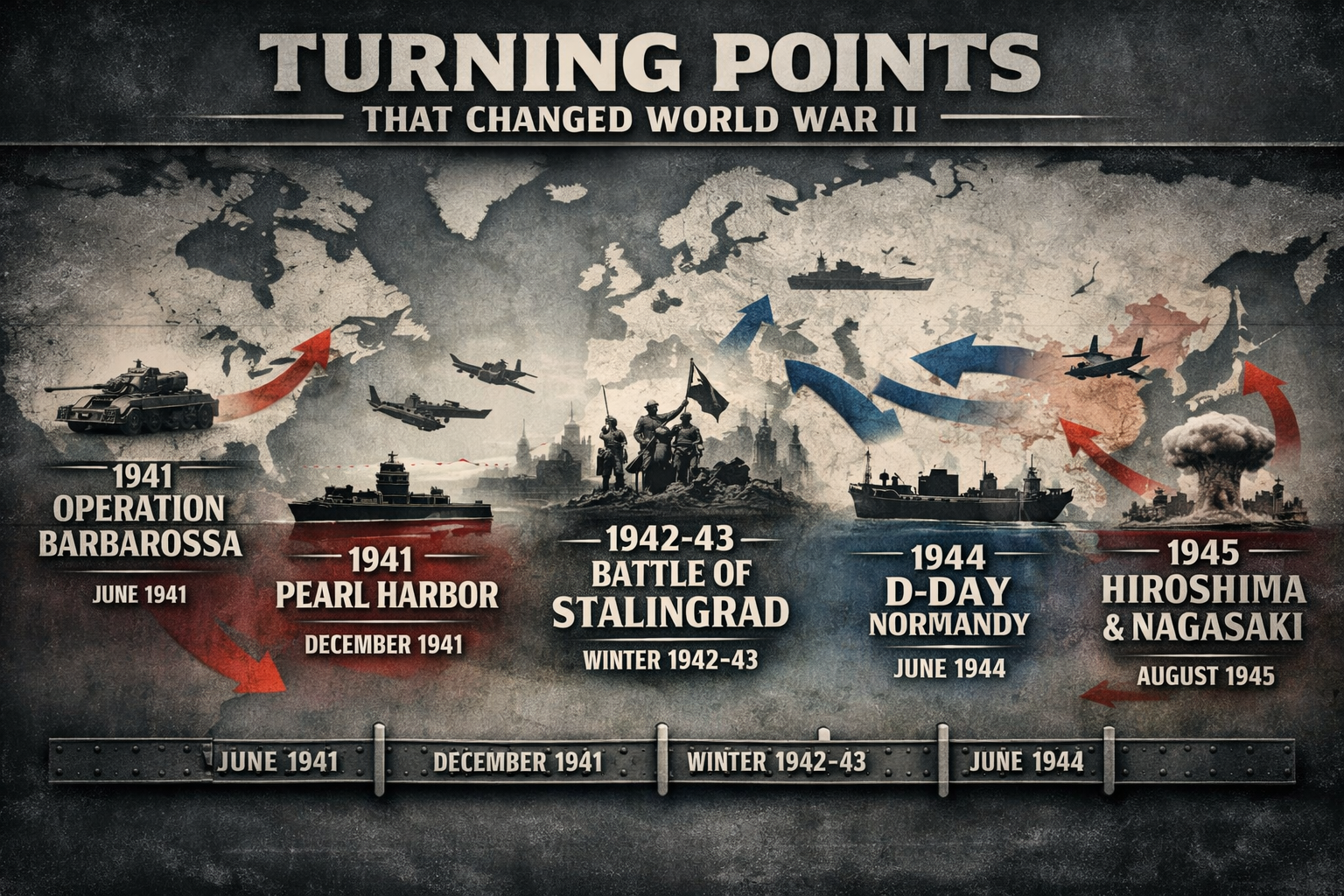
From the skies over Britain to the frozen streets of Stalingrad, from the coral atolls of the Pacific to the beaches of Normandy, these turning points that changed World War II represent moments when everything hung in the balance. Understanding these crucial junctures reveals how the war’s outcome was far from predetermined and how strategic miscalculations, technological innovations, and sheer determination could alter the fate of nations.
Key Takeaways
• Ten critical moments between 1940-1945 fundamentally altered World War II’s trajectory from likely Axis victory to total Allied triumph
• Strategic overextension by Germany and Japan created vulnerabilities that Allied forces eventually exploited across multiple theaters
• Industrial capacity and resource management proved as decisive as battlefield tactics in determining the war’s ultimate outcome
• Intelligence breakthroughs and technological advantages gave Allied forces crucial edges in key battles and campaigns
• Coordinated Allied strategy gradually overcame early Axis advantages through sustained pressure on multiple fronts
1. Battle of Britain (July-October 1940)
The Battle of Britain marked the first major defeat of Nazi Germany and proved that the Wehrmacht was not invincible. After conquering France in just six weeks, Hitler turned his attention to Britain, launching Operation Eagle Attack to gain air superiority before a planned invasion.
What Happened: The Luftwaffe launched sustained bombing campaigns against British airfields, radar stations, and eventually cities. However, the Royal Air Force (RAF), equipped with superior Spitfire and Hurricane fighters and aided by revolutionary radar technology, inflicted devastating losses on German aircraft.
Why It Mattered: Britain’s survival meant that Germany would face a two-front war once it invaded the Soviet Union. The island nation remained a crucial staging ground for future Allied operations and continued to threaten German-occupied Europe. The defeat also marked Hitler’s first major strategic failure.
How It Shifted Momentum: 🔄 The victory boosted Allied morale worldwide and demonstrated that Nazi Germany could be defeated. It preserved Britain as a base for strategic operations that would prove crucial in later conflicts, including the eventual invasion of Europe.
2. Operation Barbarossa (June 22, 1941)
Germany’s invasion of the Soviet Union represented one of the most fateful decisions in military history. Operation Barbarossa opened a massive Eastern Front that would ultimately consume German resources and manpower.
What Happened: Over 3.8 million Axis troops invaded the Soviet Union along an 1,800-mile front. Initially successful, German forces advanced rapidly, capturing millions of Soviet soldiers and threatening Moscow, Leningrad, and Stalingrad.
Why It Mattered: The invasion created the two-front war that German military planners had long feared. Despite early successes, the campaign failed to achieve its primary objective of quickly defeating the Soviet Union before winter.
How It Shifted Momentum: ⚡ The operation marked the beginning of Germany’s strategic overextension. Fighting on multiple fronts would drain German resources and prevent them from concentrating forces for decisive victories elsewhere.
3. Attack on Pearl Harbor (December 7, 1941)
Japan’s surprise attack on the U.S. Pacific Fleet transformed World War II from a primarily European conflict into a truly global war. This turning point that changed World War II brought the world’s largest industrial power into the conflict.
What Happened: Japanese carrier-based aircraft launched a surprise attack on the U.S. naval base at Pearl Harbor, Hawaii. The assault sank or damaged 18 American warships, destroyed nearly 200 aircraft, and killed over 2,400 Americans.
Why It Mattered: The attack unified American public opinion behind entering the war. Previously, isolationist sentiment had kept the United States from full participation despite providing aid to Britain and the Soviet Union.
How It Shifted Momentum: 🇺🇸 America’s entry brought enormous industrial capacity, technological innovation, and fresh manpower to the Allied cause. The “sleeping giant” that Admiral Yamamoto feared awakening would prove decisive in both the Pacific and European theaters.
4. Battle of Midway (June 4-7, 1942)
The Battle of Midway represents the decisive turning point in the Pacific Theater. This naval engagement permanently shifted the balance of power from Japan to the United States in the Pacific Ocean.
What Happened: Japanese Admiral Yamamoto planned to destroy the remaining U.S. Pacific Fleet by attacking Midway Island. However, American codebreakers had intercepted Japanese communications, allowing Admiral Nimitz to position his forces advantageously. U.S. dive bombers destroyed four Japanese aircraft carriers in a single day.
Why It Mattered: Japan lost four fleet carriers, over 200 experienced pilots, and numerous support vessels. These losses were irreplaceable given Japan’s limited industrial capacity compared to American production capabilities.
How It Shifted Momentum: ⚓ The victory gave the United States naval superiority in the Pacific and marked the beginning of the American island-hopping campaign that would eventually reach Japan itself.
5. Second Battle of El Alamein (October-November 1942)
General Bernard Montgomery’s victory at El Alamein halted Axis expansion into the Middle East and marked the beginning of the end for German forces in North Africa.
What Happened: British Commonwealth forces under Montgomery launched a carefully planned offensive against German and Italian forces led by Field Marshal Rommel. After twelve days of intense fighting, Axis forces began a long retreat westward.
Why It Mattered: The victory secured the Suez Canal, vital oil supplies, and prevented a potential link-up between German forces advancing from North Africa and those fighting in the Soviet Union.
How It Shifted Momentum: 🏜️ El Alamein marked the first major British land victory against German forces and boosted Allied morale. It also set the stage for the Allied invasion of Italy, opening a new front in southern Europe.
6. Battle of Stalingrad (August 1942 – February 1943)
The Battle of Stalingrad became the bloodiest battle in human history and marked the beginning of Germany’s irreversible decline on the Eastern Front. This brutal urban warfare exemplified the strategic mistakes that can lose wars.
What Happened: German forces attempted to capture the industrial city of Stalingrad in brutal house-to-house fighting. Soviet forces, initially pushed back to a narrow strip along the Volga River, launched Operation Uranus, encircling the German 6th Army. Despite attempts to relieve the trapped forces, the entire army was destroyed.
Why It Mattered: Germany lost an entire army of 250,000 men, including experienced officers and NCOs who were difficult to replace. The defeat shattered the myth of German invincibility and marked the beginning of a long retreat on the Eastern Front.
How It Shifted Momentum: 🔥 Stalingrad became a symbol of Soviet resilience and marked the point where Germany permanently lost the initiative in the East. The Red Army would advance almost continuously westward from this point until reaching Berlin.
7. Guadalcanal Campaign (August 1942 – February 1943)
The Guadalcanal Campaign marked the first major Allied ground offensive in the Pacific and demonstrated that Japanese forces could be defeated in sustained combat.
What Happened: U.S. Marines landed on Guadalcanal to prevent Japan from completing an airfield that would threaten Allied supply lines to Australia. The campaign involved six months of brutal jungle fighting, multiple naval battles, and constant air combat.
Why It Mattered: The victory gave the Allies their first major ground success against Japanese forces and provided a crucial airbase for future operations. Japan lost irreplaceable pilots and aircraft during the prolonged campaign.
How It Shifted Momentum: 🌴 Guadalcanal marked the beginning of the Allied offensive in the Pacific, proving that Japanese forces could be defeated through sustained pressure and superior logistics.
8. Allied Invasion of Italy (September 1943)
The invasion of Italy opened a new front in southern Europe and led to the first Axis power leaving the war. This campaign demonstrated how the turning points that changed World War II often created cascading effects across multiple theaters.
What Happened: Allied forces launched Operation Avalanche, landing at Salerno while British forces crossed from Sicily. The Italian government surrendered, though German forces continued fierce resistance throughout the peninsula.
Why It Mattered: Italy’s surrender removed one Axis power from the war and forced Germany to divert significant resources to defend the Italian peninsula. The campaign also provided valuable experience for the upcoming invasion of France.
How It Shifted Momentum: 🇮🇹 The Italian campaign tied down German divisions that could have been used to defend against the coming invasion of Normandy or to reinforce the Eastern Front against Soviet advances.
9. D-Day: The Normandy Invasion (June 6, 1944)
D-Day represented the largest amphibious invasion in history and opened the long-awaited second front in Western Europe. This operation exemplified the kind of strategic coordination that emerged from lessons learned in earlier conflicts.
What Happened: Over 150,000 Allied troops landed on five beaches along the Normandy coast, supported by massive naval and air bombardments. Despite fierce German resistance, the Allies established a secure beachhead and began advancing inland.
Why It Mattered: The invasion forced Germany to fight on multiple fronts simultaneously, stretching their resources beyond the breaking point. It also demonstrated the Allies’ ability to conduct complex, coordinated operations across vast distances.
How It Shifted Momentum: 🏖️ D-Day marked the beginning of the liberation of Western Europe and created the two-front war in Europe that Germany could not sustain. Combined with Soviet advances in the East, it made German defeat inevitable.
10. Soviet Advance into Eastern Europe (1944-1945)
The Red Army’s advance through Eastern Europe represented the final phase of Germany’s collapse and demonstrated the overwhelming force that the Soviet Union could bring to bear.
What Happened: Soviet forces launched a series of massive offensives, destroying entire German army groups and advancing rapidly through Poland, Hungary, Romania, and Bulgaria. These campaigns culminated in the Battle of Berlin and Germany’s unconditional surrender.
Why It Mattered: The Soviet advance eliminated Germany’s remaining allies in Eastern Europe and brought the war directly to German soil. The sheer scale of Soviet operations overwhelmed German defensive capabilities.
How It Shifted Momentum: 🚩 These final campaigns demonstrated the complete reversal of fortunes from the early days of Operation Barbarossa. The Red Army that had nearly collapsed in 1941 had become an unstoppable force advancing toward the heart of the Reich.
Key Patterns Behind These Turning Points That Changed World War II
Several critical patterns emerge when examining these pivotal moments:
Overextension by Axis Powers: Germany and Japan consistently attempted to control more territory than their resources could support. From the two-front war created by Barbarossa to Japan’s scattered Pacific empire, Axis forces became stretched too thin to maintain their early advantages.
Allied Industrial Superiority: The United States’ massive industrial capacity, combined with British technological innovation and Soviet manpower, eventually overwhelmed Axis production capabilities. This advantage became decisive in prolonged campaigns like Stalingrad and Guadalcanal.
Intelligence Breakthroughs: Allied success in breaking enemy codes provided crucial advantages at Midway, during the Battle of Britain, and in numerous other engagements. These intelligence victories often proved as important as battlefield tactics.
Strategic Adaptability: The Allies demonstrated superior ability to learn from defeats and adapt their strategies. From the lessons of early disasters to the sophisticated coordination of D-Day, Allied forces continuously improved their operational effectiveness.
Coordination and Unity: Unlike the Axis powers, which often pursued conflicting objectives, the Allies developed increasingly effective coordination mechanisms. This unity of effort proved crucial in mounting complex operations across multiple theaters.
Why These Turning Points Matter in 2026
Understanding these turning points that changed World War II provides crucial insights into how conflicts evolve and how apparent advantages can quickly disappear. The war’s outcome wasn’t predetermined—it resulted from a series of strategic decisions, technological innovations, and battlefield victories that gradually shifted momentum from one side to the other.
These moments demonstrate that wars are won through sustained effort rather than single decisive battles. Each turning point built upon previous victories and created conditions for future success. The Allies’ ability to maintain pressure across multiple fronts while adapting to changing circumstances ultimately proved decisive.
The lessons learned from these turning points influenced post-war strategic thinking and continue to shape military doctrine today. From the importance of air superiority demonstrated in the Battle of Britain to the decisive role of industrial capacity shown throughout the conflict, these insights remain relevant for understanding modern warfare and international relations.
Conclusion
The turning points that changed World War II reveal a fundamental truth about warfare: victory often belongs not to those who start strongest, but to those who adapt fastest and sustain their efforts longest. Each of these ten moments represented a shift in momentum that built upon previous successes and created opportunities for future victories.
From Britain’s lonely stand in 1940 to the final Soviet assault on Berlin, these turning points demonstrate how strategic vision, technological innovation, and sheer determination can overcome seemingly insurmountable odds. The Axis powers’ early advantages in training, equipment, and tactical doctrine were gradually overcome by Allied superiority in production, coordination, and adaptability.
For students of history and strategy, these turning points offer invaluable lessons about the nature of conflict and the factors that determine victory and defeat. They remind us that even in humanity’s darkest hours, the course of events can change through courage, innovation, and unwavering commitment to a cause.
Take Action: Explore these battles in greater detail through documentaries, historical accounts, and museum exhibits. Understanding how these pivotal moments unfolded provides crucial context for comprehending not just World War II, but the broader patterns of conflict and cooperation that continue to shape our world today.
World War II wasn’t decided by a single victory—but by the moments when everything began to change.