A single delayed order cost Germany 300,000 soldiers at Stalingrad. One intelligence failure at Midway sank Japan’s naval supremacy forever. World War II wasn’t just won through superior strategy and industrial might—it was fundamentally shaped by critical mistakes that altered the entire course of history. These 10 mistakes that changed World War II demonstrate how individual decisions, tactical blunders, and strategic miscalculations can determine the fate of nations and reshape the global order.
The war’s outcome hinged not only on brilliant military leadership but also on catastrophic errors that opened doors for enemy victories. From Hitler’s disastrous decision to invade the Soviet Union to Japan’s surprise attack that awakened a sleeping giant, these pivotal mistakes reveal how quickly fortunes can shift in global conflict.
Key Takeaways
- Strategic overreach proved more devastating than battlefield defeats, with Germany’s multi-front war strategy ultimately causing their downfall
- Intelligence failures at critical moments, particularly at Pearl Harbor and Midway, shifted naval supremacy and brought new powers into the conflict
- Tactical stubbornness in battles like Stalingrad and the Bulge wasted irreplaceable resources when flexibility could have preserved fighting strength
- Timing errors in major operations, from delayed D-Day responses to premature Soviet invasion, created windows of opportunity for enemy forces
- Underestimating opponents consistently led to strategic disasters, whether dismissing Soviet resistance or American industrial capacity
The Strategic Blunders That Shaped History
1. Operation Barbarossa: Opening Pandora’s Box
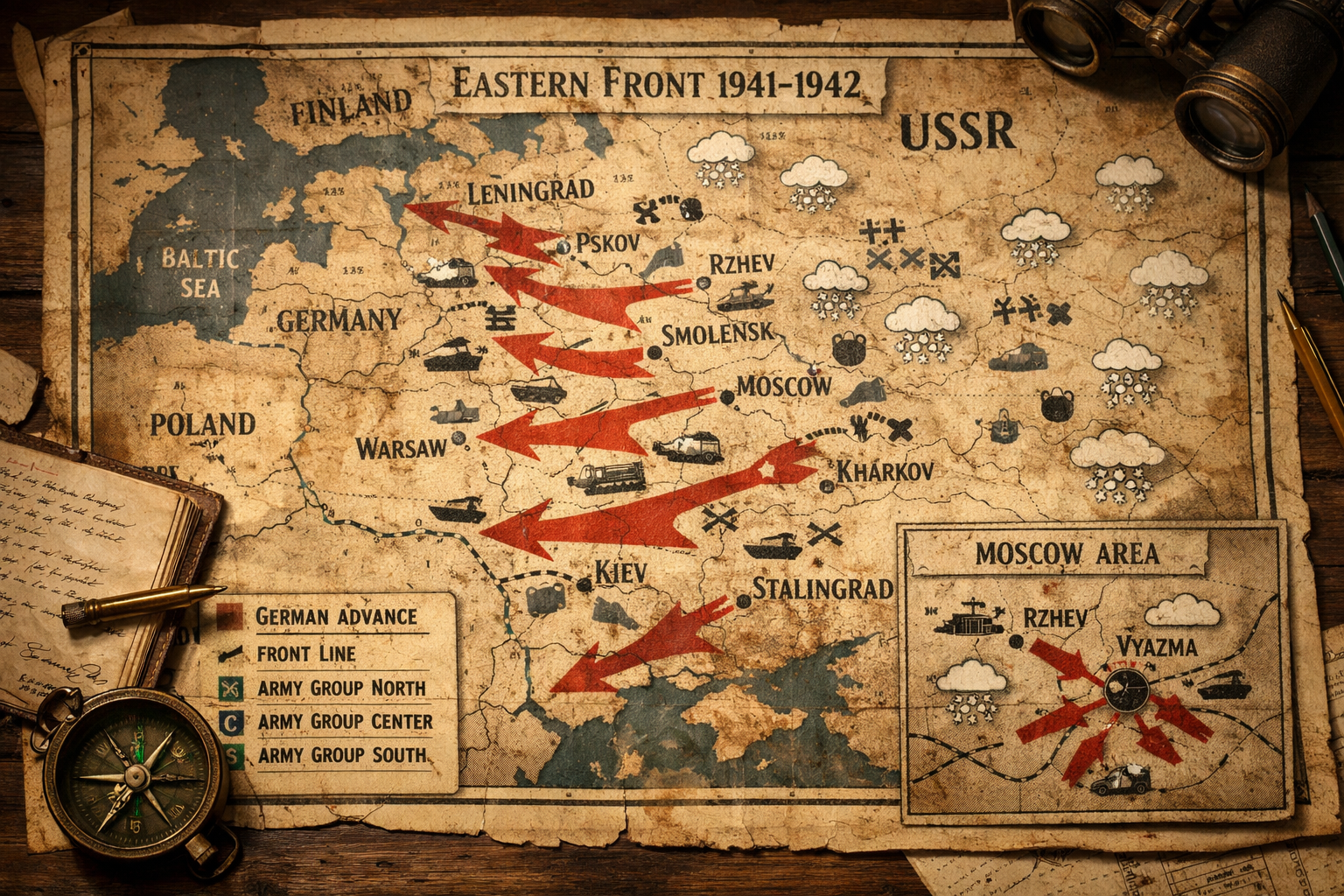
The Mistake: On June 22, 1941, Adolf Hitler made perhaps the most consequential error of World War II by launching Operation Barbarossa, the invasion of the Soviet Union, while still fighting Britain.
Who Made It: Hitler, against the advice of many German generals who warned about fighting a two-front war—the same mistake that contributed to Germany’s defeat in World War I.
What Happened: The German Wehrmacht initially achieved stunning success, capturing millions of Soviet soldiers and advancing deep into Russian territory. However, the invasion was delayed by six crucial weeks due to operations in the Balkans, pushing the timeline dangerously close to the Russian winter.
Immediate Consequences:
- 🔥 4 million Axis troops committed to the Eastern Front
- ❄️ Winter warfare without proper equipment or preparation
- 💀 Massive casualties from both combat and harsh conditions
- 🏭 Soviet industrial evacuation preserved war production capacity
Long-Term Impact: This decision created the dreaded two-front war that stretched German resources beyond their limits. The Soviet Union’s massive industrial capacity and seemingly endless manpower reserves gradually wore down German forces, while the delayed timeline meant German troops faced the brutal Russian winter unprepared.
2. The Stalingrad Obsession: Pride Before the Fall
The Mistake: Hitler’s refusal to allow the German 6th Army to retreat from Stalingrad, turning a tactical operation into a symbolic battle that Germany couldn’t afford to lose.
Who Made It: Hitler personally, overruling General Paulus and other commanders who recognized the deteriorating situation.
What Happened: What began as a strategic push toward the Caucasus oil fields became a devastating urban warfare nightmare. German forces became trapped in brutal house-to-house fighting while Soviet forces encircled the city.
Immediate Consequences:
- 🏴 300,000 German soldiers killed, wounded, or captured
- ⚡ Entire 6th Army destroyed, Germany’s most experienced fighting force
- 📈 Soviet morale surge after their first major victory
- 🔄 Strategic initiative shifted permanently to the Soviets
The psychological impact of this defeat cannot be overstated—it marked the beginning of Germany’s long retreat on the Eastern Front.
3. Pearl Harbor: Awakening the Sleeping Giant
The Mistake: Japan’s surprise attack on Pearl Harbor brought the United States fully into World War II, transforming a regional conflict into a truly global war.
Who Made It: Admiral Yamamoto and Japanese military leadership, despite Yamamoto’s own reservations about fighting America’s industrial capacity.
What Happened: On December 7, 1941, Japanese naval forces launched a surprise attack on the U.S. Pacific Fleet at Pearl Harbor, sinking multiple battleships and killing over 2,400 Americans.
Immediate Consequences:
- 🇺🇸 American war declaration within 24 hours
- 🏭 Industrial mobilization of the world’s largest economy
- ⚓ Pacific Theater expansion with full U.S. naval commitment
- 🤝 Allied coordination strengthened with American resources
Long-Term Impact: This attack fundamentally changed the war’s trajectory by bringing American industrial might fully into the conflict. The United States’ ability to fight simultaneously in Europe and the Pacific, while supplying allies worldwide, proved decisive. Japan had hoped to cripple American naval power, but instead created a determined enemy with unlimited resources for a prolonged conflict.
4. D-Day Response Failure: Missing the Critical Moment
The Mistake: German forces failed to mount an effective immediate counterattack against the D-Day landings, allowing Allied forces to establish a permanent foothold in Western Europe.
Who Made It: German high command, particularly Field Marshal Rommel and von Rundstedt, who disagreed on defensive strategy, plus Hitler’s interference in tactical decisions.
What Happened: Despite knowing an invasion was coming, German forces were poorly positioned and coordinated when the Allies landed at Normandy on June 6, 1944. Critical panzer reserves were held back due to command confusion and Hitler’s direct control over their deployment.
Immediate Consequences:
- 🏖️ Allied beachhead established within 48 hours
- 🚢 Massive reinforcement capability secured
- ⚔️ Two-front war in full effect for Germany
- 📉 German strategic reserves depleted in piecemeal counterattacks
The failure to “throw the Allies back into the sea” within the first critical hours sealed Germany’s fate on the Western Front.
Naval and Pacific Theater Disasters
5. Battle of Midway: Intelligence Catastrophe
The Mistake: Japanese forces walked into a carefully prepared American trap due to compromised communications and overconfidence in their naval superiority.
Who Made It: Admiral Nagumo and Japanese naval intelligence, who failed to recognize that their codes had been broken by American cryptographers.
What Happened: American codebreakers intercepted Japanese plans for the Midway operation, allowing Admiral Nimitz to position his forces perfectly. On June 4-7, 1942, the Japanese lost four aircraft carriers and many of their most experienced pilots.
Immediate Consequences:
- 🛩️ Four Japanese carriers sunk (Akagi, Kaga, Soryu, Hiryu)
- ✈️ Experienced pilot losses that Japan couldn’t replace
- 🌊 Naval superiority shifted to the United States
- 📍 Strategic initiative in the Pacific transferred to America
This battle marked the turning point in the Pacific War, ending Japanese expansion and beginning their long retreat toward the home islands.
6. Battle of the Bulge: The Last Gamble
The Mistake: Hitler’s decision to launch a massive offensive in the Ardennes, using Germany’s last strategic reserves in a desperate attempt to split Allied forces.
Who Made It: Hitler, against the advice of generals who preferred a defensive strategy to preserve remaining forces.
What Happened: From December 16, 1944, to January 25, 1945, German forces launched their last major offensive, initially achieving surprise but ultimately failing to reach their objectives.
Immediate Consequences:
- 🪖 100,000+ German casualties from irreplaceable veteran units
- ⛽ Fuel shortages stranded German armor
- 🏰 Strategic reserves exhausted with no replacement capacity
- 🛡️ Allied defensive success demonstrated German weakness
Long-Term Impact: This offensive consumed Germany’s last mobile reserves, leaving them unable to defend against the final Allied push into Germany. The resources wasted in the Bulge could have prolonged Germany’s defense significantly.
Mediterranean and African Missteps
7. North African Campaign: Logistics Nightmare
The Mistake: Axis powers overextended their supply lines across the Mediterranean while failing to secure adequate logistics for sustained operations in North Africa.
Who Made It: German and Italian high command, particularly in their failure to prioritize Malta’s capture and secure Mediterranean shipping lanes.
What Happened: Despite Rommel’s tactical brilliance, Axis forces in North Africa consistently suffered from fuel, ammunition, and equipment shortages due to vulnerable supply lines and competing priorities.
Immediate Consequences:
- 🚢 Supply ship losses to Allied naval and air attacks
- ⛽ Chronic fuel shortages limiting offensive operations
- 🏜️ Strategic retreat from advanced positions
- 🇬🇧 Allied foothold preserved for future operations
The loss of North Africa opened southern Europe to Allied invasion and eliminated Axis influence in the Mediterranean.
8. Operation Market Garden: Bridge Too Far
The Mistake: Allied forces attempted an overly ambitious airborne operation to capture key bridges in the Netherlands, underestimating German defensive capabilities.
Who Made It: Field Marshal Montgomery and Allied command, who ignored intelligence about German armored units in the area.
What Happened: From September 17-25, 1944, Allied airborne forces attempted to capture bridges at Eindhoven, Nijmegen, and Arnhem, but the operation failed when ground forces couldn’t reach the isolated paratroopers in time.
Immediate Consequences:
- 🪂 17,000 Allied casualties, including elite airborne units
- 🌉 Strategic objectives remained in German hands
- ❄️ War prolonged into another winter
- 🛡️ German confidence boosted by successful defense
This failure meant the war would continue into 1945, costing thousands more lives and allowing Germany additional time to develop advanced weapons technology.
Eastern Front Catastrophes
9. Siege of Leningrad: The Grinding Stalemate
The Mistake: German forces chose to besiege Leningrad rather than capture it quickly, tying up massive resources for 872 days without strategic gain.
Who Made It: German Army Group North and Hitler’s decision to starve the city rather than assault it directly.
What Happened: From September 1941 to January 1944, German and Finnish forces maintained a siege that consumed enormous resources while failing to eliminate Soviet resistance or capture the city’s industrial capacity.
Immediate Consequences:
- 👥 Massive civilian casualties (over 1 million deaths)
- 🪖 German forces tied down that could have been used elsewhere
- 🏭 Industrial capacity remained partially operational
- 💪 Soviet resistance symbol inspired nationwide determination
The siege became a symbol of Soviet resistance while draining German resources that were desperately needed on other fronts.
10. Multi-Front Strategic Failure: Divided Focus
The Mistake: Germany’s decision to fight simultaneously on multiple fronts without the resources to sustain such widespread operations.
Who Made It: Hitler and German high command, who failed to prioritize objectives and concentrate forces effectively.
What Happened: By 1943, German forces were fighting in Russia, North Africa, Italy, the Atlantic, and defending occupied territories across Europe, stretching their military beyond sustainable limits.
Immediate Consequences:
- 📉 Resource dilution across multiple theaters
- 🚫 No strategic reserves for crisis response
- ⚡ Initiative loss on all major fronts
- 🔄 Defensive posture became permanent
This strategic overreach violated fundamental military principles and made German defeat inevitable once Allied production reached full capacity.
Common Patterns Behind These Critical Mistakes
The Psychology of Strategic Failure
Several recurring themes emerge from analyzing these 10 mistakes that changed World War II:
🎯 Overconfidence and Hubris
Leaders consistently underestimated enemy capabilities while overestimating their own forces. This pattern appears in virtually every major mistake, from Pearl Harbor to Stalingrad.
📊 Intelligence Failures
Critical decisions were made with incomplete or ignored intelligence. The failure to properly assess enemy strength, weather conditions, or strategic capabilities led to repeated disasters.
⏰ Poor Timing and Coordination
Many mistakes involved timing errors—attacking too early, too late, or without proper coordination between different military branches and allied forces.
🎯 Strategic vs. Tactical Thinking
Leaders often became fixated on tactical victories while losing sight of strategic objectives, as seen in the Stalingrad obsession and the Bulge offensive.
Research shows that those who think further into the future are less likely to take risks, yet many of these mistakes involved leaders taking enormous gambles with insufficient long-term planning.
Which Mistake Was the Biggest Game-Changer?
The Great Debate: Pearl Harbor vs. Operation Barbarossa
Military historians continue debating which mistake had the most significant impact on the war’s outcome:
🌅 Pearl Harbor Argument:
- Brought the world’s largest industrial power into the war
- Created a two-ocean conflict for the Allies to manage
- Provided unlimited resources for prolonged warfare
- Enabled simultaneous European and Pacific operations
❄️ Operation Barbarossa Argument:
- Created the devastating two-front war for Germany
- Opened the massive Eastern Front that consumed 80% of German forces
- Led directly to Stalingrad and subsequent Eastern Front disasters
- Violated the fundamental strategic principle of concentration of force
“The invasion of Russia was the decisive mistake. Everything that happened afterward was just a consequence of that initial strategic error.” – Military historian David Glantz
Both mistakes share a common thread: they transformed regional conflicts into global wars that the Axis powers lacked the resources to sustain.
How These Mistakes Fundamentally Changed the War
Momentum Shifts and Strategic Consequences
These errors created cascading effects that extended far beyond their immediate tactical impact:
🔄 Initiative Transfer
Each major mistake transferred strategic initiative to the Allies, forcing Axis powers into increasingly desperate defensive positions.
📈 Resource Allocation
Mistakes forced poor resource allocation—defending Stalingrad instead of strategic withdrawal, wasting reserves in the Bulge rather than preparing defenses, maintaining the Leningrad siege instead of redeploying forces.
⏱️ Time Factor
Many mistakes cost precious time, allowing enemies to mobilize resources, develop new weapons, or prepare defenses. The delayed Barbarossa timeline proved particularly costly when winter arrived.
🤝 Alliance Strengthening
Axis mistakes often strengthened Allied cooperation and resolve, while successful Allied operations built momentum and confidence.
The interconnected nature of these mistakes demonstrates how military strategists throughout history have learned that single decisions can determine the fate of entire civilizations.
Lessons for Modern Strategic Thinking
Timeless Principles Revealed
These 10 mistakes that changed World War II reveal enduring principles of strategic decision-making:
🎯 Concentration of Force
Dividing attention and resources across multiple objectives often leads to failure everywhere rather than success anywhere.
📊 Intelligence and Information
Accurate intelligence gathering and honest assessment of enemy capabilities remain crucial for strategic success.
⚖️ Risk vs. Reward Calculation
Many mistakes involved taking enormous risks for limited potential gains, violating basic strategic cost-benefit analysis.
🕐 Timing and Patience
Strategic patience often proves more valuable than tactical aggression, especially when facing opponents with superior resources.
The study of these historical mistakes continues to inform modern military doctrine and strategic planning, demonstrating that the fundamental principles of warfare remain remarkably consistent across different eras and technologies.
Conclusion
The 10 mistakes that changed World War II demonstrate that history’s greatest conflicts are often decided not by superior strength alone, but by critical errors that create opportunities for the enemy. From Hitler’s disastrous decision to invade the Soviet Union while fighting Britain, to Japan’s attack on Pearl Harbor that awakened American industrial might, these mistakes reveal how single decisions can alter the course of human history.
Each error followed predictable patterns: overconfidence in one’s own capabilities, underestimation of enemy strength and resolve, poor intelligence assessment, and the violation of fundamental strategic principles. Whether through tactical stubbornness at Stalingrad, intelligence failures at Midway, or strategic overreach across multiple fronts, these mistakes created cascading consequences that ultimately determined the war’s outcome.
For students of military history and strategic thinking, these examples provide invaluable lessons about the importance of realistic assessment, strategic patience, and the concentration of force. They remind us that in warfare, as in many aspects of life, it’s often not the strongest who prevail, but those who make the fewest critical errors.
Next Steps for Further Learning:
- Study detailed accounts of each battle to understand tactical-level decision making
- Examine how modern military doctrine incorporates lessons from these historical mistakes
- Research the best generals in history to understand successful strategic thinking
- Analyze how intelligence and technology continue to shape modern warfare
The legacy of World War II reminds us that in the crucible of global conflict, a few critical errors didn’t just cost battles—they changed the fate of the world forever.