
History isn’t just something you read—it’s something you live every day. The alarm clock that wakes you, the democratic vote you cast, the smartphone connecting you to billions of people, and even the security checkpoint at the airport all trace their origins to pivotal moments that happened decades or centuries ago. These 10 Historical Events That Still Affect You Today didn’t just reshape their own eras—they fundamentally rewired how modern society operates, creating the invisible framework that governs your daily existence in 2026.
Every morning when you wake up, you’re experiencing the accumulated effects of revolutions, wars, social movements, and technological breakthroughs that occurred long before you were born. The job you work, the rights you enjoy, the technology you use, and the freedoms you take for granted all emerged from specific historical turning points that continue to influence your life in ways both obvious and hidden.
Key Takeaways
• Historical events create lasting systems – Major moments in history established the political, economic, and social frameworks we still use today
• Your daily life reflects past struggles – From voting rights to workplace protections, current freedoms emerged from historical conflicts and movements
• Technology builds on historical foundations – Modern innovations like the internet evolved from wartime communication needs and earlier technological revolutions
• Global events shape local experiences – International conflicts and agreements continue to influence domestic policies, security measures, and economic systems
• Understanding these connections empowers informed citizenship – Recognizing historical influences helps you better navigate and participate in modern society
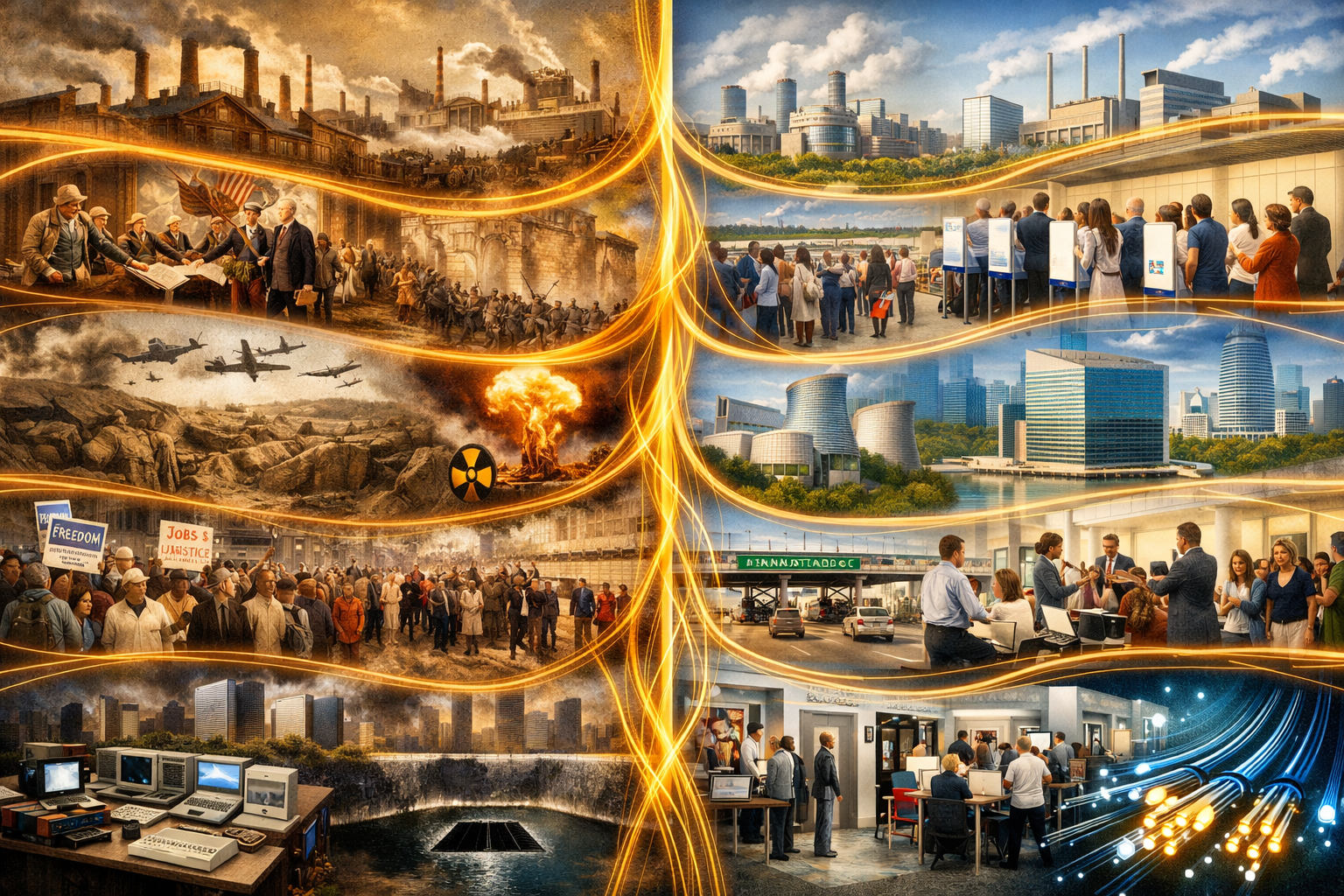
The Industrial Revolution (1760-1840): The Foundation of Modern Work Life
What Happened
The Industrial Revolution marked humanity’s shift from agricultural and handicraft economies to mechanized manufacturing. Beginning in Britain around 1760, this transformation introduced steam power, factory systems, and mass production techniques that spread across Europe and North America throughout the 1800s.
Why It Mattered Then
This revolution fundamentally changed how people worked and lived. Families moved from rural farms to industrial cities. Traditional craftsmen were replaced by factory workers operating machines. Production capacity increased exponentially, creating unprecedented wealth while also establishing new social classes and labor conditions.
How It Still Affects You Today 👉
Your Career Structure: The concept of a “job” with set hours, wages, and workplace hierarchy emerged during this period. Modern employment contracts, labor unions, and workplace safety regulations all trace back to Industrial Revolution-era conflicts between workers and factory owners.
Urban Living: If you live in a city, you’re residing in spaces originally designed around industrial needs. Modern urban planning, public transportation systems, and even apartment buildings evolved from Industrial Revolution housing requirements.
Consumer Culture: Mass production made goods affordable and widely available, creating the consumer economy that drives modern capitalism. The expectation that products should be cheap, standardized, and readily available stems directly from industrial manufacturing principles.
Just as 7 Ancient Roman Ideas that are Still Being Used Today continue to influence modern governance, the Industrial Revolution’s impact on work and society remains equally profound in 2026.
The American Revolution (1775-1783): Blueprint for Modern Democracy
What Happened
Thirteen American colonies declared independence from British rule, fought a successful war, and established a new nation based on democratic principles. The revolution created the first modern republic with a written constitution, separation of powers, and individual rights protections.
Why It Mattered Then
This revolution proved that ordinary people could overthrow established authority and create their own government. The Declaration of Independence and U.S. Constitution became templates for democratic movements worldwide, introducing radical concepts like “government by consent of the governed.”
How It Still Affects You Today 👉
Voting Rights: Your ability to participate in elections stems directly from American revolutionary ideals about popular sovereignty and representative government.
Constitutional Protections: Freedom of speech, religion, and press—rights you likely consider fundamental—were first formally protected in the U.S. Bill of Rights, influencing constitutional frameworks globally.
Federal Government Structure: The three-branch system (executive, legislative, judicial) with checks and balances, now used by many nations, originated from American revolutionary concerns about preventing tyranny.
The French Revolution (1789-1799): Equality and Citizenship Rights
What Happened
French citizens overthrew their monarchy, executed King Louis XVI, and attempted to rebuild society based on liberty, equality, and fraternity. This revolution spread democratic ideals across Europe while demonstrating both the power and dangers of popular uprisings.
Why It Mattered Then
The French Revolution universalized concepts of human rights and citizenship. It challenged the divine right of kings and aristocratic privilege, declaring that all people possessed inherent rights regardless of birth status.
How It Still Affects You Today 👉
Equal Treatment Under Law: Modern legal systems emphasizing equal justice regardless of social class emerged from French revolutionary principles.
Secular Government: The separation of church and state, reducing religious authority over civil matters, became a cornerstone of modern democratic governance.
National Identity: The concept of citizenship based on shared civic values rather than ethnic or religious identity—crucial for diverse modern societies—originated during this revolution.
World War I (1914-1918): Redrawing the Global Map
What Happened
A global conflict involving major world powers resulted in unprecedented destruction and the collapse of four empires: German, Austro-Hungarian, Russian, and Ottoman. The war introduced new technologies, changed social structures, and redrew national boundaries across Europe and the Middle East.
Why It Mattered Then
WWI ended the old European order and created the modern nation-state system. It accelerated technological development, expanded women’s roles in society, and established new international institutions aimed at preventing future conflicts.
How It Still Affects You Today 👉
Current Geopolitical Tensions: Many ongoing conflicts in the Middle East trace back to artificial borders drawn after WWI, when the Ottoman Empire was divided among European powers.
International Organizations: The concept of global governance through international bodies like the United Nations evolved from WWI-era attempts to create lasting peace.
Modern Warfare Technology: Military innovations from WWI, including aviation, chemical weapons regulations, and communications systems, continue influencing defense policies and international law.
The lasting impact of this conflict demonstrates how military strategies in US history shape today‘s geopolitical landscape.
World War II (1939-1945): Reshaping Global Power
What Happened
The most devastating conflict in human history involved over 30 countries and resulted in 70-85 million deaths. The war ended with Allied victory, the Holocaust’s revelation, nuclear weapons’ introduction, and the emergence of the United States and Soviet Union as superpowers.
Why It Mattered Then
WWII fundamentally restructured global power relationships and established new international norms around human rights, war crimes, and collective security. It accelerated decolonization and technological advancement while demonstrating the need for international cooperation.
How It Still Affects You Today 👉
International Law: Modern concepts of crimes against humanity, genocide, and universal human rights emerged from WWII tribunals and the Holocaust’s aftermath.
Global Alliances: NATO, the United Nations, and other international organizations that shape current global politics were created in response to WWII’s lessons.
Technological Innovation: Developments in computing, jet engines, radar, and medical treatments that emerged from wartime research continue benefiting civilian life today.
The Cold War (1947-1991): Nuclear Age and Global Rivalry
What Happened
A prolonged period of geopolitical tension between the United States and Soviet Union characterized by nuclear arms races, proxy wars, space competition, and ideological conflict between capitalism and communism without direct military confrontation.
Why It Mattered Then
The Cold War shaped international relations for nearly half a century, driving technological innovation, influencing domestic policies worldwide, and creating the framework for modern global politics through competing spheres of influence.
How It Still Affects You Today 👉
Nuclear Security: Current nuclear non-proliferation treaties, missile defense systems, and international monitoring of nuclear materials all originated from Cold War concerns about nuclear warfare.
Space Technology: GPS navigation, satellite communications, and weather forecasting systems you use daily emerged from Cold War space race competition.
Global Political Alignments: Many current international relationships and conflicts reflect Cold War-era alliances and proxy conflicts that never fully resolved.
The Civil Rights Movement (1950s-1960s): Equality and Social Justice
What Happened
A decades-long struggle by African Americans and allies to end racial segregation and discrimination in the United States through legal challenges, peaceful protests, and legislative action, culminating in landmark civil rights legislation.
Why It Mattered Then
This movement demonstrated how organized peaceful resistance could transform unjust systems and inspired similar movements worldwide while establishing legal precedents for equality and non-discrimination.
How It Still Affects You Today 👉
Anti-Discrimination Laws: Employment, housing, and education protections that prevent discrimination based on race, gender, religion, and other characteristics stem from Civil Rights era legislation.
Protest Strategies: Modern social movements use tactics developed during the Civil Rights Movement, including organized boycotts, peaceful demonstrations, and media campaigns.
Workplace Diversity: Corporate diversity initiatives, equal opportunity employment, and inclusive hiring practices emerged from Civil Rights Movement achievements and ongoing advocacy.
The Fall of the Berlin Wall (1989): End of Division
What Happened
The symbolic barrier dividing East and West Berlin was torn down by citizens, marking the beginning of German reunification and the end of the Cold War’s European division. This event accelerated the Soviet Union’s collapse and Eastern Europe’s democratic transformation.
Why It Mattered Then
The Berlin Wall’s fall symbolized the triumph of democratic ideals over authoritarian control and enabled the creation of a more integrated global economy by removing barriers between previously divided regions.
How It Still Affects You Today 👉
Globalized Economy: The expansion of free trade, international supply chains, and global financial markets accelerated after Eastern European countries joined the world economy.
European Integration: The European Union’s expansion and the euro currency system became possible after Cold War divisions ended, affecting international trade and travel.
Migration Patterns: Current immigration policies and refugee assistance programs evolved partly from managing population movements after the Iron Curtain’s fall.
September 11 Attacks (2001): Security and Surveillance
What Happened
Coordinated terrorist attacks on the World Trade Center and Pentagon killed nearly 3,000 people and triggered major changes in U.S. foreign policy, domestic security measures, and international counter-terrorism cooperation.
Why It Mattered Then
9/11 fundamentally altered how governments balance security with civil liberties and launched the “War on Terror,” reshaping international relations and domestic policies across multiple countries.
How It Still Affects You Today 👉
Airport Security: Enhanced screening procedures, identification requirements, and travel restrictions you encounter at airports worldwide originated from post-9/11 security measures.
Digital Surveillance: Government monitoring of communications, data collection practices, and privacy debates in 2026 trace back to surveillance programs expanded after 9/11.
Foreign Policy: Ongoing military interventions, international cooperation on terrorism, and immigration policies continue reflecting post-9/11 security priorities.
This event represents one of many 14 moments that shocked the world and permanently altered global security consciousness.
The Rise of the Internet (1990s-2000s): Digital Transformation
What Happened
The World Wide Web evolved from a military communication network into a global information system accessible to ordinary users, revolutionizing commerce, communication, education, and entertainment while creating entirely new industries.
Why It Mattered Then
The internet’s emergence created the first truly global communication network accessible to individuals, democratizing information access while enabling new forms of economic activity and social interaction.
How It Still Affects You Today 👉
Daily Communication: Email, social media, video calling, and instant messaging that connect you to people worldwide became possible through internet infrastructure.
Economic Transformation: E-commerce, remote work, digital banking, and the gig economy that characterize modern employment emerged from internet capabilities.
Information Access: Your ability to instantly access news, education, entertainment, and services from anywhere reflects the internet’s transformation of information distribution.
Similar to how Top 7 Inventions from the Twentieth Century revolutionized daily life, the internet continues reshaping human interaction and economic activity.
The Hidden Connections: How These Events Link Together
Understanding these 10 Historical Events That Still Affect You Today requires recognizing their interconnected nature rather than viewing them as isolated incidents. Each event built upon previous developments while setting the stage for future changes.
Political Evolution: The American and French Revolutions established democratic principles that influenced responses to both World Wars, which in turn shaped the Cold War’s ideological competition and modern international institutions.
Technological Progression: Industrial Revolution manufacturing techniques enabled mass production of weapons and supplies during major wars, while wartime innovation accelerated technological development that eventually produced the internet.
Social Movements: Civil Rights Movement strategies drew inspiration from earlier democratic revolutions while adapting to industrial-age communication technologies, creating templates for modern activism.
Security Responses: Each major conflict or attack prompted new security measures that accumulated over time, creating today’s complex system of international monitoring, defense alliances, and domestic surveillance.
These connections demonstrate that history operates as a continuous chain of cause and effect rather than separate episodes, with each generation inheriting and modifying the systems created by previous events.
How These Events Shape Your Daily Life
The influence of these 10 Historical Events That Still Affect You Today extends into virtually every aspect of modern existence, often in ways that seem completely natural but actually represent specific historical choices and developments.
Work and Income 💼
- Your 40-hour work week originated from Industrial Revolution labor negotiations
- Employment benefits and workplace safety regulations emerged from industrial-era worker organizing
- The concept of career advancement through different companies reflects post-WWII economic mobility
Rights and Freedoms ⚖️
- Your voting rights stem from democratic revolutions in America and France
- Free speech protections trace back to Enlightenment-era political philosophy
- Anti-discrimination laws emerged from Civil Rights Movement victories
Technology Use 📱
- Internet access evolved from Cold War military communication needs
- GPS navigation originated from space race competition
- Digital privacy concerns reflect post-9/11 surveillance expansion
Safety and Security 🛡️
- Airport security procedures resulted from terrorist attack responses
- International law enforcement cooperation expanded after global conflicts
- Nuclear safety regulations emerged from Cold War arms control agreements
Financial Systems 💰
- International banking regulations developed after economic disruptions from major wars
- Consumer credit systems expanded during post-WWII economic growth
- Global trade agreements evolved from efforts to prevent conflicts through economic integration
The smartphone you use combines internet technology (Cold War origins), GPS satellites (space race), touchscreen interfaces (developed for military applications), and global manufacturing (enabled by Berlin Wall’s fall and economic integration). Even this single device represents the convergence of multiple historical developments.
Why Most People Don’t Notice These Historical Connections
Despite their pervasive influence, most people remain unaware of how these 10 Historical Events That Still Affect You Today continue shaping modern life. Several factors contribute to this historical blindness:
Gradual Implementation ⏰
Changes implemented over decades or generations feel natural rather than historically contingent. The gradual expansion of democratic participation, workplace rights, and technological capabilities makes these developments seem inevitable rather than the result of specific historical struggles.
System Normalization 🔄
Institutions and practices become so embedded in daily life that they appear to be natural features of human society rather than historical innovations. Democratic elections, public education, and consumer markets feel like permanent fixtures rather than relatively recent historical developments.
Educational Fragmentation 📚
History education often presents events as isolated incidents rather than ongoing processes with contemporary relevance. Students learn about the Industrial Revolution as a past event rather than understanding how industrial principles continue governing modern work life.
Invisibility of Success 👁️
Successful historical changes become invisible precisely because they work so well. Democratic institutions, international law, and technological infrastructure operate smoothly enough that people don’t think about their historical origins or the struggles required to create them.
This invisibility can be problematic because it makes people less likely to actively maintain and improve the systems they’ve inherited, potentially taking for granted freedoms and institutions that required enormous effort to establish.
Conclusion
The 10 Historical Events That Still Affect You Today demonstrate that you are not simply living in the present—you are living inside the accumulated results of centuries of human struggle, innovation, and transformation. Every institution you interact with, every right you exercise, and every technology you use carries the DNA of pivotal historical moments that continue shaping your daily experience.
From the democratic principles established by 18th-century revolutions to the digital networks emerging from 20th-century conflicts, these events created the invisible architecture of modern life. Understanding these connections empowers you to become a more informed citizen, better equipped to participate in ongoing historical processes rather than simply experiencing their effects.
Take Action: Start recognizing historical influences in your daily life. When you vote, remember the revolutionary struggles that established democratic rights. When you use technology, consider the wartime innovations and Cold War competition that made it possible. When you benefit from workplace protections or civil rights, acknowledge the movements that fought to establish them.
The past didn’t disappear—it became the world you live in today. By understanding how these historical events continue affecting your life, you gain the knowledge needed to help shape what comes next.



