The FBI estimates that only 61% of violent crimes are ever solved, but some cases transcend statistics to become cultural phenomena that define entire generations. These Famous Crimes of the 20th Century didn’t just make headlines—they rewrote the rules of law enforcement, transformed media coverage, and left permanent marks on society’s collective memory.
The 20th century marked a turning point where crime, media, and investigation converged in unprecedented ways. Mass communication allowed shocking events to reach global audiences instantly, while advancing forensic science promised answers that often remained frustratingly elusive. From political assassinations that triggered world wars to serial killers who taunted police through cryptic letters, these cases shaped how we understand criminal behavior, justice, and the dark corners of human nature.
What makes certain crimes unforgettable while others fade into obscurity? The answer lies in a perfect storm of mystery, media coverage, cultural timing, and lasting impact. These Famous Crimes of the 20th Century continue to spawn documentaries, books, and debates nearly a century later because they touch on fundamental questions about power, justice, and truth that remain relevant in 2026.
Key Takeaways
- Media Revolution: The 20th century’s communication advances transformed local crimes into global phenomena, creating the first truly “famous” criminal cases
- Forensic Evolution: These cases drove major advances in criminal investigation techniques, from fingerprinting to DNA analysis
- Cultural Impact: Beyond their immediate victims, these crimes influenced laws, politics, and popular culture for decades
- Enduring Mysteries: Many cases remain unsolved or controversial, fueling ongoing fascination and conspiracy theories
- Societal Change: Each crime reflected and sometimes accelerated broader social transformations in American and global society
1. The Assassination of Archduke Franz Ferdinand (1914)
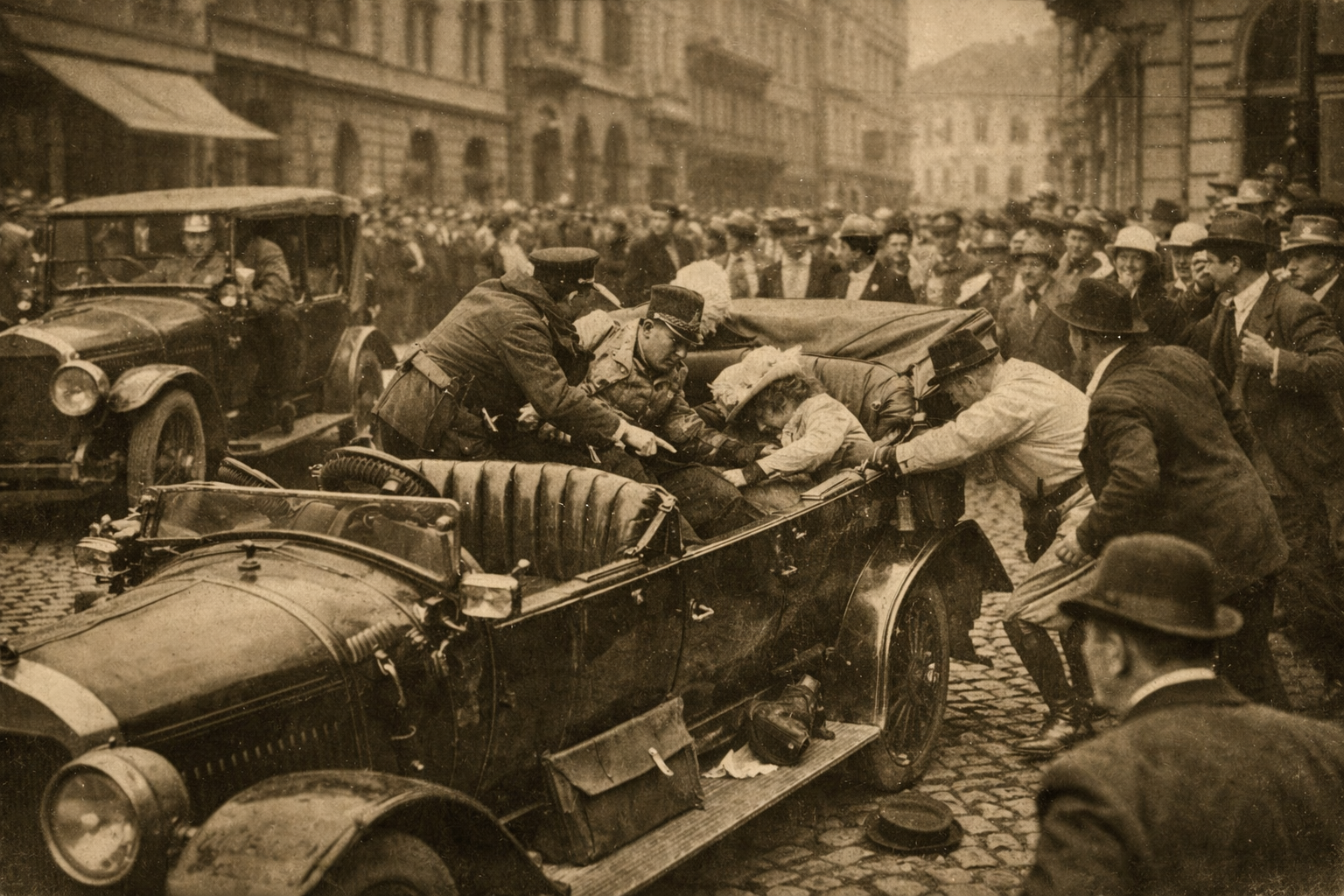
No single criminal act in history triggered consequences as catastrophic as the assassination of Archduke Franz Ferdinand on June 28, 1914. This political murder didn’t just claim two lives—it ignited World War I and reshaped the entire 20th century.
The Powder Keg of Europe 🧨
By 1914, Europe teetered on the brink of war. The Austro-Hungarian Empire’s annexation of Bosnia-Herzegovina in 1908 had inflamed Serbian nationalism, while a complex web of military alliances turned regional tensions into continental threats. The Balkans had become Europe’s “powder keg,” needing only a spark to explode.
Gavrilo Princip provided that spark. The 19-year-old Serbian nationalist belonged to the Black Hand, a secret society dedicated to uniting all South Slavs under Serbian rule. When Archduke Franz Ferdinand announced his visit to Sarajevo—on Serbia’s national day, no less—Princip and his conspirators saw their opportunity.
The Fatal Day
The assassination plot initially failed. Earlier that morning, conspirator Nedeljko Čabrinović had thrown a bomb at the Archduke’s motorcade, but it bounced off and exploded under the wrong car. The royal couple continued their planned route, seemingly safe.
Fate intervened when their driver took a wrong turn onto Franz Joseph Street. As the car stopped to reverse direction, it came to a halt directly in front of Schiller’s delicatessen—where Gavrilo Princip happened to be standing. From just five feet away, Princip fired two shots with his FN Model 1910 pistol. The first bullet struck the Archduke in the neck; the second hit his pregnant wife Sophie in the abdomen.
Both died within minutes.
The Domino Effect
Austria-Hungary’s declaration of war on Serbia activated a chain reaction of military alliances. Russia mobilized to support Serbia, Germany declared war on Russia, France entered to honor its Russian alliance, and Britain joined when Germany invaded Belgium. Within six weeks, most of Europe was at war.
The conflict that followed claimed over 16 million lives and destroyed four empires. How World War I changed warfare forever extended far beyond military tactics—it revolutionized international relations, redrew global maps, and set the stage for an even deadlier second world war.
Lasting Impact
Princip’s shots in Sarajevo demonstrate how individual criminal acts can alter the course of history. The assassination remains a stark reminder that in an interconnected world, local violence can have global consequences. Modern terrorism and political violence still echo the lessons learned from that fatal day in 1914.
2. The Lindbergh Baby Kidnapping (1932)
The kidnapping of Charles Lindbergh Jr. became the “Crime of the Century” long before that phrase lost its impact through overuse. This case transformed American law enforcement and established precedents for handling high-profile kidnappings that remain relevant today.
America’s Hero
Charles Lindbergh Sr. was arguably the most famous person in America in 1932. His solo transatlantic flight in 1927 had made him an international celebrity, and the birth of his son Charles Jr. in 1930 was front-page news nationwide. The Lindberghs represented American achievement and optimism during the depths of the Great Depression.
The Crime
On the evening of March 1, 1932, someone climbed a ladder to the second-floor nursery of the Lindbergh home in Hopewell, New Jersey. They snatched 20-month-old Charles Jr. from his crib, leaving behind a ransom note demanding $50,000. The crude ladder broke during the escape, but the kidnapper successfully fled with the child.
Media Circus and Investigation
The case attracted unprecedented media attention. Hundreds of reporters descended on the small town of Hopewell, turning the investigation into a public spectacle. The New York Police Department, New Jersey State Police, and FBI all became involved, sometimes working at cross-purposes.
The kidnapper made contact through a series of ransom notes, eventually raising the demand to $70,000. Lindbergh, desperate to recover his son, agreed to pay. On April 2, 1932, he delivered the ransom money to a man in a Bronx cemetery who claimed to represent the kidnappers.
Tragic Discovery
Despite paying the ransom, Charles Jr. was never returned alive. On May 12, 1932, his decomposed body was found in woods near the Lindbergh home. The child had died from a skull fracture, likely during the kidnapping itself. The ransom payment had been a cruel deception.
Capture and Trial
The breakthrough came in 1934 when Bruno Hauptmann used one of the marked ransom bills at a gas station. Police found more ransom money hidden in his garage, along with wood that matched the kidnapping ladder. Hauptmann, a German immigrant and carpenter, was arrested and charged with the crime.
The trial became another media sensation. Hauptmann maintained his innocence throughout, but the evidence against him was substantial. He was convicted of first-degree murder and executed in 1936, though some doubts about his guilt persist today.
Legal Legacy
The Lindbergh kidnapping led directly to the Federal Kidnapping Act of 1932, making kidnapping a federal crime when victims are transported across state lines. This “Lindbergh Law” gave the FBI jurisdiction in kidnapping cases and established the death penalty for kidnappers whose victims are harmed.
The case also highlighted the need for better coordination between law enforcement agencies and established protocols for managing media coverage during high-profile investigations. These lessons proved invaluable as America faced other notorious crimes throughout the century.
3. The St. Valentine’s Day Massacre (1929)
No single event better symbolized the violence and lawlessness of Prohibition-era America than the St. Valentine’s Day Massacre. This brazen daylight execution shocked the nation and marked the beginning of the end for organized crime’s golden age.
Prohibition’s Bloody Business
The 18th Amendment, which banned alcohol sales in 1920, created a massive black market that organized crime eagerly filled. Chicago became the epicenter of bootlegging operations, with rival gangs controlling different territories and fighting brutal wars for supremacy.
By 1929, two main factions dominated Chicago’s underworld: Al Capone’s South Side Italian gang and George “Bugs” Moran’s North Side Irish gang. Their rivalry had escalated from business competition to personal vendetta, with dozens of murders on both sides.
The Setup
On February 14, 1929, Moran’s gang received a tip about a truckload of hijacked whiskey available at a warehouse at 2122 North Clark Street. Seven men gathered at the SMC Cartage building that morning, including several of Moran’s top lieutenants. Ironically, Moran himself was running late and never arrived—a delay that likely saved his life.
The Execution
At approximately 10:30 AM, a black Cadillac pulled up outside the warehouse. Four men emerged: two dressed as Chicago police officers, two in civilian clothes. The fake officers entered the building and ordered the seven men inside to line up against the wall for what appeared to be a routine police raid.
Instead of arrests, the visitors opened fire with Thompson submachine guns and shotguns. In less than five minutes, all seven victims lay dead or dying. The shooters calmly walked out, with the “civilians” appearing to be under arrest by the “officers”—a ruse that initially fooled witnesses.
Public Outrage
The massacre’s brutality shocked even violence-hardened Chicagoans. Newspapers published graphic photos of the crime scene, and public opinion began turning against the gangsters who had previously been seen as romantic outlaws fighting unjust Prohibition laws.
The federal government took notice. President Herbert Hoover declared Al Capone “Public Enemy Number One” and ordered a massive investigation. While Capone was never directly linked to the massacre, the increased scrutiny eventually led to his conviction for tax evasion in 1931.
Cultural Impact
The St. Valentine’s Day Massacre became a symbol of organized crime’s excesses and helped build public support for Prohibition’s repeal. The event inspired countless books, movies, and television shows, cementing its place in American popular culture.
More importantly, it demonstrated that even the most powerful criminals weren’t above the law. The massacre marked the peak of Chicago’s gang wars and the beginning of a federal crackdown that would eventually break the power of Prohibition-era organized crime syndicates.
The connection between this era and later criminal organizations can be traced through figures like the famous Irish mobsters who continued operating long after Prohibition ended, adapting their methods but never matching the brazen violence of the 1920s.
4. The Black Dahlia Murder (1947)
Few unsolved crimes have captured public imagination like the Black Dahlia murder. The brutal killing of Elizabeth Short in 1947 Los Angeles combined Hollywood glamour, shocking violence, and media sensationalism into a mystery that remains unsolved nearly 80 years later.
The Victim
Elizabeth Short was a 22-year-old aspiring actress from Massachusetts who had come to Los Angeles chasing Hollywood dreams. Standing 5’5″ with striking black hair and pale skin, she fit the classic image of a 1940s film noir heroine. Short struggled financially and moved frequently between apartments, hotels, and friends’ homes.
Despite later media portrayals, Short was not a prostitute or involved in organized crime. She was simply another young woman trying to make it in Hollywood during the post-war boom. Her nickname “Black Dahlia” came from her preference for black clothing and was coined by the press after her death, possibly referencing the 1946 film “The Blue Dahlia.”
The Discovery
On January 15, 1947, housewife Betty Bersinger was walking with her three-year-old daughter in the Leimert Park neighborhood when she spotted what she initially thought was a discarded mannequin in a vacant lot. Upon closer inspection, she realized it was a human body and immediately called police.
The crime scene was unlike anything investigators had encountered. Short’s body had been cut in half at the waist, drained of blood, and posed in a grotesque display. Her mouth had been slashed from ear to ear in a gruesome “Glasgow smile.” The killer had clearly spent considerable time with the body, suggesting knowledge of anatomy or surgical procedures.
Media Frenzy
The Los Angeles press went into overdrive, with newspapers competing to publish the most sensational details. The case received more coverage than any crime in Los Angeles history, with reporters often interfering with the police investigation. Some journalists even posed as detectives to interview witnesses and potential suspects.
The media attention created a feedback loop of public fascination and increasingly wild theories. Every detail of Short’s life was scrutinized and often distorted, creating a mythology around the victim that overshadowed the actual person she had been.
Investigation Challenges
The LAPD received over 500 confessions from people claiming responsibility for the murder, but none proved credible. The investigation was hampered by contaminated evidence, jurisdictional disputes, and the media circus surrounding the case.
Dozens of suspects emerged over the years, from local doctors to Hollywood figures to drifters passing through Los Angeles. Some investigations pointed to George Hodel, a prominent Los Angeles physician, while others focused on various transients and mentally ill individuals who had made suspicious statements.
Enduring Mystery
Despite numerous books, documentaries, and investigations, Elizabeth Short’s killer was never identified. The case remains officially open, though most of the original investigators and potential suspects are now deceased.
The Black Dahlia murder became a symbol of Los Angeles’s dark underbelly during Hollywood’s golden age. It inspired countless works of fiction and established many tropes still used in crime stories today: the beautiful victim, the incompetent police, the sensationalist media, and the killer who vanishes without a trace.
5. The Assassination of John F. Kennedy (1963)
No event in modern American history has been more thoroughly examined, debated, and mythologized than the assassination of President John F. Kennedy on November 22, 1963. This crime didn’t just kill a president—it shattered America’s innocence and launched a thousand conspiracy theories.
Dallas, November 22
President Kennedy arrived in Dallas as part of a political trip to Texas, riding in an open-top Lincoln Continental through Dealey Plaza at 12:30 PM. The motorcade was traveling slowly to allow crowds to see the popular president and First Lady Jackie Kennedy.
As the presidential limousine turned onto Elm Street, shots rang out. The first bullet missed entirely, the second struck Kennedy in the back and exited through his throat, and the third delivered the fatal head wound captured in the infamous Zapruder film. Texas Governor John Connally, riding in the same car, was also wounded but survived.
The Suspect
Within hours, police arrested Lee Harvey Oswald, a 24-year-old former Marine and self-proclaimed Marxist who worked at the Texas School Book Depository overlooking Dealey Plaza. Evidence linking Oswald to the crime included his ownership of the murder weapon, his presence in the building during the shooting, and his suspicious behavior afterward.
However, Oswald never stood trial. On November 24, while being transferred between jails, he was shot and killed by nightclub owner Jack Ruby in front of television cameras. Ruby’s motive remains unclear, though he claimed he wanted to spare Jackie Kennedy the ordeal of a trial.
The Warren Commission
President Lyndon Johnson appointed Chief Justice Earl Warren to head a commission investigating the assassination. After ten months of investigation, the Warren Commission concluded that Oswald acted alone in killing Kennedy and that Ruby acted alone in killing Oswald.
The commission’s 888-page report addressed numerous conspiracy theories but failed to satisfy many Americans. Critics pointed to inconsistencies in witness testimony, questions about the “magic bullet” theory, and the suspicious circumstances surrounding key evidence.
Conspiracy Culture
The Kennedy assassination spawned an entire industry of conspiracy theories. Alternative explanations have implicated the CIA, the Mafia, Cuban exiles, the Soviet Union, and even Vice President Johnson. Popular culture embraced these theories, with films like Oliver Stone’s “JFK” presenting conspiracy scenarios as fact.
Polls consistently show that most Americans believe in some form of conspiracy, despite multiple official investigations reaching the same conclusion as the Warren Commission. The House Select Committee on Assassinations (1976-1979) found a “probable conspiracy” based on acoustic evidence but couldn’t identify additional shooters.
Cultural Impact
Kennedy’s assassination marked the end of what many consider America’s age of innocence. The event coincided with escalating involvement in Vietnam, growing civil rights tensions, and increasing distrust of government institutions. The phrase “where were you when Kennedy was shot?” became a generational touchstone.
The assassination also transformed how presidents are protected, leading to massive changes in Secret Service procedures and protocols. The open, accessible presidency that Kennedy represented largely ended that day in Dallas.
Ongoing Debates
In 2026, nearly 63 years after the assassination, debates continue. The release of classified documents has provided new details but no smoking guns. The case remains a perfect storm of tragedy, mystery, and cultural significance that ensures its place among the most Famous Crimes of the 20th Century.
6. The Manson Family Murders (1969)
The Manson Family murders didn’t just shock America—they shattered the idealism of the 1960s counterculture movement and revealed the dark potential lurking beneath the era’s message of peace and love. These crimes marked a violent end to the decade’s utopian dreams.
The Cult Leader
Charles Manson was a career criminal and charismatic manipulator who attracted a following of mostly young, middle-class women seeking meaning in the turbulent late 1960s. Manson preached an apocalyptic philosophy he called “Helter Skelter,” based on his twisted interpretation of Beatles lyrics, predicting a race war that would destroy civilization.
Living on the remote Spahn Ranch outside Los Angeles, Manson’s “Family” grew to include about 100 followers who saw him as a messianic figure. He used drugs, sex, and psychological manipulation to maintain control over his disciples, gradually preparing them for violence.
The Tate Murders
On August 9, 1969, Manson sent four Family members—Susan Atkins, Patricia Krenwinkel, Linda Kasabian, and Charles “Tex” Watson—to 10050 Cielo Drive in Benedict Canyon. Their target was Terry Melcher, a record producer who had previously lived there, but the house was now occupied by director Roman Polanski and his pregnant wife, actress Sharon Tate.
Polanski was in Europe filming, but Tate was home with friends: Jay Sebring, Abigail Folger, and Wojciech Frykowski. The killers also murdered Steven Parent, an 18-year-old visiting the property’s caretaker. All five victims were brutally stabbed and shot, with “PIG” written in blood on the front door.
The LaBianca Murders
The following night, Manson personally led another group to the Los Feliz home of Leno and Rosemary LaBianca, wealthy grocery store owners chosen apparently at random. After securing the victims, Manson left Watson, Krenwinkel, and Leslie Van Houten to carry out the murders. The killers carved “WAR” into Leno’s stomach and wrote “DEATH TO PIGS” and “HEALTER SKELTER” in blood on the walls.
Investigation and Arrest
Initially, police didn’t connect the two crime scenes. The breakthrough came when Family member Susan Atkins, arrested on unrelated charges, boasted about the murders to cellmates. Her detailed confessions led to the arrest of Manson and his followers.
The investigation revealed the full scope of Manson’s influence and the Family’s other crimes, including additional murders that may never be fully documented. The randomness of victim selection particularly terrified the public—if Sharon Tate wasn’t safe in her Benedict Canyon mansion, no one was safe anywhere.
The Trial
The trial became a media circus, with Manson and his co-defendants disrupting proceedings, carving X’s into their foreheads, and making bizarre statements. Manson’s courtroom behavior—including attempting to attack the judge—reinforced his image as a dangerous madman.
Linda Kasabian, who had participated in both nights but not committed violence, became the prosecution’s key witness in exchange for immunity. Her testimony provided crucial details about the Family’s activities and Manson’s control over his followers.
Cultural Impact
The Manson murders effectively ended the 1960s counterculture movement’s mainstream appeal. The idea that hippie communes could harbor such violence shattered public tolerance for alternative lifestyles and communal living experiments.
The case also highlighted the dangers of cult manipulation and charismatic leadership. Manson became the archetypal cult leader, and his methods of control are still studied by psychologists and law enforcement agencies dealing with similar groups.
Legacy
Charles Manson died in prison in 2017, but the cultural impact of his crimes continues. The murders remain a touchstone for discussions about evil, manipulation, and the loss of innocence. They represent a dark turning point when America realized that the idealism of the 1960s could be corrupted into something monstrous.
The connection between charismatic criminal leaders and their followers echoes through other Famous Crimes of the 20th Century, demonstrating how individual evil can spread through manipulation and shared delusion.
7. The Zodiac Killer Case (Late 1960s–1970s)
The Zodiac Killer terrorized Northern California for over a decade, but his greatest weapon wasn’t his gun—it was his ability to manipulate media and law enforcement through cryptic letters and ciphers. This case pioneered the modern serial killer’s use of communication as both weapon and shield.
Reign of Terror
Between 1968 and 1969, the Zodiac Killer committed at least five confirmed murders in the San Francisco Bay Area, though he claimed responsibility for 37 deaths. His confirmed victims included high school students David Faraday and Betty Lou Jensen, college student Darlene Ferrin, college student Cecelia Shepard, and taxi driver Paul Stine.
The attacks showed no clear pattern beyond their brutality. The killer used different weapons—guns, knives—and struck in various locations from remote lovers’ lanes to busy city streets. This unpredictability made him nearly impossible to track and kept the entire region in fear.
The Letters
What set the Zodiac apart from other serial killers was his compulsive need to communicate with police and media. Beginning in July 1969, he sent a series of letters to San Francisco newspapers, each containing details only the killer would know.
The first letters included pieces of a 408-character cipher that the killer claimed contained his identity. When cracked by a local couple, the cipher revealed a rambling message about collecting slaves for the afterlife but no useful identifying information.
Psychological Warfare
The Zodiac’s letters weren’t just confessions—they were psychological weapons designed to terrorize the public and taunt law enforcement. He threatened to kill school children, claimed to have bombs, and provided detailed descriptions of his crimes to prove his authenticity.
His correspondence included complex ciphers, some of which remain unsolved today. The killer seemed to enjoy the intellectual game, challenging police and amateur codebreakers while maintaining his anonymity. This cat-and-mouse dynamic kept him in headlines long after his last confirmed murder.
Investigation Challenges
The Zodiac case involved multiple jurisdictions with varying levels of cooperation. The killer’s ability to strike across county lines complicated the investigation, while his letters created false leads and conspiracy theories that diverted resources from legitimate detective work.
Police developed several suspects over the years, including Arthur Leigh Allen, a convicted child molester who died in 1992. While circumstantial evidence linked Allen to the crimes, definitive proof remained elusive. DNA testing of evidence has eliminated some suspects but hasn’t identified the killer.
Cultural Impact
The Zodiac Killer became the template for the modern serial killer in popular culture. His combination of random violence and intellectual games influenced countless books, movies, and television shows. The 2007 film “Zodiac” brought renewed attention to the case and its impact on the investigators who became obsessed with solving it.
The case also demonstrated how serial killers could use media attention to amplify their terror. The Zodiac’s letters created a feedback loop where media coverage encouraged more communication, which generated more coverage, keeping the killer in the public eye even during periods of inactivity.
Modern Developments
In 2020, amateur codebreakers finally solved the Zodiac’s 340-character cipher, sent in 1969. The message was another rambling taunt with no identifying information, but the breakthrough showed that modern computing power could crack codes that had stumped investigators for decades.
Despite numerous investigations, documentaries, and amateur detective work, the Zodiac Killer’s identity remains unknown. The case file stays open, though most investigators believe the killer is likely dead given the decades that have passed since his last confirmed communication.
Lasting Mystery
The Zodiac case represents the perfect unsolved crime: enough evidence to know a brilliant killer was responsible, but not enough to identify him. This combination of certainty and mystery ensures the case remains one of the most discussed among Famous Crimes of the 20th Century, inspiring new theories and investigations well into the 21st century.
8. The Watergate Scandal (1972–1974)
While not a traditional violent crime, the Watergate scandal ranks among the most consequential criminal cases of the 20th century. This political crime toppled a presidency, transformed American journalism, and fundamentally altered how citizens view their government.
The Break-In
On June 17, 1972, five men were arrested while burglarizing the Democratic National Committee headquarters in the Watergate complex in Washington, D.C. The burglars carried sophisticated surveillance equipment and large amounts of cash, suggesting this wasn’t a typical robbery.
Initial media coverage treated it as a minor local crime story. The arrested men included James McCord, security coordinator for President Nixon’s re-election campaign, but the White House dismissed any connection as coincidental. Press Secretary Ron Ziegler famously called it a “third-rate burglary attempt.”
The Investigation
Two young Washington Post reporters, Bob Woodward and Carl Bernstein, began investigating connections between the burglars and the Nixon administration. Their source, known only as “Deep Throat” (later revealed to be FBI Associate Director Mark Felt), provided crucial guidance that kept the investigation moving forward.
The reporters discovered that the break-in was part of a broader campaign of political espionage and sabotage directed against Nixon’s opponents. Money used to fund the operation was traced back to Nixon’s re-election committee, suggesting high-level involvement in the crimes.
The Cover-Up
As investigations intensified, evidence emerged of a systematic cover-up reaching into the highest levels of government. White House officials had attempted to limit the FBI investigation, paid hush money to the burglars, and destroyed potentially incriminating documents.
The cover-up proved more damaging than the original crime. Nixon’s attempts to use executive privilege and claims of national security to block investigations only increased suspicions about his involvement. The phrase “what did the president know and when did he know it?” became the investigation’s central question.
Congressional Hearings
In 1973, the Senate established a special committee to investigate Watergate. The televised hearings captivated the nation and revealed the extent of political corruption in the Nixon administration. Key testimony came from White House counsel John Dean, who directly implicated Nixon in the cover-up.
The most dramatic revelation came when White House aide Alexander Butterfield disclosed that Nixon had secretly recorded all Oval Office conversations. These tapes became the smoking gun that could definitively prove or disprove Nixon’s involvement in the scandal.
The Tapes
Nixon’s refusal to release the tapes led to a constitutional crisis. When he fired Special Prosecutor Archibald Cox for pursuing the recordings, the “Saturday Night Massacre” triggered calls for impeachment. The Supreme Court ultimately ruled that executive privilege couldn’t override judicial subpoenas for criminal evidence.
When the tapes were finally released, they revealed Nixon’s direct involvement in the cover-up and included the infamous 18½-minute gap that suggested deliberate evidence destruction. The recordings showed a president willing to abuse his power to protect himself and his associates.
Resignation
Facing certain impeachment and removal from office, Nixon became the first U.S. president to resign on August 9, 1974. His departure marked the end of a constitutional crisis that had paralyzed the government for two years and deeply damaged public trust in political institutions.
Vice President Gerald Ford’s subsequent pardon of Nixon prevented criminal prosecution but sparked controversy about whether justice had been served. Many of Nixon’s associates, including Attorney General John Mitchell and White House Chief of Staff H.R. Haldeman, served prison sentences for their roles in the scandal.
Long-Term Impact
Watergate fundamentally changed American politics and journalism. The scandal demonstrated that investigative reporting could hold even the most powerful officials accountable, inspiring a generation of journalists to pursue similar exposés.
The case also led to significant reforms in campaign finance, government ethics, and presidential powers. Laws requiring financial disclosure, limiting executive privilege, and strengthening congressional oversight all emerged from the Watergate experience.
Cultural Legacy
The suffix “-gate” became shorthand for political scandals, while “Deep Throat” entered popular culture as the archetypal anonymous source. The scandal reinforced cynicism about government that had been growing since the Vietnam War and continues to influence American political discourse today.
Watergate proved that in America, no one is above the law—not even the president. This principle, tested during one of the nation’s greatest constitutional crises, remains a cornerstone of American democracy and secures Watergate’s place among the most significant Famous Crimes of the 20th Century.
9. The Tylenol Murders (1982)
The Chicago Tylenol murders introduced America to a terrifying new form of random violence: product tampering. This case changed how we buy medicine, transformed packaging safety, and created a template for domestic terrorism that remains relevant in 2026.
Seven Random Deaths
Between September 29 and October 1, 1982, seven people in the Chicago area died after taking Extra-Strength Tylenol capsules laced with potassium cyanide. The victims—ranging in age from 12 to 35—had no connection to each other except their fatal choice of pain reliever.
The first victim, 12-year-old Mary Kellerman, died after taking Tylenol for cold symptoms. Within days, similar deaths occurred across the region. The randomness was particularly terrifying: anyone who happened to buy the wrong bottle could die within minutes of taking what they thought was safe medication.
Investigation and Panic
Chicago police initially didn’t connect the deaths until they noticed the common link: all victims had recently taken Tylenol. Testing revealed that someone had opened capsules, replaced the medicine with cyanide, and returned the bottles to store shelves.
The discovery triggered immediate panic. Johnson & Johnson, Tylenol’s manufacturer, issued a nationwide recall of 31 million bottles—a $100 million decision that likely saved countless lives. Stores pulled Tylenol from shelves, and many people discarded all over-the-counter medications from their homes.
The Investigation
The FBI launched one of the largest investigations in its history, interviewing over 35,000 people and following up on hundreds of thousands of leads. The case was particularly challenging because the tampering could have occurred anywhere in the supply chain, from manufacturing to retail shelves.
Investigators determined that the tampering occurred after the bottles reached stores, ruling out factory contamination. The killer had somehow obtained bottles, carefully opened them, replaced contents with cyanide, and returned them to shelves—all without detection.
Copycat Crimes
The Tylenol murders inspired numerous copycat incidents across the country. Reports of tampered products flooded in, though most proved to be false alarms or hoaxes. However, several legitimate cases of product tampering occurred, showing how one criminal’s method could spread nationwide.
The copycat effect demonstrated a new form of terrorism: using consumer products as weapons to create widespread fear. The randomness made it impossible for people to protect themselves through normal precautions, creating anxiety that extended far beyond Chicago.
Industry Response
The crisis transformed product packaging across industries. Tamper-evident seals, which were rare before 1982, became standard on medications, foods, and cosmetics. The familiar safety features we take for granted today—shrink bands, foil seals, and tamper-evident caps—all emerged from this tragedy.
Johnson & Johnson’s response became a textbook case in crisis management. The company’s immediate recall, cooperation with authorities, and development of new tamper-resistant packaging helped restore public trust and actually strengthened the Tylenol brand long-term.
Legal Changes
The murders led to the Federal Anti-Tampering Act of 1983, making product tampering a federal crime punishable by up to life in prison. The law gave federal authorities jurisdiction over cases that cross state lines and established severe penalties for product contamination.
These legal changes recognized that product tampering wasn’t just murder—it was a form of terrorism that could destabilize entire industries and undermine public confidence in consumer safety.
The Unsolved Mystery
Despite the massive investigation, the Tylenol killer was never identified. The case remains open, though most investigators believe the perpetrator is likely dead given the decades that have passed. Several suspects were investigated over the years, but none were charged with the murders.
The unsolved nature of the case adds to its lasting impact. The killer demonstrated that someone could commit mass murder, terrorize an entire nation, and disappear without a trace. This possibility continues to influence security measures and emergency response planning.
Modern Relevance
The Tylenol murders established the template for modern product terrorism and bioterrorism concerns. The case showed how easily consumer products could be weaponized and how quickly panic could spread through modern media coverage.
In 2026, as supply chains become increasingly global and complex, the lessons from the Tylenol murders remain relevant. The case demonstrated that protecting public safety requires constant vigilance, industry cooperation, and the ability to respond quickly to emerging threats.
10. The O.J. Simpson Case (1994–1995)
No criminal trial in American history received more media coverage or generated more public discussion than the O.J. Simpson murder case. This “Trial of the Century” exposed deep racial divisions in American society and transformed how the public views celebrity, justice, and the legal system.
The Victims
On June 12, 1994, Nicole Brown Simpson, the ex-wife of former NFL star O.J. Simpson, was found brutally murdered outside her Brentwood condominium along with Ronald Goldman, a waiter returning sunglasses she had left at a restaurant. Both victims had suffered multiple stab wounds in what appeared to be a frenzied attack.
Nicole had divorced Simpson in 1992 after a turbulent marriage marked by documented domestic violence. Police had responded to several domestic disturbance calls at the Simpson home, and Nicole had obtained restraining orders against her ex-husband. This history of abuse would become central to the prosecution’s case.
The Suspect
O.J. Simpson was one of America’s most recognizable celebrities. The former Heisman Trophy winner and NFL Hall of Famer had transitioned into acting and broadcasting after his football career. His public image was that of a charismatic, successful African American who had transcended racial barriers to achieve mainstream acceptance.
However, behind this public persona was evidence of a controlling and violent relationship with Nicole. Police records documented multiple incidents of domestic abuse, including a 1989 assault for which Simpson pleaded no contest and received only probation and community service.
The Evidence
The prosecution presented what seemed like overwhelming evidence against Simpson:
- DNA evidence linking his blood to the crime scene
- A history of domestic violence against Nicole
- No alibi for the time of the murders
- Physical evidence including a bloody glove found at his home
- A pattern of controlling behavior toward his ex-wife
The defense, led by Johnnie Cochran, Alan Dershowitz, and F. Lee Bailey (dubbed the “Dream Team”), challenged every piece of evidence and raised questions about police competence and potential misconduct.
The Trial
Judge Lance Ito allowed television cameras in the courtroom, turning the trial into a daily drama watched by millions. The proceedings revealed stark differences in how Black and white Americans viewed the case, with polls showing overwhelming belief in Simpson’s guilt among whites and innocence among Blacks.
The defense successfully shifted focus from Simpson’s guilt to alleged police racism and incompetence. They highlighted Detective Mark Fuhrman’s racist statements and suggested evidence had been planted. The famous glove demonstration, where Simpson struggled to put on the bloody gloves while wearing latex gloves underneath, provided a dramatic moment that seemed to support the defense.
The Verdict
On October 3, 1995, after less than four hours of deliberation, the jury found Simpson not guilty on all criminal charges. The verdict created a stark racial divide: television coverage showed Black Americans celebrating while white Americans watched in shock and disbelief.
The acquittal highlighted deep divisions in American society about race, justice, and the legal system. Many African Americans saw the verdict as justice finally being served to a Black man by a system that had historically discriminated against them. Many white Americans saw it as a miscarriage of justice where celebrity and race trumped evidence.
Civil Trial
In 1997, a civil jury found Simpson liable for the wrongful deaths of both victims and ordered him to pay $33.5 million in damages. The civil trial had different rules of evidence and a lower burden of proof (“preponderance of evidence” rather than “beyond a reasonable doubt”), allowing the plaintiffs to present a more complete case.
Cultural Impact
The Simpson case marked a watershed moment in American race relations and media coverage of criminal trials. It demonstrated how the same evidence could be interpreted completely differently depending on one’s perspective on race and the justice system.
The trial also established the template for modern media circuses around high-profile cases. The combination of celebrity, violence, race, and wealth created irresistible television that changed how news organizations cover criminal proceedings.
Legacy
The O.J. Simpson case remains a touchstone for discussions about race, celebrity justice, and domestic violence. It highlighted how wealth and fame can influence legal outcomes and exposed the different realities experienced by Black and white Americans in the criminal justice system.
The case also advanced public understanding of DNA evidence and domestic violence, even as it raised questions about how these issues are handled in high-profile cases. The trial’s impact on American culture ensures its place among the most significant Famous Crimes of the 20th Century.
Conclusion
These ten Famous Crimes of the 20th Century share common threads that explain their enduring fascination: they combined shocking violence with compelling mysteries, occurred during pivotal moments in history, and were amplified by evolving media technology. From Gavrilo Princip’s shots that triggered World War I to O.J. Simpson’s trial that exposed America’s racial divisions, each case reflected and shaped the society in which it occurred.
The Media Revolution 📺
The 20th century witnessed the transformation of crime reporting from local newspaper stories to global media events. Radio, television, and mass-circulation magazines allowed shocking crimes to reach unprecedented audiences instantly. This media attention didn’t just report on crimes—it shaped public perception, influenced investigations, and sometimes even affected legal outcomes.
Forensic Evolution 🔬
These cases drove major advances in criminal investigation techniques. The Lindbergh kidnapping led to federal jurisdiction laws, the Zodiac case pushed cipher analysis forward, and the O.J. Simpson trial introduced DNA evidence to mainstream America. Each investigation revealed the limitations of existing methods and spurred innovations that improved law enforcement capabilities.
Cultural Mirrors 🪞
More than just criminal acts, these crimes served as mirrors reflecting broader social anxieties and transformations. The Manson murders marked the end of 1960s idealism, Watergate shattered trust in government, and the Tylenol murders introduced fears of random consumer terrorism. They became cultural touchstones that helped define entire eras.
Lasting Questions ❓
Many of these cases remain partially or completely unsolved, fueling ongoing fascination and conspiracy theories. The Black Dahlia, Zodiac Killer, and JFK assassination continue generating new books, documentaries, and investigations. This combination of known facts and persistent mysteries creates perfect conditions for enduring public interest.
Modern Relevance 🔄
The lessons from these Famous Crimes of the 20th Century remain relevant in 2026. Product tampering concerns echo the Tylenol murders, political scandals still earn the “-gate” suffix from Watergate, and high-profile trials continue following the media circus template established by the Simpson case. Understanding these historical crimes provides insight into contemporary criminal justice challenges.
Next Steps for Crime Enthusiasts 📚
To deepen your understanding of criminal history:
- Explore related cases from earlier periods, including 19th-century gangsters who laid groundwork for 20th-century organized crime
- Study forensic advances that emerged from these investigations and continue evolving today
- Examine media coverage to understand how reporting shaped public perception and legal outcomes
- Research legal reforms that resulted from these cases and their ongoing impact on criminal justice
- Consider psychological factors that drive both criminal behavior and public fascination with notorious crimes
These crimes didn’t just make headlines—they made history. Their impact extends far beyond their immediate victims to influence law, culture, and society in ways still felt today. By understanding these cases, we gain insight not just into criminal behavior, but into the societies that produced, investigated, and remembered them. The 20th century’s most famous crimes continue teaching us about justice, media, and human nature as we navigate the criminal challenges of the 21st century.