
Before bombs could destroy cities in hours, sieges destroyed them slowly—through starvation, disease, fear, and relentless violence. These prolonged military campaigns represented warfare at its most merciless, where entire populations became trapped behind walls that transformed from protection into prison cells.
Throughout history, brutal sieges that turned cities into graveyards have demonstrated humanity’s capacity for both endurance and cruelty. Unlike quick battles that decided outcomes in days, sieges stretched for months or years, creating conditions where survival itself became a daily battle. The true horror lay not just in the military tactics, but in watching civilizations slowly collapse from within.
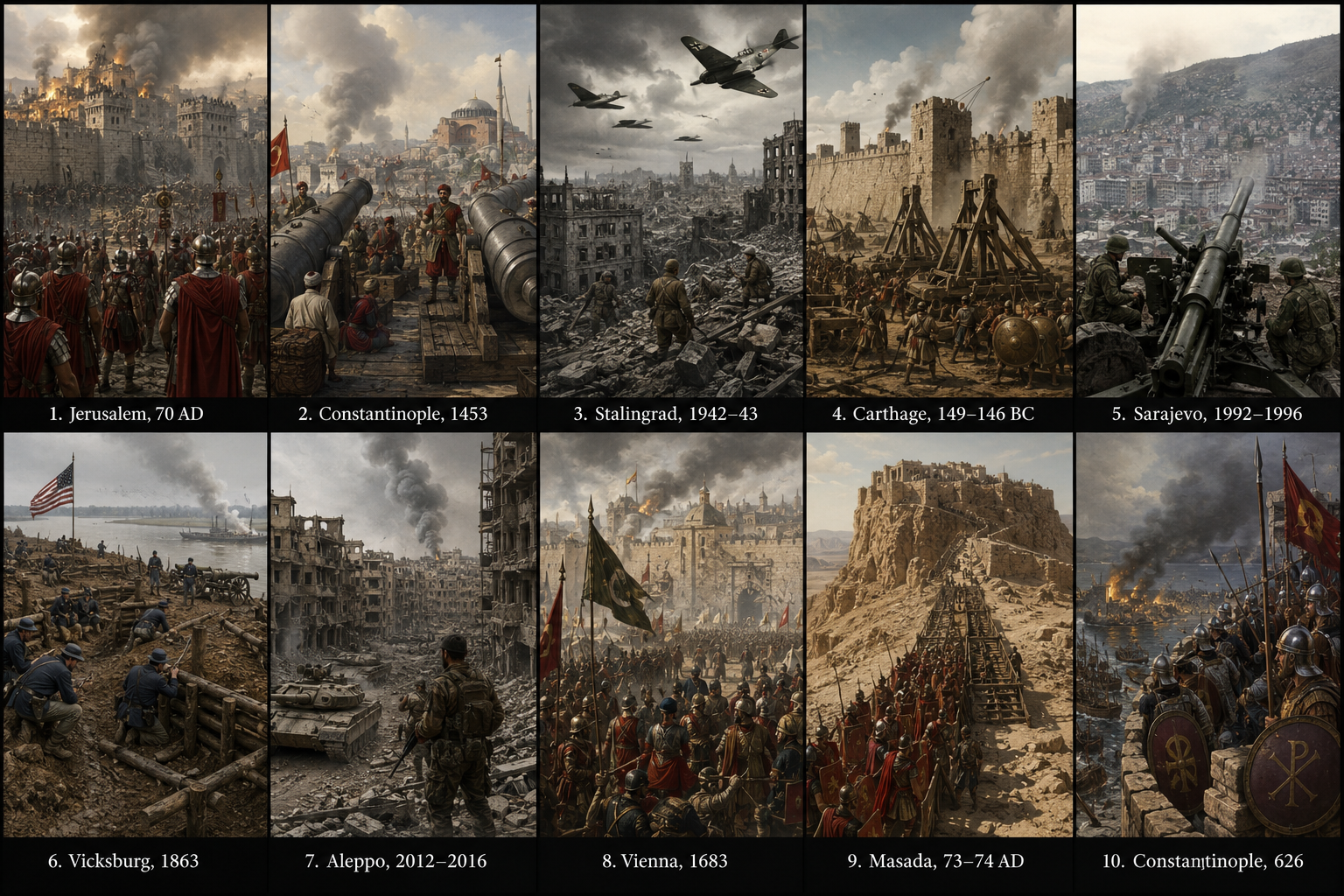
These ten sieges reveal how cities—symbols of human achievement and progress—could become monuments to suffering and death. Each represents a different era of warfare, yet all share the common thread of transforming bustling urban centers into landscapes of desperation and destruction.
Key Takeaways
• Sieges weaponized basic human needs – Food, water, and safety became tools of warfare as attackers systematically cut off supply lines
• Civilians suffered disproportionately – Non-combatants often faced higher death rates than soldiers due to starvation, disease, and exposure
• Psychological warfare proved devastating – The mental toll of prolonged isolation and constant threat often broke defenders before physical assault
• Technology shaped siege outcomes – From Roman engineering to modern artillery, military innovations determined which cities survived and which became graveyards
• Strategic locations paid the highest price – Cities controlling trade routes, religious sites, or political power faced the most brutal and determined sieges
Why Sieges Were Warfare’s Most Devastating Tactic
Siege warfare represented a calculated form of destruction that went far beyond traditional battlefield confrontations. When armies surrounded a city, they created a closed system where every resource became finite and every day brought inhabitants closer to collapse.
The effectiveness of sieges stemmed from their ability to turn a city’s strengths against itself. High walls that once provided security became barriers preventing escape. Dense populations that represented prosperity became breeding grounds for disease. Food stores that ensured stability became countdown timers to starvation.
The Anatomy of Urban Destruction
Cities under siege experienced a predictable descent into chaos:
- Week 1-4: Initial optimism and rationing
- Month 2-3: Food shortages and social tension
- Month 4+: Starvation, disease, and social collapse
- Final phase: Desperation leading to surrender or massacre
Disease often proved more lethal than enemy weapons. Typhus, dysentery, and plague thrived in overcrowded, unsanitary conditions. Historical records show that bloody events throughout history often involved sieges where disease killed more people than direct combat.
The psychological impact compounded physical suffering. Constant fear, uncertainty about loved ones outside the walls, and witnessing daily deaths created trauma that lasted generations. Survivors of major sieges often described the experience as watching their world slowly die around them.
The 10 Most Brutal Sieges That Turned Cities Into Graveyards
1. The Siege of Stalingrad (1942-1943) 🏭
The Battle of Stalingrad transformed an industrial city into history’s most devastating urban battlefield. German forces, expecting quick victory, instead found themselves trapped in months of brutal house-to-house combat that reduced the city to rubble and bones.
The Descent into Hell: By winter 1942, Stalingrad had become unrecognizable. Entire city blocks disappeared under artillery bombardment. Civilians who couldn’t evacuate lived in basements and sewers, emerging only to search for food among the ruins. The Volga River, frozen solid, became a highway for supplies—and a graveyard for those who didn’t make it across.
German soldiers described fighting for individual rooms in apartment buildings, only to discover the next floor held enemy troops. The city’s factories continued producing tanks even as battles raged in their corridors. Over 1.2 million people died in and around Stalingrad, making it one of the deadliest sieges in human history.
The siege’s brutality stemmed from its strategic importance. Hitler demanded the city bearing Stalin’s name, while Soviet forces received orders to defend every building to the death. This political symbolism transformed military strategy into a death match where retreat meant execution by one’s own side.
2. The Siege of Leningrad (1941-1944) ❄️
For 872 days, Leningrad endured the longest siege in modern warfare. The German army’s plan was simple: surround the city and starve its 3 million inhabitants into submission. What followed became a testament to human endurance under impossible conditions.
Starvation as Warfare: By December 1941, daily bread rations dropped to 125 grams—less than three slices. People ate wallpaper paste, leather belts, and sawdust mixed with flour. The city’s zoo animals disappeared into cooking pots. Cannibalism, though officially denied, became an open secret as social norms collapsed under extreme hunger.
The first winter proved catastrophic. With no fuel for heating and temperatures dropping to -30°F, residents burned furniture, books, and wooden buildings for warmth. Bodies accumulated faster than burial crews could remove them. Over 1 million civilians died, most from starvation and cold rather than enemy action.
Yet Leningrad refused to surrender. The city’s cultural institutions—the Hermitage, the Philharmonic—continued operating even as staff members died at their posts. This defiance became legendary, but the human cost transformed the “Hero City” into a massive graveyard where survival itself became an act of resistance.
3. The Siege of Jerusalem (70 CE) ⛪
When Roman legions surrounded Jerusalem during the First Jewish-Roman War, they initiated a siege that would destroy the Second Temple and scatter the Jewish people for nearly 2,000 years. The Roman historian Josephus documented horrors that shocked even hardened soldiers.
Ancient Brutality: The Romans built a siege wall around Jerusalem, trapping over 1 million people inside during Passover. As food supplies dwindled, famine reached biblical proportions. Josephus recorded instances of mothers cooking their own children, and wealthy families dying beside piles of gold that couldn’t buy a single grain of wheat.
The siege revealed the calculated cruelty of Roman military engineering. Legions crucified Jewish prisoners within sight of the city walls—sometimes 500 per day—creating a forest of crosses designed to break defender morale. When the walls finally fell, Roman soldiers slaughtered inhabitants indiscriminately, turning the Temple Mount into a killing field.
The destruction extended beyond immediate casualties. Romans systematically dismantled Jerusalem’s walls, burned the Temple, and enslaved survivors. This siege didn’t just end a rebellion—it eliminated Jewish political independence and began a diaspora that lasted until 1948. The city that had been the center of Jewish civilization became a cautionary tale about the price of defying Rome.
4. The Siege of Constantinople (1453) 🕌
The fall of Constantinople marked the end of the Byzantine Empire and demonstrated how new military technology could overcome even the world’s strongest fortifications. Sultan Mehmed II’s massive cannons shattered walls that had protected the city for over 1,000 years.
When Walls Became Worthless: Constantinople’s triple-layered walls had repelled countless sieges, but Mehmed’s Hungarian engineer Orban created cannons that fired 600-pound stone balls. The largest cannon, nicknamed “Basilica,” could be heard 10 miles away and required 60 oxen to move. These weapons represented a revolution in siege warfare that made traditional fortifications obsolete.
The 53-day siege combined medieval tactics with Renaissance technology. Ottoman forces used Greek fire, undermining, naval blockades, and psychological warfare alongside their artillery. Emperor Constantine XI died fighting on the walls, and his body was never definitively identified among the thousands of corpses.
The city’s fall sent shockwaves across Europe and marked the definitive end of the Roman Empire that had lasted over 1,400 years. Ottoman forces transformed the Hagia Sophia from Christianity’s greatest cathedral into a mosque, symbolizing not just military victory but civilizational change. Constantinople’s transformation into Istanbul represented one of history’s most significant cultural shifts achieved through siege warfare.
5. The Siege of Sarajevo (1992-1996) 📺
The longest siege in modern European history brought medieval warfare tactics to the television age. Bosnian Serb forces surrounded Sarajevo for 1,425 days, subjecting 380,000 residents to constant sniper fire, artillery bombardment, and systematic starvation.
Modern Medieval Warfare: Unlike historical sieges, Sarajevo’s ordeal played out on international television. The world watched as civilians sprinted across “Sniper Alley” to avoid rifle fire, queued for water under mortar threat, and buried loved ones in parks because cemeteries were too dangerous to reach.
The siege’s psychological dimension proved particularly cruel. Attackers positioned on surrounding hills could observe daily life through rifle scopes, turning routine activities into life-or-death gambles. Children grew up never knowing safety, developing games that mimicked dodging bullets and identifying weapon sounds.
Despite international attention, the siege continued for nearly four years. Over 11,000 people died, including 1,600 children. The city’s multicultural character—Bosniaks, Serbs, and Croats who had lived together for generations—became both a target for ethnic cleansing and a symbol of resistance. Sarajevo’s survival proved that even in the 1990s, cities could still be transformed into graveyards through siege warfare.
6. The Siege of Carthage (149-146 BCE) ⚔️
Rome’s final siege of Carthage represented warfare aimed not at conquest but at complete annihilation. The Third Punic War’s conclusion demonstrated how sieges could erase entire civilizations from history.
Systematic Extermination: After breaching Carthage’s walls, Roman forces spent six days clearing the city house by house. Defenders and civilians alike were killed or enslaved. 150,000 survivors were sold into slavery, while the city itself was systematically demolished. Romans then plowed salt into the ground—though this detail may be legendary—to ensure nothing would grow there again.
The siege’s brutality stemmed from Roman determination to eliminate their greatest rival permanently. Carthage had threatened Rome’s existence during the Punic Wars, and Roman leaders decided that coexistence was impossible. This wasn’t conquest for territory or tribute, but genocide designed to remove Carthaginian civilization entirely.
The destruction succeeded completely. Carthage, once the Mediterranean’s greatest trading power, vanished from history. Its libraries burned, its people scattered or enslaved, its very location eventually forgotten until archaeologists rediscovered it centuries later. This siege proved that determined attackers could achieve what natural disasters rarely accomplished: the complete erasure of a major civilization.
7. The Siege of Vicksburg (1863) 🇺🇸
Vicksburg’s 47-day siege during the American Civil War demonstrated how modern artillery could terrorize civilian populations while achieving strategic military objectives. The “Gibraltar of the Confederacy” controlled Mississippi River traffic, making its capture essential for Union victory.
Underground Survival: As Union artillery pounded the city with over 22,000 shells, residents retreated into caves carved from hillsides. These underground refuges housed entire families for weeks, creating a subterranean city complete with furniture, kitchens, and makeshift schools. Children were born and died in these caves, never seeing sunlight during the siege.
Food shortages forced residents to eat mules, rats, and shoe leather. The city’s newspaper began printing on wallpaper when regular paper ran out. Confederate soldiers, weakened by malnutrition, could barely man their defensive positions by the siege’s end.
Vicksburg’s fall gave the Union complete control of the Mississippi River, effectively splitting the Confederacy in half. The strategic victory came at enormous cost to civilians who had no voice in the political decisions that made their city a target. Local residents reportedly refused to celebrate July 4th for decades afterward, marking how siege trauma could persist long after military objectives were achieved.
8. The Siege of Aleppo (2012-2016) 🏢
Syria’s ancient trading city became a modern battlefield where historical patterns of urban warfare repeated with 21st-century weapons. The siege of eastern Aleppo trapped 275,000 civilians in an area smaller than Manhattan’s Central Park.
Urban Warfare Evolution: Government forces used barrel bombs—crude devices filled with explosives and shrapnel—dropped from helicopters to terrorize civilian areas. Hospitals and schools became deliberate targets, forcing medical staff to operate in underground facilities. The siege demonstrated how modern warfare could combine medieval starvation tactics with precision-guided munitions.
International aid organizations struggled to deliver supplies through dangerous corridors. Thousands of civilians died, many from preventable diseases and malnutrition rather than direct combat. Children comprised a significant portion of casualties, highlighting how siege warfare particularly impacts the most vulnerable populations.
The siege’s documentation through social media created unprecedented real-time coverage of urban destruction. Residents posted videos from bombed buildings, doctors livestreamed operations, and children recorded final messages as neighborhoods fell. This digital documentation preserved evidence of siege warfare’s human cost in ways previous generations couldn’t achieve.
9. The Siege of Vienna (1529 & 1683) 🏰
Vienna faced two major Ottoman sieges that determined whether Islamic expansion would continue into central Europe. These sieges represented civilizational conflicts where religious and cultural survival seemed at stake for both sides.
Europe’s Eastern Gate: The 1529 siege saw Suleiman the Magnificent’s army reach Vienna’s walls after conquering most of southeastern Europe. Harsh winter weather and determined Habsburg defense forced Ottoman withdrawal, but the threat remained. The 1683 siege brought an even larger Ottoman army that nearly succeeded in taking the city.
During the second siege, Vienna’s 11,000 defenders faced 140,000 Ottoman troops. Civilians participated directly in defense, melting down church bells for cannon balls and fighting alongside soldiers on the walls. Starvation and disease weakened the city daily, making relief essential for survival.
The siege’s climax came when a Polish-led relief army charged Ottoman positions in history’s largest cavalry attack. This victory marked the beginning of Ottoman decline in Europe and secured Christian control over central European territories. Vienna’s survival ensured that European cultural and religious development would continue along Western rather than Eastern lines.
10. The Siege of Masada (73-74 CE) 🏜️
The Roman siege of Masada’s mountain fortress created one of history’s most tragic endings, where defenders chose mass suicide over capture. This siege demonstrated how geography could prolong resistance but not prevent ultimate defeat.
Engineering vs. Desperation: Roman legions built a massive earthen ramp up Masada’s western cliff, requiring months of labor and enormous resources to reach the fortress. The 960 Jewish defenders, led by Eleazar ben Yair, watched their doom approach with mathematical certainty as the ramp grew higher each day.
When Roman victory became inevitable, defenders made a collective decision that shocked their enemies. Rather than face slavery or execution, they killed their own families and themselves, leaving only seven survivors to tell the story. Roman soldiers entering the fortress found organized rows of bodies instead of the expected final battle.
The siege’s aftermath created a powerful symbol of resistance that resonated through Jewish history. Masada became a metaphor for choosing death over subjugation, influencing Jewish thought for nearly 2,000 years. Modern Israeli military units swear oaths at Masada, declaring “Masada shall not fall again,” transforming this ancient graveyard into a symbol of national determination.
The Common Horrors of Siege Warfare
Across different eras and continents, brutal sieges that turned cities into graveyards shared remarkably similar patterns of human suffering. These commonalities reveal how siege warfare attacked the fundamental requirements for urban civilization.
Starvation as a Weapon 🍞
Every successful siege weaponized hunger. Attackers systematically cut supply lines, destroyed crops, and prevented food deliveries to create artificial famines. Historical records document a predictable progression:
- Luxury foods disappeared first (meat, wine, spices)
- Basic grains became precious commodities
- Alternative food sources emerged (pets, leather, tree bark)
- Social taboos collapsed (cannibalism in extreme cases)
The psychological impact of watching children starve often broke defender morale more effectively than military assault. Parents faced impossible choices between feeding their families and supporting the city’s defense.
Disease and Urban Collapse 🦠
Overcrowded conditions, poor sanitation, and weakened immune systems created perfect environments for epidemic disease. Typhus, dysentery, and plague regularly killed more people than enemy weapons. These diseases didn’t discriminate between soldiers and civilians, often claiming entire families within days.
Medical care collapsed as physicians died and medical supplies ran out. Simple injuries became death sentences, and childbirth mortality rates skyrocketed. Cities that had represented humanity’s greatest achievements in public health reverted to pre-civilization mortality rates.
Psychological Warfare 💭
Siege attackers understood that breaking minds was often easier than breaking walls. Common psychological tactics included:
- Displaying captured defenders’ bodies to demoralize remaining troops
- Preventing burial of the dead to spread disease and despair
- Broadcasting surrender demands during quiet moments to encourage defection
- Timing attacks to disrupt sleep and create constant anxiety
The mental health impact persisted long after sieges ended. Survivors often exhibited what modern psychology would recognize as post-traumatic stress disorder, struggling with survivor guilt, hypervigilance, and recurring nightmares about their experiences.
Why These Sieges Still Fascinate Historians
The enduring interest in brutal sieges that turned cities into graveyards stems from their unique position in human history. Unlike quick battles that decided outcomes in hours, sieges created extended laboratories for observing human behavior under extreme stress.
Windows into Human Endurance 💪
Sieges revealed both humanity’s capacity for resilience and its potential for cruelty. Defenders often showed remarkable creativity in survival, developing new food sources, improvised weapons, and innovative defensive tactics. Simultaneously, attackers demonstrated calculated patience in inflicting suffering, waiting months or years to achieve their objectives.
These events provide historians with detailed records of how civilizations respond when their fundamental assumptions about safety and security collapse. The documentation from major sieges offers insights into social psychology that remain relevant for understanding modern conflicts and disasters.
Technological Innovation Under Pressure ⚙️
Many military innovations emerged from siege warfare necessity. Defenders created new weapons, communication systems, and survival techniques when conventional methods failed. Attackers developed advanced engineering, logistics, and psychological warfare tactics to overcome seemingly impossible obstacles.
The relationship between ancient innovations and modern technology often traces back to siege warfare developments. Concepts like psychological operations, urban warfare tactics, and civilian protection protocols evolved from lessons learned during history’s most brutal sieges.
Moral Complexity of Survival 🤔
Sieges forced participants into moral gray areas where normal ethical rules became survival obstacles. Historians study these events to understand how extreme circumstances affect human decision-making and social structures.
Questions that emerged from siege situations remain relevant today: When does resistance become futile? How should societies balance military objectives against civilian welfare? What obligations do attackers have toward non-combatant populations? These dilemmas, first explored in ancient sieges, continue influencing modern international law and military ethics.
The documentation of civilian experiences during sieges also provides crucial perspectives often missing from traditional military histories. These accounts reveal how violent historical events affected ordinary people, not just political and military leaders.
Conclusion
The ten brutal sieges that turned cities into graveyards examined here represent more than military history—they reveal humanity’s capacity for both endurance and destruction when survival itself becomes warfare. From ancient Jerusalem to modern Aleppo, these events demonstrate that the fundamental dynamics of siege warfare remain remarkably consistent across millennia.
Each siege followed a predictable pattern: initial optimism gave way to growing desperation as food, water, and hope dwindled. Cities that had been centers of culture, commerce, and civilization transformed into landscapes of suffering where daily survival required extraordinary courage. The true victims were often civilians who had no voice in the political decisions that made their homes into battlefields.
These historical events offer crucial lessons for understanding modern conflicts. Urban warfare continues to devastate civilian populations, and the psychological tactics developed during ancient sieges still appear in contemporary conflicts. The siege of Sarajevo proved that even in the television age, cities could be systematically destroyed while the world watched.
The legacy of these brutal sieges extends beyond their immediate destruction. They shaped the development of international law, influenced military strategy, and created cultural memories that persist for generations. Understanding how cities became graveyards helps explain why certain locations remain sensitive, why some populations maintain deep historical grievances, and how trauma can influence political behavior centuries later.
For those interested in exploring more about historical violence and its lasting impact, examining how civilizations rise and fall provides additional context for understanding these devastating events. The patterns revealed in siege warfare continue to influence how we think about urban planning, emergency preparedness, and international humanitarian law in 2026.
The cities that survived their sieges often emerged stronger, with deeper appreciation for peace and security. Those that became graveyards serve as permanent reminders of warfare’s human cost and the fragility of the urban civilization that defines human progress.


